Invited to Iași for three events dedicated to literature and the Balkan imagination, Romanian novelist Doina Ruști will take part in literary gatherings held from November 18 to 20, 2026, hosted by Alexandru Ioan Cuza University, the National College, and George Enescu National University of Arts. The discussions will focus on Balkan identity, fantastic literature, and her recent novels.
The city of Iași occupies a central place in her novel Nas de bulgar (Humanitas, 2026), a confessional narrative about love and the discovery of identity that continues the story begun in Ferenike (2025). Here, her university years in Iași become the substance of fiction. The novel is also a tribute to the city's educational tradition, particularly to classical philology.
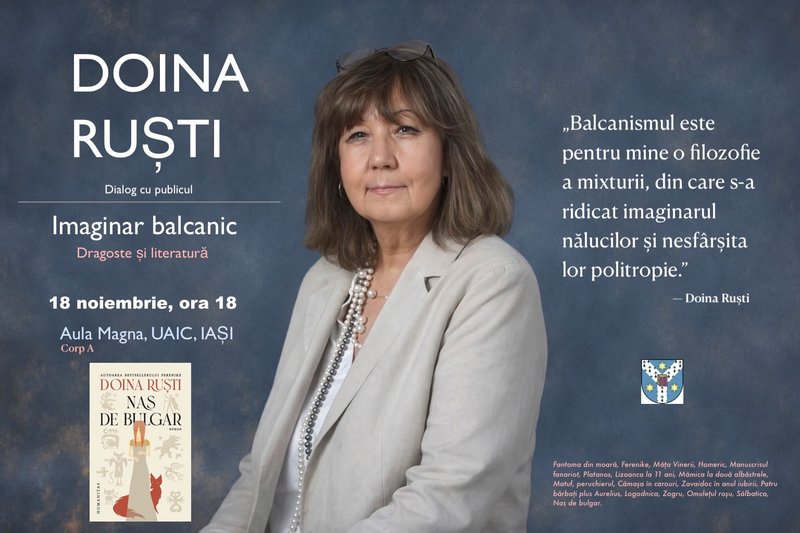
At Alexandru Ioan Cuza University in Iași, Doina Ruști will participate in a public conversation about her literary work and career. The main theme will be the Balkan imagination that shapes her novels.
“For me, Balkanism is a philosophy of mixture, from which emerged the imaginary world of phantoms and their endless polytropy.”
— Doina Ruști
The event will take place on Wednesday, November 18, at 6:00 p.m., in the Mihai Eminescu Aula Magna, Building A, Alexandru Ioan Cuza University, Iași.
The opening address will be delivered by Professor Liviu-George Maha, Rector of the University.
The gathering will bring together academics, intellectuals from Iași, university students, school pupils, and members of reading clubs. It will take the form of a conversation moderated by Professor Ioan Alexandru Tofan of the Faculty of Philosophy.
Joining the author will be Associate Professor Livia Iacob from the Faculty of Letters, Associate Professor Ionuț Nistor from the Faculty of History, and Associate Professor Roxana Curcă from the Faculty of Letters.
Also invited are prominent figures from the literary and cultural community of Iași, including Cassian Maria Spiridon, Lăcrămioara Petrescu, Mihaela Paraschiv, Claudia Târnăuceanu, Emanuela Ilie, Ioana Soreanu, Florina Năstase, Oana Lazăr, Dana Bădulescu, and many others.
“I am interested in Balkan identity because it is fluid, threatened, and full of historical remnants. In the Balkans, you never put a full stop. Through its Latin heritage, Balkanism incorporates history into the immediate moment, into an endless present that has diluted the sense of gravity. Even the gravity of our relationship with our ancestors.”
— Doina Ruști
Thursday, November 19, at 1:30 p.m., Doina Ruști will meet students at the National College in Iași to discuss her recent novels Matuf, the Wigmaker and Nas de bulgar (Bulgarian Nose), both published by Humanitas in 2026.
Friday, November 20, at 12:00 p.m., Doina Ruști will deliver a lecture at George Enescu National University of Arts in Iași on the Balkan dimension of her literary work. The event is part of the second edition of the symposium Balkan Interferences in Music and Art.
“And above the multicoloured bustle hovered a scent of deep regret, a fragrance of roasted almonds, of a mouth that had smacked its lips over baklava, of a man who had rubbed himself against the door of a harem.”
— Doina Ruști, The Phanariot Manuscript
With a substantial body of work and a distinctive literary imagination, Doina Ruști is an award-winning Romanian novelist whose writing is studied in schools and universities. Her works — novels and short stories — have been translated into 18 languages, with more than 40 titles published in translation.
She is particularly known for her Balkan imagination and her distinctive combination of fantastic fiction and uncompromising social realism.
Doina Ruști was born in Comoșteni, southern Romania, on February 15, 1957, but spent her formative intellectual years in Iași. She graduated from the classical languages programme at Garabet Ibrăileanu High School in 1976 and from the Faculty of Philology at Alexandru Ioan Cuza University in 1980.
One of her landmark novels is Fantoma din moară (The Ghost in the Mill, Polirom, 2008), a work of fiction about Romanian communism, acclaimed by critics and examined in academic studies.
The novels Ferenike (Humanitas, 2025) and Nas de bulgar (Humanitas, 2026) explore related themes.
Through her Phanariot trilogy — The Phanariot Manuscript, The Book of Perilous Dishes, and Homeric — Doina Ruști reconstructs the imaginary world of eighteenth-century Balkan Bucharest in an original, richly inventive narrative style. The Book of Perilous Dishes, the most widely translated novel in the trilogy, was published in English in London in 2022 and recommended by the Historical Novel Society.
Following these novels, Doina Ruști has published more than 300 short stories inspired by the Balkans, some of which have also appeared in translation. The prestigious American literary magazine Conjunctions recently published her short story The Wallachian Hound.
Among her best-known books is Lizoanca la 11 ani (Lizoanca at Eleven, Trei, 2009), a novel about childhood and moral decay in a small Romanian village. Its style was compared to Camus's The Plague by the Italian newspaper Il Libero, and the novel has been included in several European university curricula.
Her other works include Zavaidoc în anul iubirii (2024), Paturi oculte (2020), and two young adult novels, Platanosand The Wild Girl, among others.
Her most recent novel is Matuf, the Wigmaker (Humanitas Junior, 2026).
Her literary distinctions include the Bucharest Writers' Association Award (2007), the Romanian Writers' Union Prize for Prose (2008), the Romanian Academy's Ion Creangă Prize (2009), and the Hungarian Writers' Prize for a Translated Book, awarded in Budapest in 2018.
She is a university professor specialising in the history of world culture and civilisation.
A monograph examining her entire literary work was published in 2025: Pompilia Chifu, Doina Ruști, un personaj în propria carte (Doina Ruști, a Character in Her Own Book).
Website: https://www.doinarusti.ro
“One afternoon, at the most languid hour of the day, when every Bucharest belly was stuffed with food, at that time when yet another death might be announced, someone suffocated by the plague's festering sores, darkness fell over Bucharest. A grey, rippling cloud, like wool simmering in purplish-blue dye, cast its shadow across the entire city.
Maiorca was scrubbing clothes at the edge of the pond, while Leun watched her from behind St George's Inn. For a while, the whole city listened to the onrush of shifting dust, the tiny rustlings, just like beans spilling from a dried pod. They were locusts. People had seen them before, and judging by their density, the swarm stretched a long way.
Church bells were ringing, and columns of smoke rose from the courtyards.”
— Doina Ruști, The Phanariot Manuscript