I remember that some years ago I was at the Frankfurt Book Fair when someone from the audience asked whether my novel The Ghost in the Mill offered solutions that might soften the effects of communism. Literature is not meant to do that. Yet, as someone who lived through communism, I sometimes feel the need to say that I do not believe the drama we experienced can be judged by the rules of the world we live in today—a world that has turned everything into an indictment without constructive consequences.
Periods of oppression can only be understood from within; they can only be evaluated in their historical context.
The Ghost in the Mill gave me the freedom to build the story of an escape from history in a fantastic register, and I was glad that German readers resonated with this novel.
“Doina Ruști’s book displays a wide range of literary abilities that measure the endurance of Romanian history in the twentieth century.”
(Markus Bauer, Neue Zürcher Zeitung)
The German edition appeared in Berlin (Klak), translated by Eva Ruth Wemme, at the end of 2017, and the novel was included in the program of the Frankfurt Book Fair. I can proudly say that it received a review in Neue Zürcher Zeitung.
It is a novel filled with memories, since it was the first book I ever wrote. I struggled for a long time to publish it, without success. Although written in the late 1980s, it first appeared only in 2008 (Polirom). It is the book that brought me recognition. It received the Writers’ Union Prize for Prose and has been the subject of numerous critical studies.
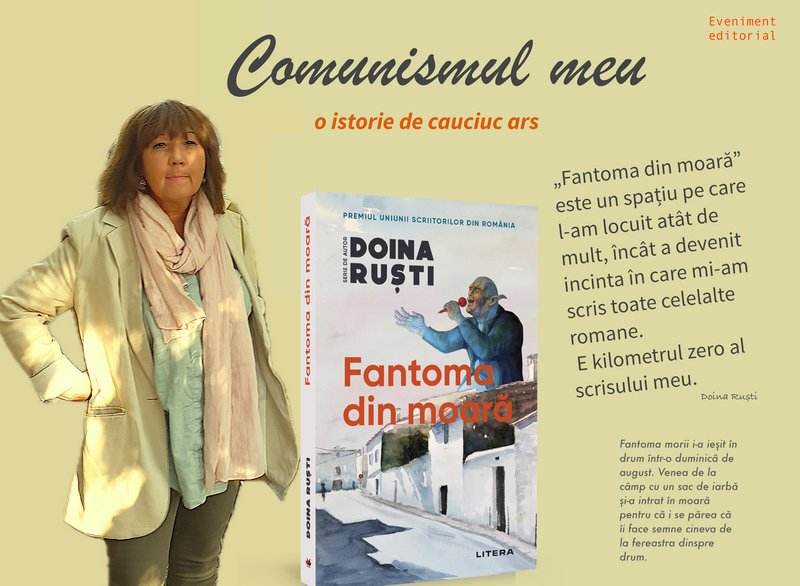
That is why this new edition of The Ghost in the Mill, now available for pre-order at Litera, moves me deeply. It is the fourth book in my author series. This is a critical edition, edited by Ovidiu Șerban, with a preface by Paul Cernat, who described it at the time of publication as “one of the most convincing and expressive works of fiction about Romanian communism published in the past decade.”
I conceived The Ghost in the Mill as a synthetic story of Romanian communism, a book about the instability of truth. The story of a schoolteacher in the 1980s intersects, across time, with the suffering of a teacher from the interwar period. Blending reality and the fantastic and written in the form of a thriller, the novel gradually becomes a fresco of the communist era—from Stalinism to the fall of the Berlin Wall.
“People still remember the day the bulldozers came, especially that sunset moment when the red dust of the mill rose into the summer sky, while on the threatening plastic bucket the iron hand of a calm and sorrowful soldier had clenched itself, floating in his blue uniform along the indelible traces of a village schoolteacher.”
The Ghost in the Mill