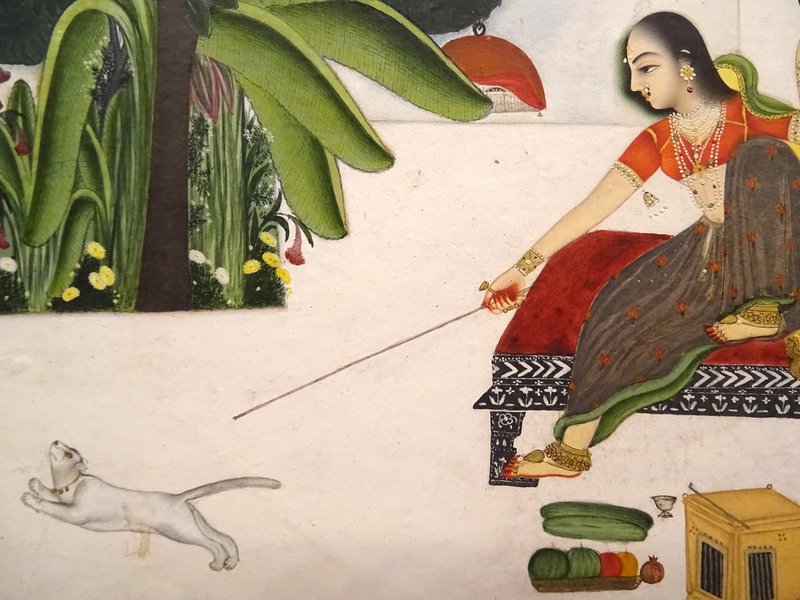
Many have laid claim to March 9. At various times it has been declared the Day of the Forty Martyrs or the Day of Men, but in older times it was simply—and exclusively—the Day of Cats.
A belief had spread that the month of March lay under the dominion of cats; more than that, it was said that on the night of March 9 a kind of congress of the feline race took place. Even today, a rumor still circulates in Bucharest that, at midnight, cats gather somewhere around Piața Rosetti to decide many things—matters of hierarchy and actions known only to their kind. Among many other things, on that night a particular cat—the finest, the wisest, and the most enchanting—is transformed into a woman. The man fortunate enough to meet her will experience a night he will never forget. It will be an angelic encounter, a drop from the bliss of the gods, from the mirage of eternity.
Among the many admirers of March 9 in former times was a cobbler, a young man, somewhat sleepless, who in the evenings would climb onto the roof of his house to gaze at the surrounding streets, especially toward what is now Piața Rosetti, where in those days there was a pond. Along its edges, among reeds and willows, the cats of Bucharest were said to gather discreetly.
On a historic night of March 9, the cobbler kept watch over the pond. Although no sound was heard and not a single willow stirred, a girl’s silhouette descended from one of the nearby streets.
The man ran toward her, intercepting her path, trying to strike up a conversation. She was slender, and her hair—once pinned into a bun—had come loose to one side, still half held by a small cap adorned with beads.
The cobbler spoke beautiful words to her, expecting at least a few coquettish replies, but the girl only smiled and blinked often, which strengthened his hope that he had encountered the queen of the cats.
With words alone he led her as far as his gate, near the Caimata Monastery, and, continuing to speak and to utter those phrases that delight anyone, he invited her inside.
It was a truly memorable night. The girl did not speak; she had swallowed her words. But there was no need for speech.
The cobbler already knew that no other encounter would ever equal this one.
The next day the girl was gone, but from the windowsill a cat was watching him. It lasted only a moment, and then it vanished, leaving behind a scent of forest, of a flower just emerging from beneath the snow.
For many years the cobbler told the story of his encounter and searched for the cat-girl. People listened with tenderness, wishing with all their hearts that the story were true, even though most of them, at the end of the tale, asked whether anything had gone missing from his house. The storyteller vehemently denied it, though he knew that the three silver talers for rent had indeed evaporated. But there was no sign that either the cat or the cat-girl had taken them. They had disappeared that evening, while he wandered the streets, while he waited by the pond.
Still, a slight hesitation disturbed his tale, and the listeners left smiling, retelling the story themselves, adding the hesitation—which, over time, became outright doubt, irony, even a grimace of skepticism.
The years passed, and the cobbler remained faithful, forever, to a single night of love.
Stories spread through Bucharest about a girl who wandered with her hair loose near Caimata, meant to drive naive night strollers mad or fleece gullible townsfolk.
Many years after the cobbler passed into the other world, a teacher from Saint Sava discovered a prayer book, on whose margins a small story had been written. A woman confessed there that every year, on the night of March 9, she dreams she is a cat. She sees herself swishing her tail at the gathering of cats, hears herself meowing, feels the fabric of the salon curtains beneath her claws. And afterward, taking small steps along the empty street, she meets a tomcat, and together they head toward Caimata Monastery, enter a house, and step into a world of miraculous pleasures, which, out of decency, she refrains from describing.
By morning, life returns to normal. For an entire year she lives her life like a nun cut off from sinful desires—until the night of March 9, when everything repeats itself, without exception.
After reading the story, the teacher from Saint Sava sighed and kept the secret of the prayer book. But as the month of March had only just begun, he decided to take a midnight walk, to consolidate his philosophical readings.