In Doina Ruști’s novels, Lipscani is not merely an old street in Bucharest, but a living, almost fabulous place, where the city gathers its voices, goods, scents, rumors, fears, and desires. In The Phanariot Trilogy, from Manuscrisul fanariot to Mâța Vinerii and Homeric, Lipscani Street and Lipscani Square appear as a heart of the city, an intersection of trade, love, curse. This is where the legends of Bucharest are born.
In this world, Lipscani is not a backdrop, but a character. Light has intensity, scents are narrative. Lipscani Street means noise, memory, fever, and power of attraction.
Lipscani is first of all a place of mixtures. Here one sees fabrics, little shoes, shops, hataiale, șalvari, anterie, fiddlers, stalls, and people arriving from every part of the city. The square is the living center of Phanariot Bucharest, the place where the gaze fills with colors and scents.
“I went as far as Lipscani Square. Everything made me stare open-mouthed, and even now, as I write, I can barely keep myself from telling you about the fabrics or the little shoes covered with beads. The lights were coming on — I will never forget it — and it smelled of pumpkin just taken out of the oven. Beside the railing of a shop, some fiddlers were playing, drawing out little tears and deep sighs. I was in the heart of the marketplace. Around me rustled floral hataiale, șalvari, and anterie as light as down.”
Mâța Vinerii

Phanariots by Doina Ruști
The name Lipscani comes from trade. In Manuscrisul fanariot, the street is linked to the merchants who came from Lipsca, to shops, walks, ideas, and the bustle of a world in motion.
“That was why Leun had made a habit of roaming the street which, because of the many merchants who had come from Lipsca, had begun to be called Lipscani. And his walks brought him ideas.”
Manuscrisul fanariot
In Mâța Vinerii, Lipscani Square becomes a dizzying mechanism, a clock, a chewing magma, a mill. Whoever enters no longer knows where the road is leading. Paths mingle, carriages block one another, peddlers shout, and the city seems to chew up its own stories.
“Everything went smoothly until Lipscani Square, which was a kind of clock, a chewing magma, in short, the place where, as later proved to be the case, I always had to begin again. I did not understand it then, but only with time, after I realized that all roads led to it. Lipscani Square was a kind of curse, but it was also there that the key to my whole story lay.”
Mâța Vinerii
“Lipscani Square was like a mill, a whirlpool. Once inside, you forgot your dreams.”
Mâța Vinerii
Lipscani is also a network of rumors. News enters through inns, slips toward churches, passes from mouth to mouth, and spreads through the entire city. Around the street gather inns, churches, towers, squares, and places of passage.
“The rumor was discussed at length by the few telari, and an hour later it entered Lipscani, through the inns, and slipped into Zlătari, into the church…”
Manuscrisul fanariot
In Doina Ruști’s Phanariot world, the street may be shadowed by a flying little chest, watched through the eyes of a woman who becomes the legend of a house, lit by a glass moon, or crossed by carriages that open like flowers. Historical reality constantly opens toward the fabulous.
“The two men were going down toward Lipscani. Over Bucharest, a glass moon had risen, and from the houses heated with oak wood came the sound of fiddlers and the tinkling of clavirs.”
Manuscrisul fanariot
“There were two small bottles hidden in a coffer, which she saw every night setting off by itself, like a flying little chest, passing over the Inn of St. George, shadowing Lipscani…”
Manuscrisul fanariot
“One night, while everyone in the house was asleep, the coffer in the drawing room opened, and one of Despina’s dresses made its way toward the door, floating like a raven in search of prey. The cook, who, for who knows what reason, had got out of bed, saw the silk dress going out the door, carried by a gust of wind, and ran to the window, from where she followed the path of that dress among the stalls, through Gorgani Square, until it rose above the houses, disappearing over Lipscani Street, swallowed by the insatiable shadows of the night.”
“In Lipscani Square, as usual, there was a crowd, and the carriages had stopped one against another. Beside the tecar, the stranger’s horses were snorting, and only then were the people of Bucharest to see his face. Under the petrified eyes of the crowd, the carriage began to unfold, exactly as a flower unfolds…”
Mâța Vinerii
One of the strongest fabulous nuclei of Lipscani is Zoica’s story, the woman who remains by the window, watching the street until her eyes seem to contain every detail of the place. From this image an urban legend is born: “the house with eyes.”
“She gazed ceaselessly through the rounded glass, like a half-moon. And she would remain like that for many long years, without uttering a word, so that many people of Bucharest stopped to look at her eyes, which grew larger every day, widening so they could take in Lipscani Street and all its details, dilated across the whole surface of the window like mirrors, so that even a hundred years after the family had died out, people continued to call that street corner The House with Eyes.”
Manuscrisul fanariot

Preziosi, compilation. Copyright doinarusti.ro
In these novels, Lipscani is not simply an urban landmark. It is a place one enters and never leaves unchanged. Here dreams are forgotten, songs are heard, rumors are born, loves are altered, and roads open. The street becomes a map of destiny, a zone of passage between history and the fabulous.
“Lipscani Square was a kind of curse, but it was also there that the key to my whole story lay.”
Mâța Vinerii
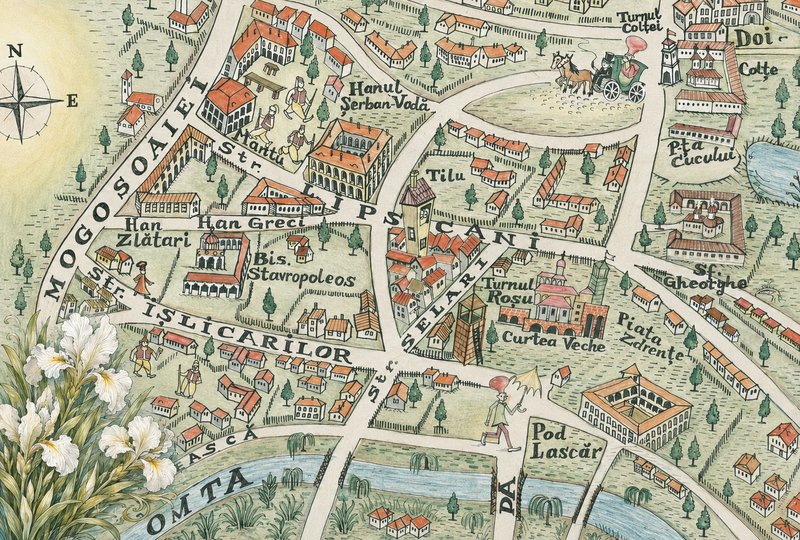
[Image: fragment from the map in Manuscrisul fanariot, the Lipscani area]
See also: