Another famous Beardless One was Turnavitu. We know the name from Urmuz, from Ismail and Turnavitu, though it is not Urmuz’s character I have in mind. History records several Turnavitus, among them one much reviled in the eighteenth century, accused of betrayals and entangled in numerous events. The name was relatively common at the time, used generically for those who came from Greek Târnovo, in Meglen: some Greeks, most of them Megleno-Romanians, scattered through schools as teachers, or through trade. One of them, born in Bucharest and belonging to the second generation of Meglenites, was called Dumitrachi.
He knew every trick in the book and had a way of attaching people to him. Whenever a new prince ascended the throne, he would immediately send for Turnavitu. And once Turnavitu had crossed the palace threshold, he changed plans and brought in new dreams. The prince’s eyes would cling to him forever, and some rulers, weaker in spirit, sank into depression whenever Turnavitu left Bucharest.
He was involved in many of Wallachia’s hidden affairs.
It is said that Mavrogheni did not take a single step without him. They were inseparable, embracing in carriages, even, some said, shut up together in a floating balloon which certain people claimed to have seen above the Dâmbovița at noon. In the Divan they sat eye to eye, and Mavrogheni, who is known to have been somewhat mad, never went against Turnavitu’s word. When he left for war in 1788, he appointed Turnavitu as his deputy, infuriating all the boyars.
Turnavitu was slender and, of course, beardless. Delicate, fine-skinned, without the slightest hair on his body or face, he looked like an ephebe from the ancient world. Despite his fragile appearance, he made frequent journeys to Stamboul, without soldiers and without weapons on him. In the whitish dust of the Balkans, you could recognize him from a great distance by his unmistakable red coat, with a white design sewn onto the back: a bird with outspread wings.
He brought goods, passed fearlessly through bands of Pazvangii, and although he drove an unpretentious little carriage, he flew like the wind. One day you saw him at Colțea, and the next he was already at Hagia Sophia, in Stamboul.
The strange thing was that anyone who had ever tried to accompany him had vanished along the way. They set out with Arnaut guards, in a column of carts, but something happened on the road, so that only Turnavitu reached the destination. For this reason, and for others too, a rumour went around that he was a demon who fed on his companions. Some said he had an enormous bird that carried him from place to place. The bird, of course, was carnivorous and fond of people. It was also said that during his travels Turnavitu became invisible, or, God forbid, that he was a sorcerer.
Among those determined to solve the mystery was Hristache, a pitar from whom much of what is known about this Turnavitu has come down to us.
The pitar followed him, determined to write his story. He disguised himself as an old beggar woman, or as a nun, kept hidden, trailed him at a distance, and even went so far as to camouflage himself inside a bush, so as not to be seen. In the end, all these efforts were worthwhile. Almost everything we know about Turnavitu comes from Hristache’s chronicle, Hristache being a minor boyar with the rank of pitar, and a writer.
Indeed, after Turnavitu crossed the Danube, a bird appeared, and he climbed onto its back. The two of them disappeared into the sun-whitened plain, and Hristache, after all his efforts, was left high and dry.
But he was not a man to give up easily. He waited there through the night, and the next day the bird appeared again and swept away everything in its path: people and animals, herds of goats and mules loaded with bundles — everything on the Giurgiu road vanished. Hristache, hidden under a basket, no longer dared to move. Either he had not been seen, or perhaps he had been deliberately spared, left as a witness to what had happened. The bird did not eat people, but its shadow erased every living creature from the landscape.
The pitar did not dare move for almost an hour.
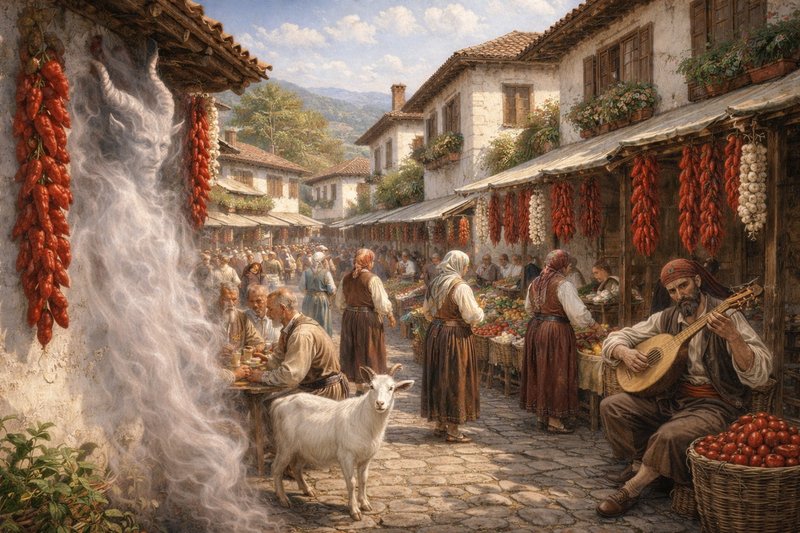
He returned to Bucharest full of fear, and after some time he decided to confront the Beardless One. He waited for him in a crowded market, knowing that Turnavitu passed through there quite often. When Turnavitu appeared, the pitar began questioning him, under the eyes of the townspeople and in the silence of the square. Turnavitu, however, seemed dazed and knew nothing of any bird, of any journey. Something suspicious, an uncertain fluttering, hovered above the vendors’ stalls.
But the pitar was prepared: he drew his yataghan and, with a single movement, cut off Turnavitu’s head. At least that is what he thought. In Turnavitu’s place there now stood a mist, a dense perfume. The whole market seemed enchanted, and over the houses rose the smell of hot peppers roasted on embers. It made you want to sleep, to dream, or to let yourself be carried away by the waters of the Dâmbovița, by the undulations of a zephyr.
Sleep overcame the pitar, and for many minutes he no longer knew who he was.
Hristache’s attempts to bring Turnavitu to heel were numerous, but with no notable results. Apart from the midday sleep, nothing remained in his mind. Only the description of the enormous bird survived in his chronicle — a history in verse, I forgot to tell you — preserved down to our own day, though not in its entirety. In time, the pages about the bird were lost, perhaps torn out, perhaps merely erased, yet the mouths of Bucharest people still tell of the mist that sometimes descends at noon, from Colțea downward: little clouds that bring sleep and dreaming.
In the chronicle of Hristache the Pitar, one can still read only the portrait of this singular character, who stood beside four Phanariot princes. It is known that he was killed in Stamboul, under unclear circumstances, although a note in an Ottoman document says that a mist fell over the Bosphorus, and many witnesses believed Turnavitu had fled across the sea, wrapped in the hair of the noon fairies, who spend their time upon the Black Sea.