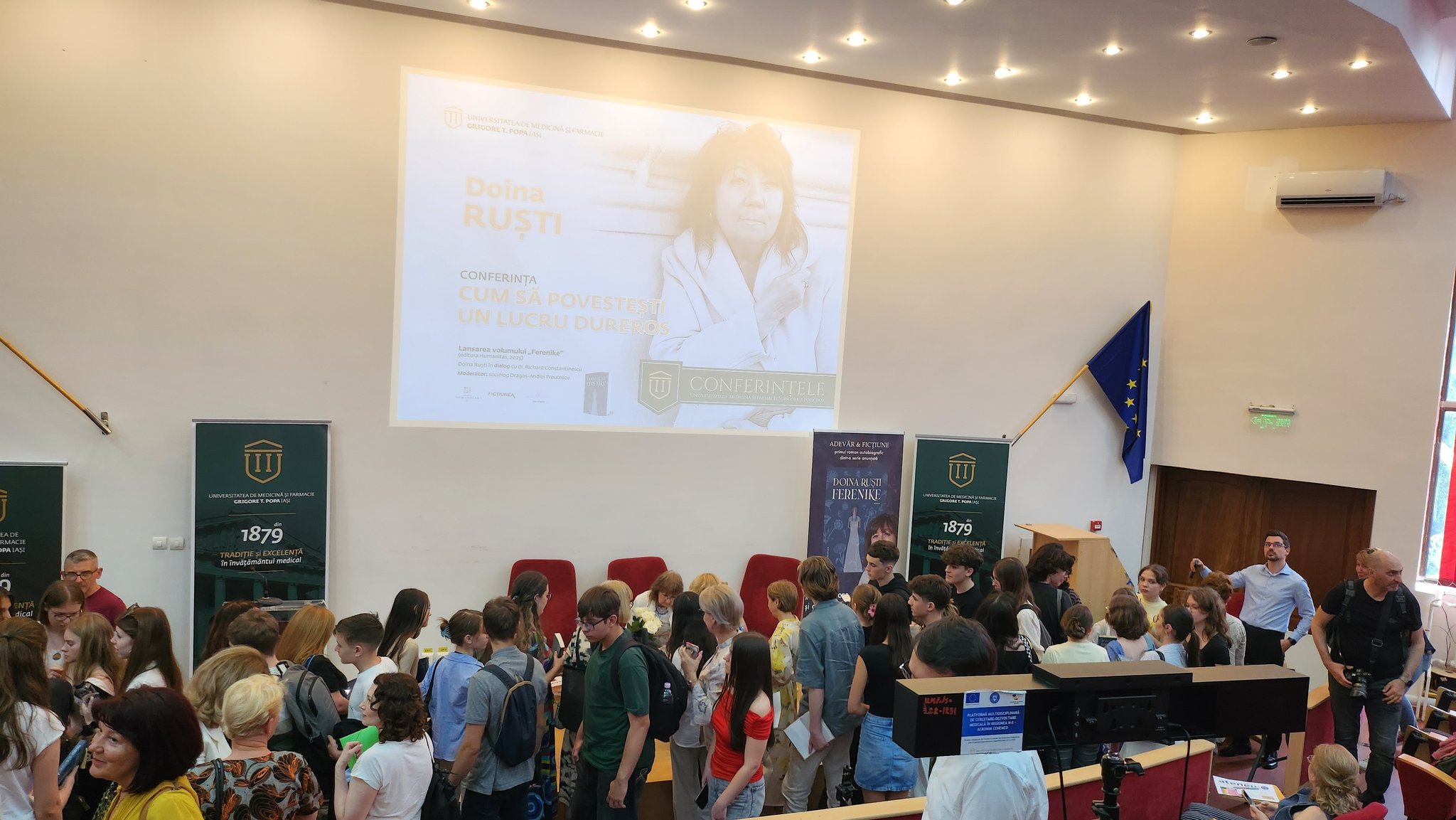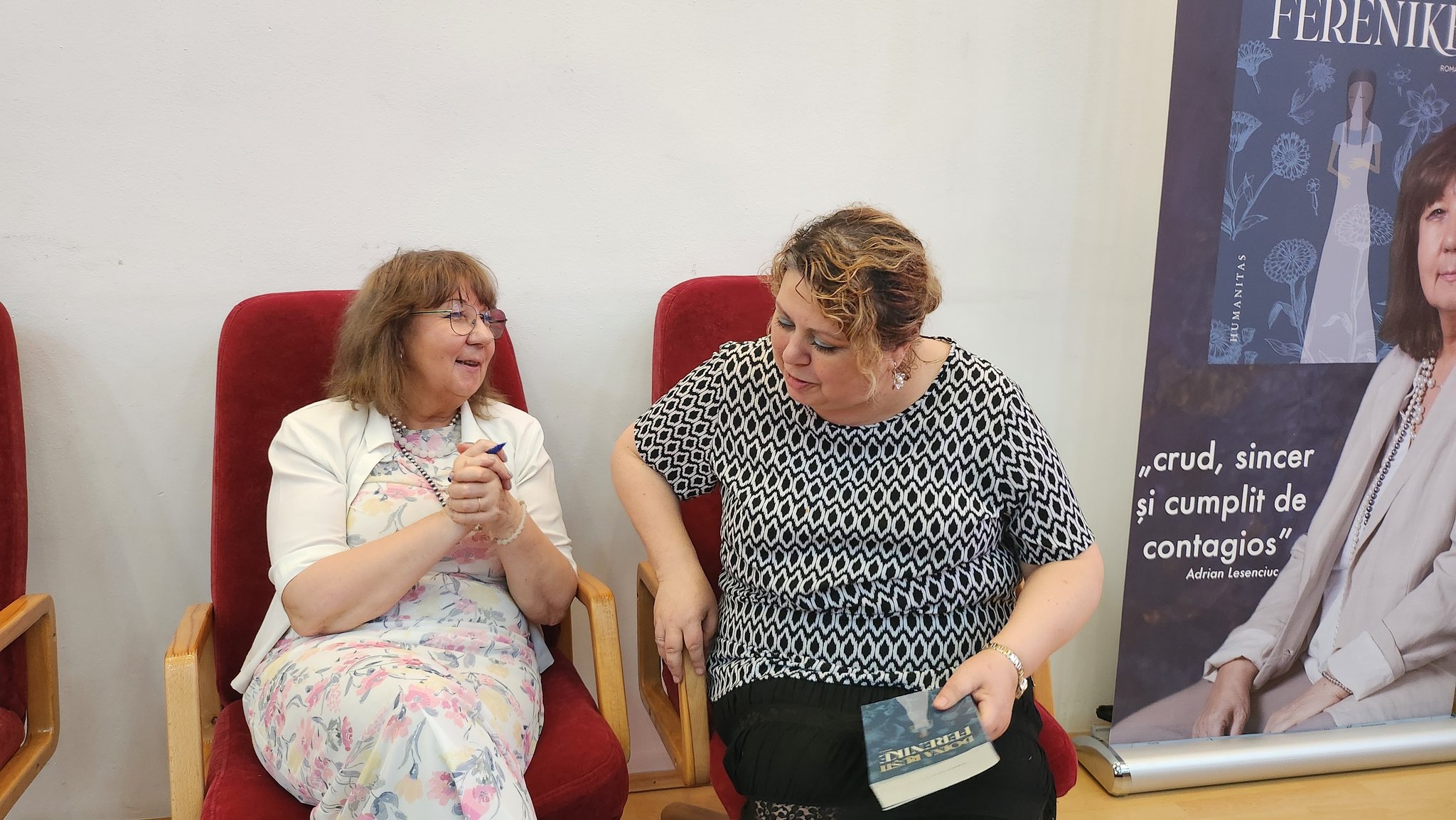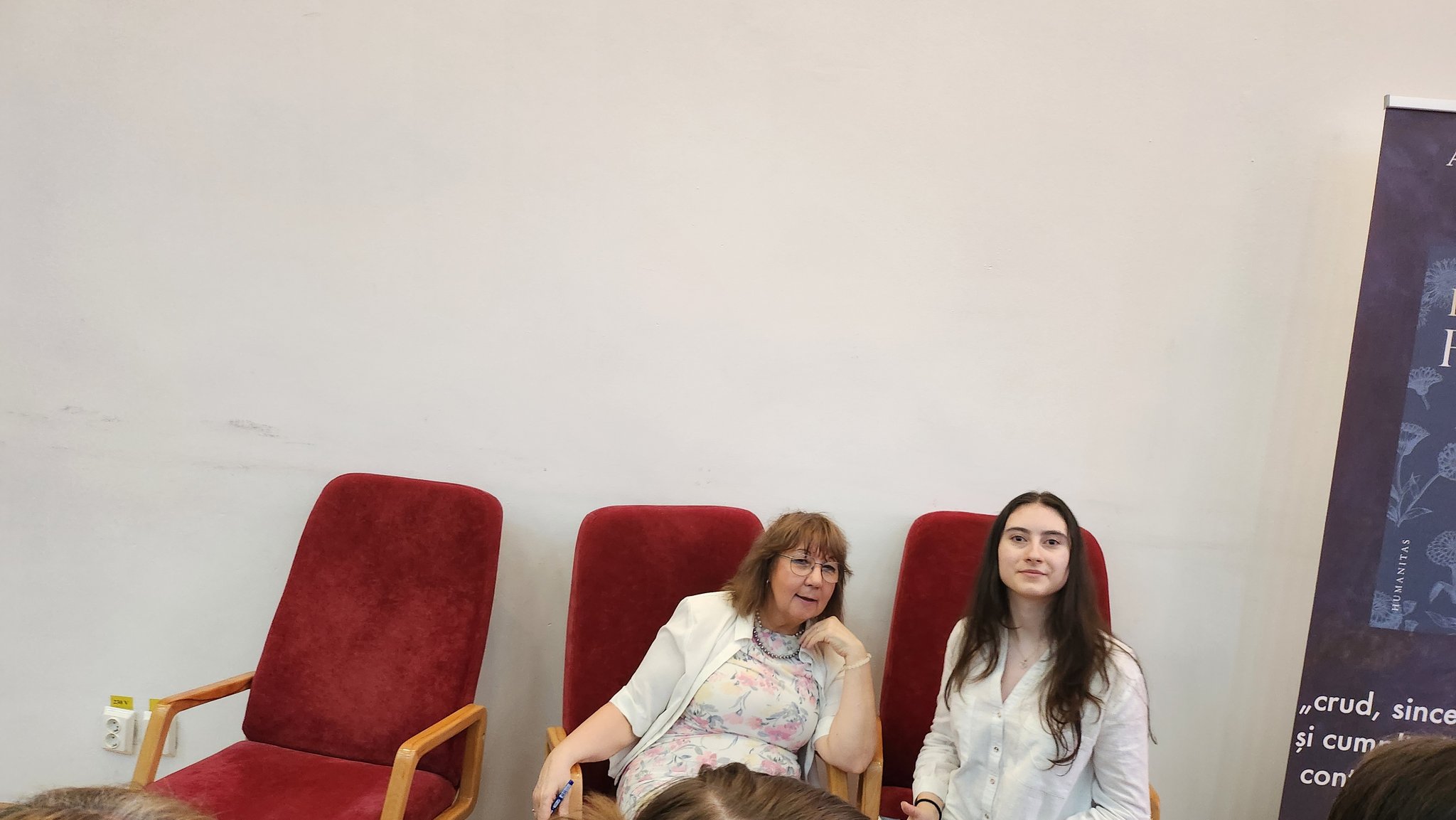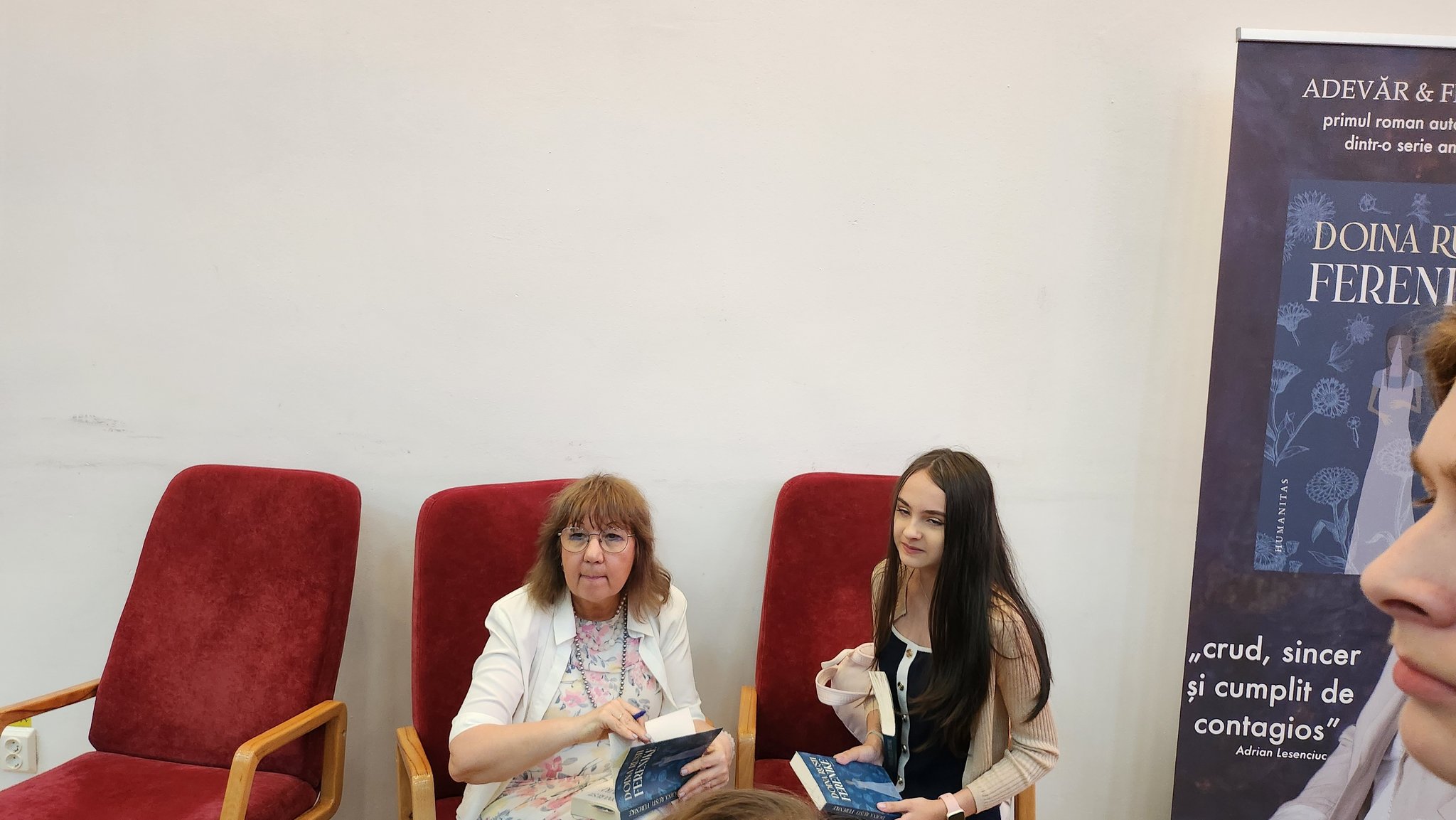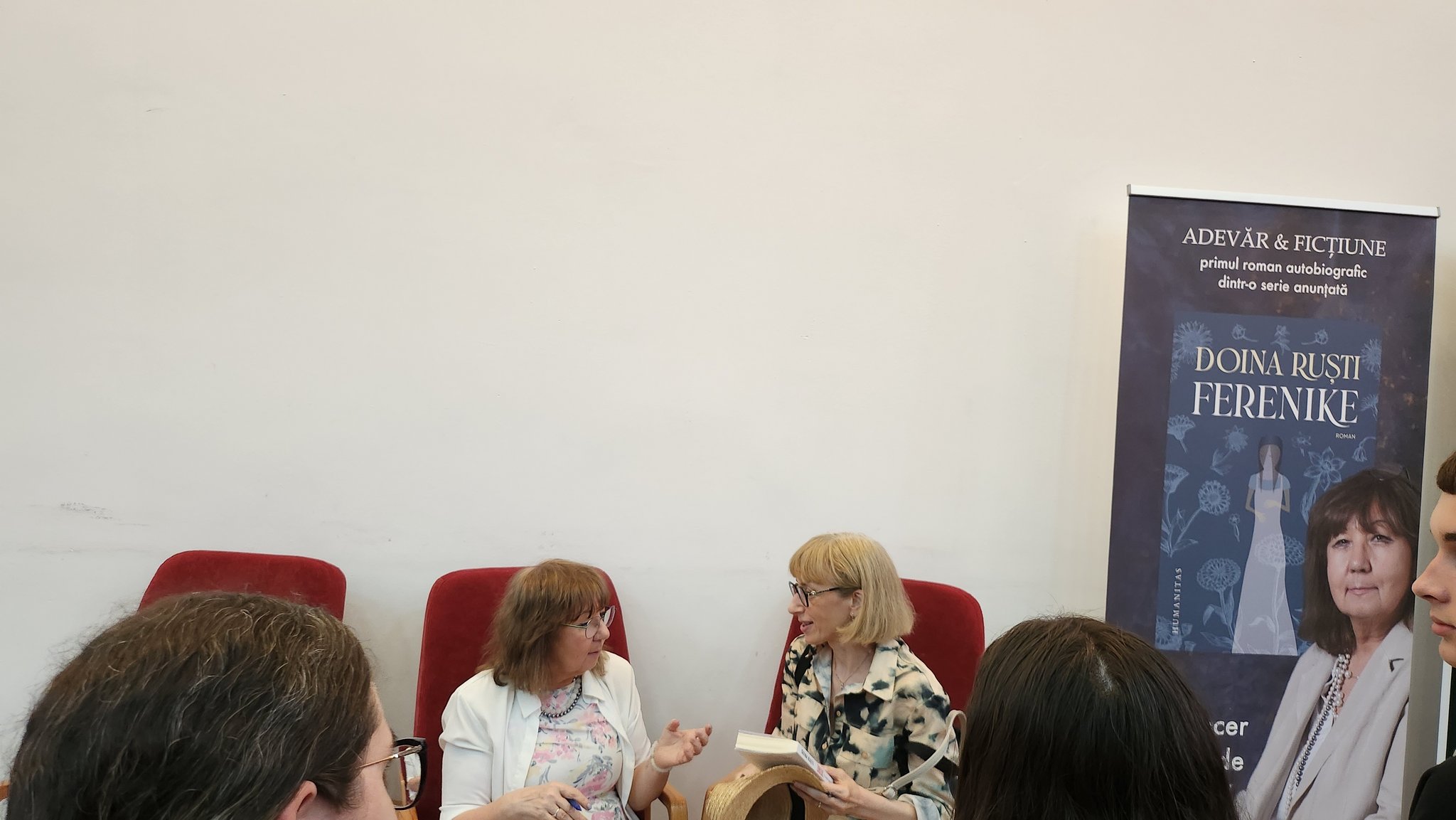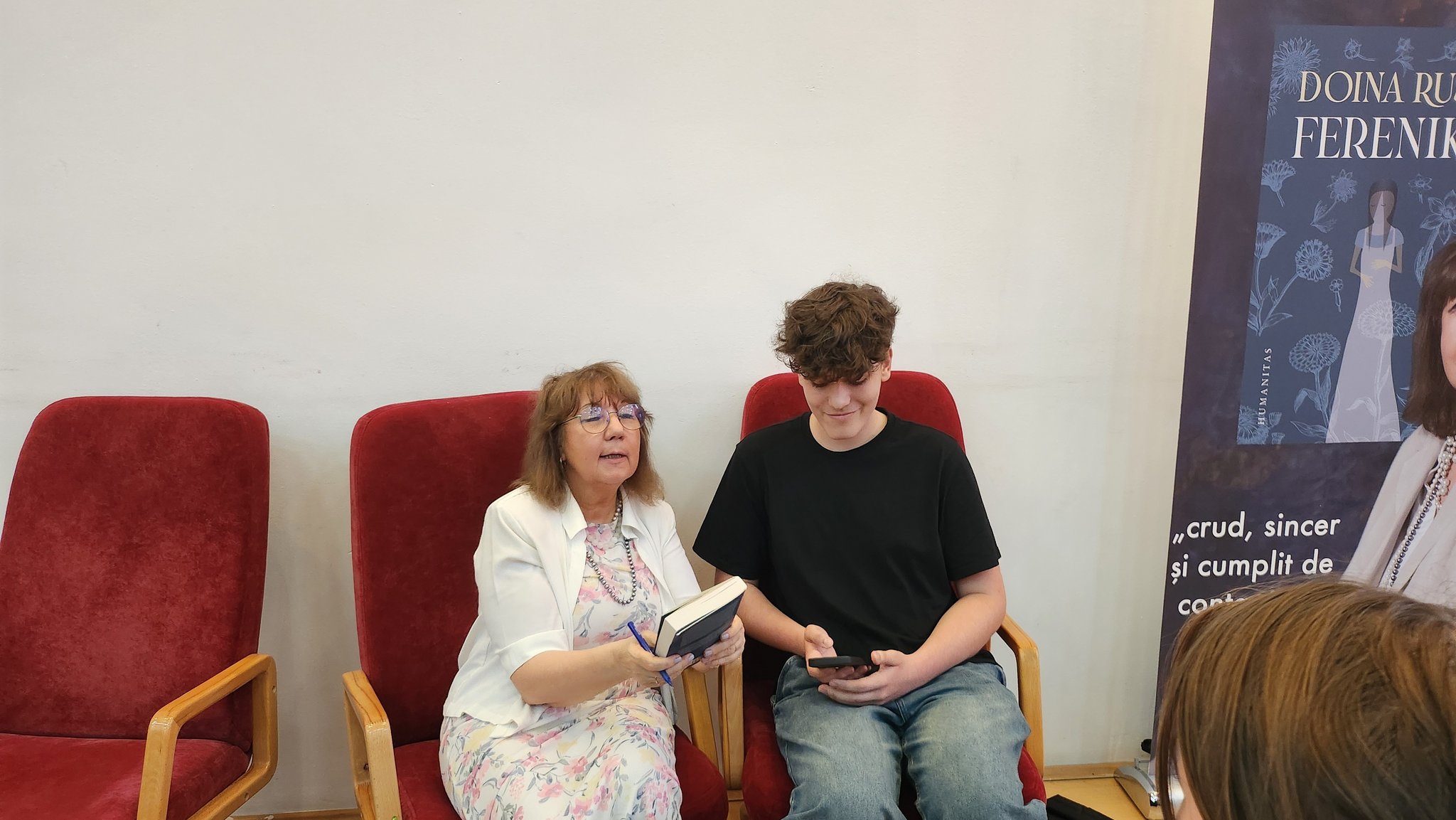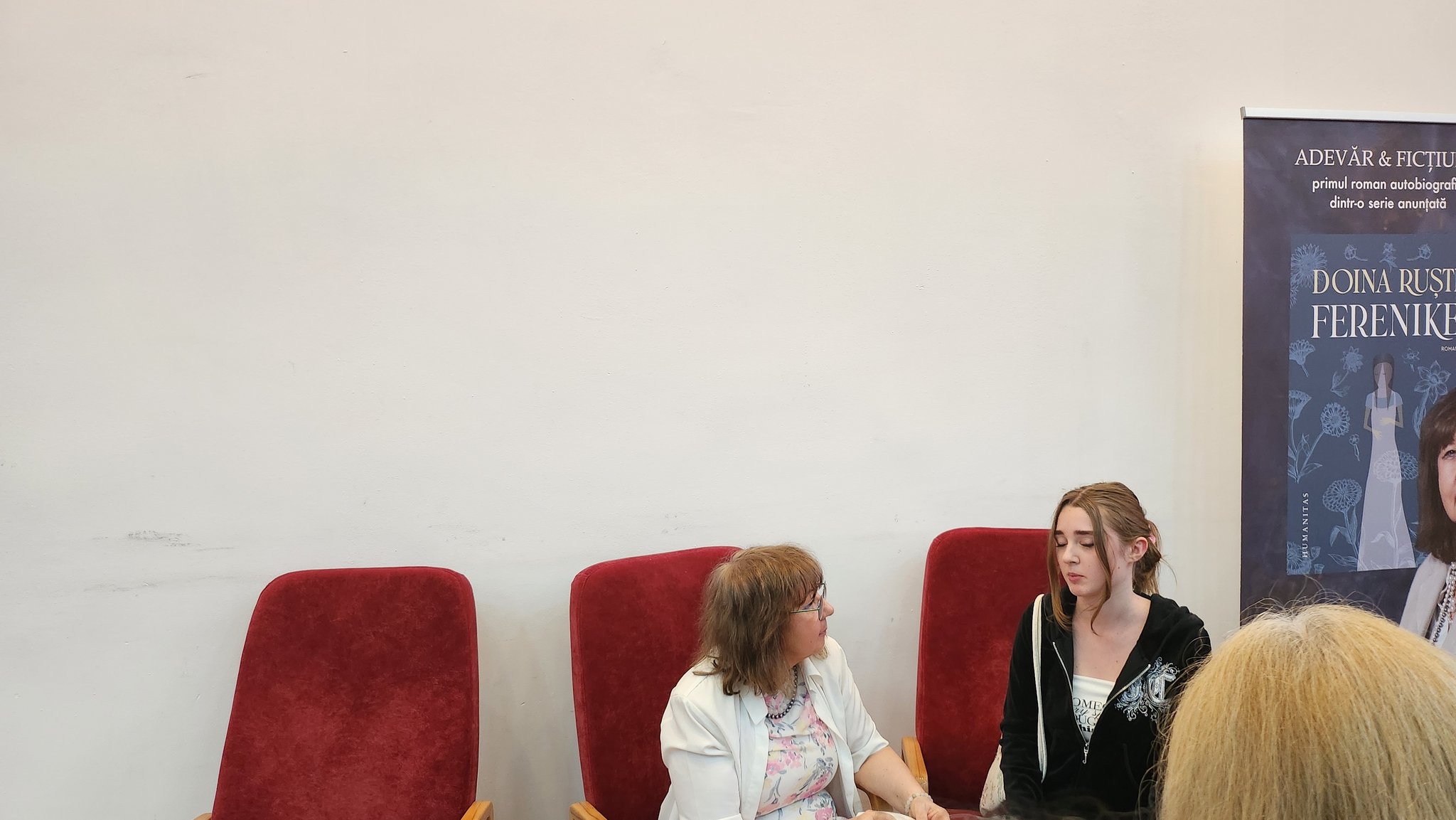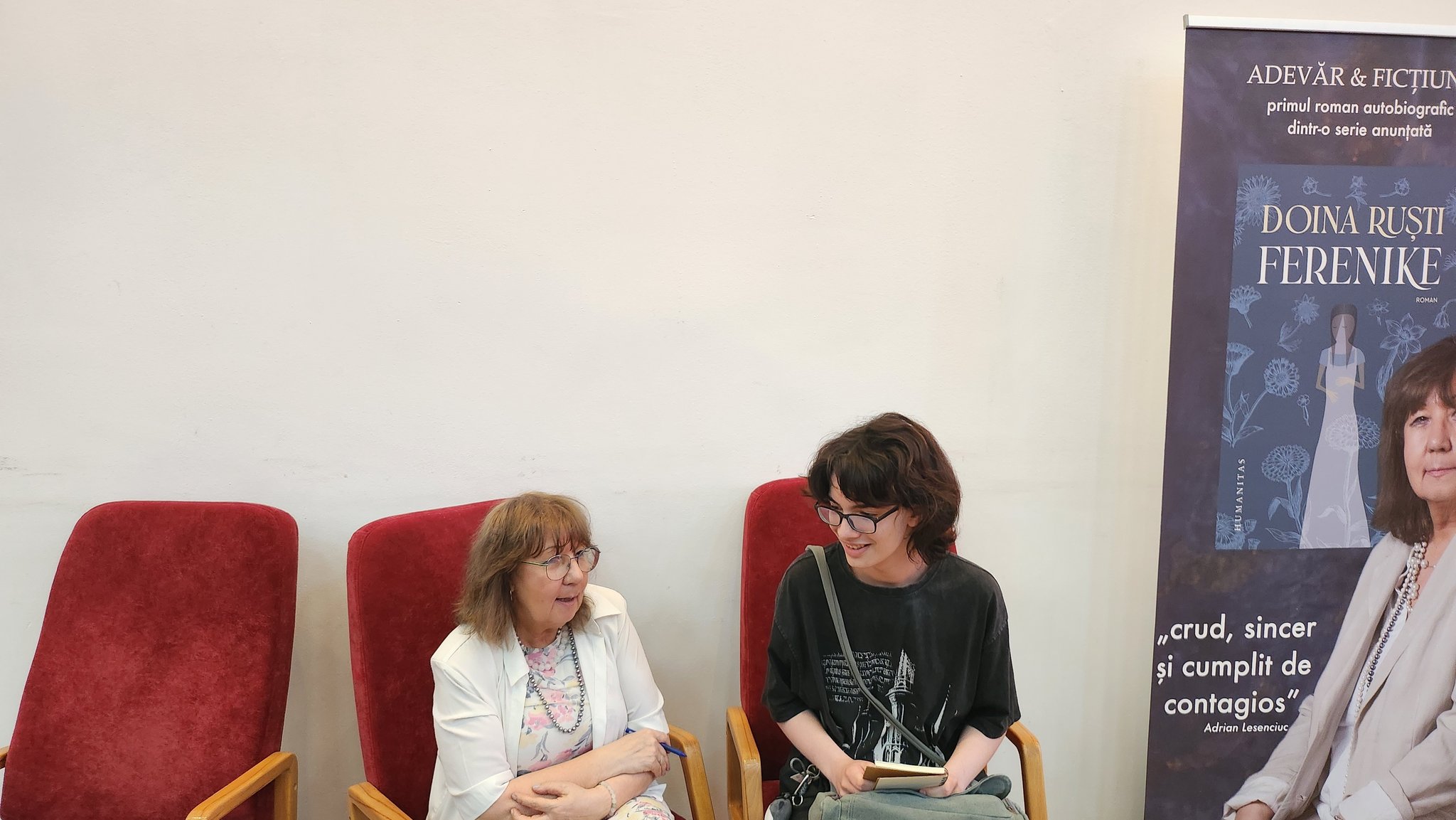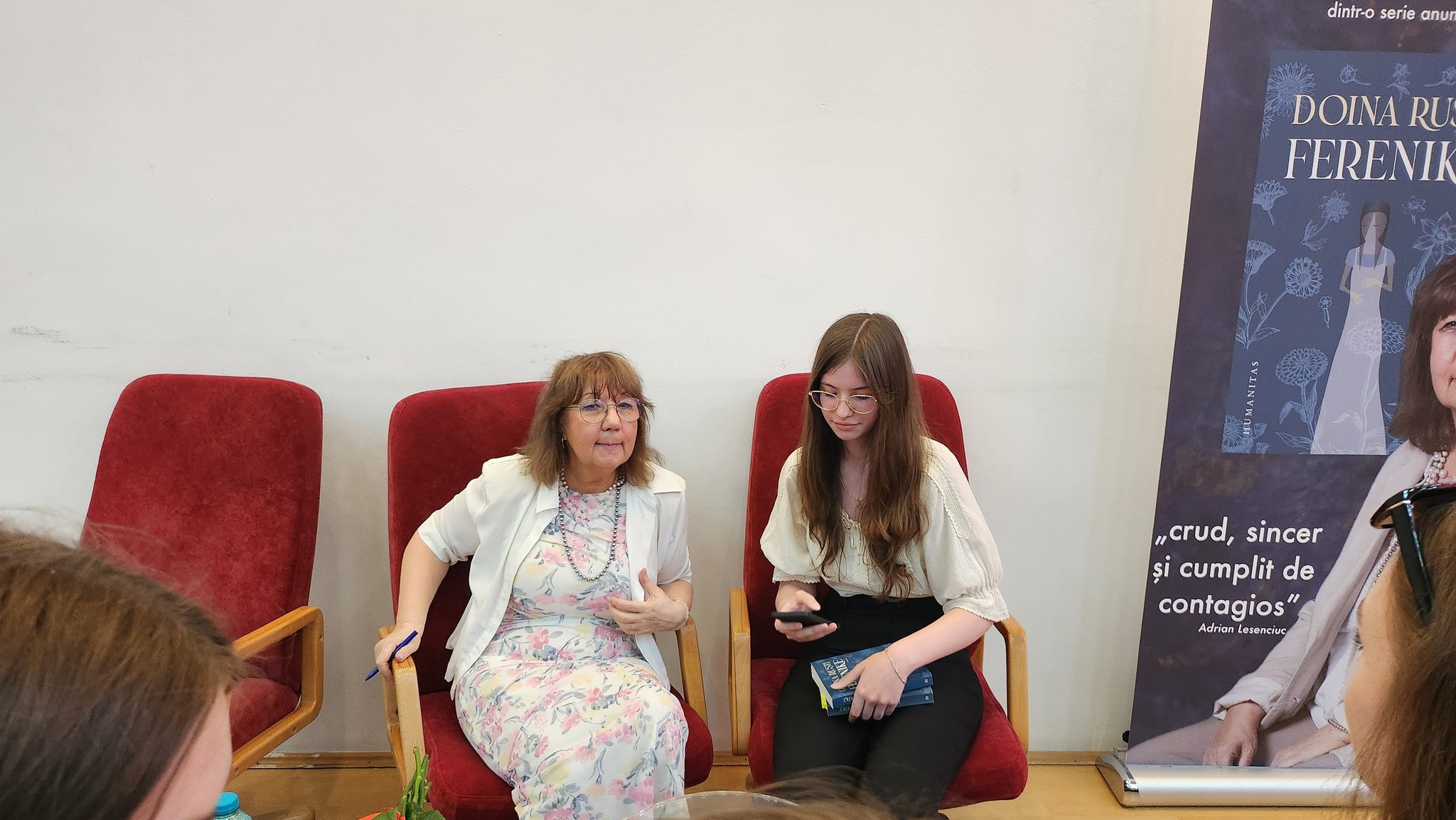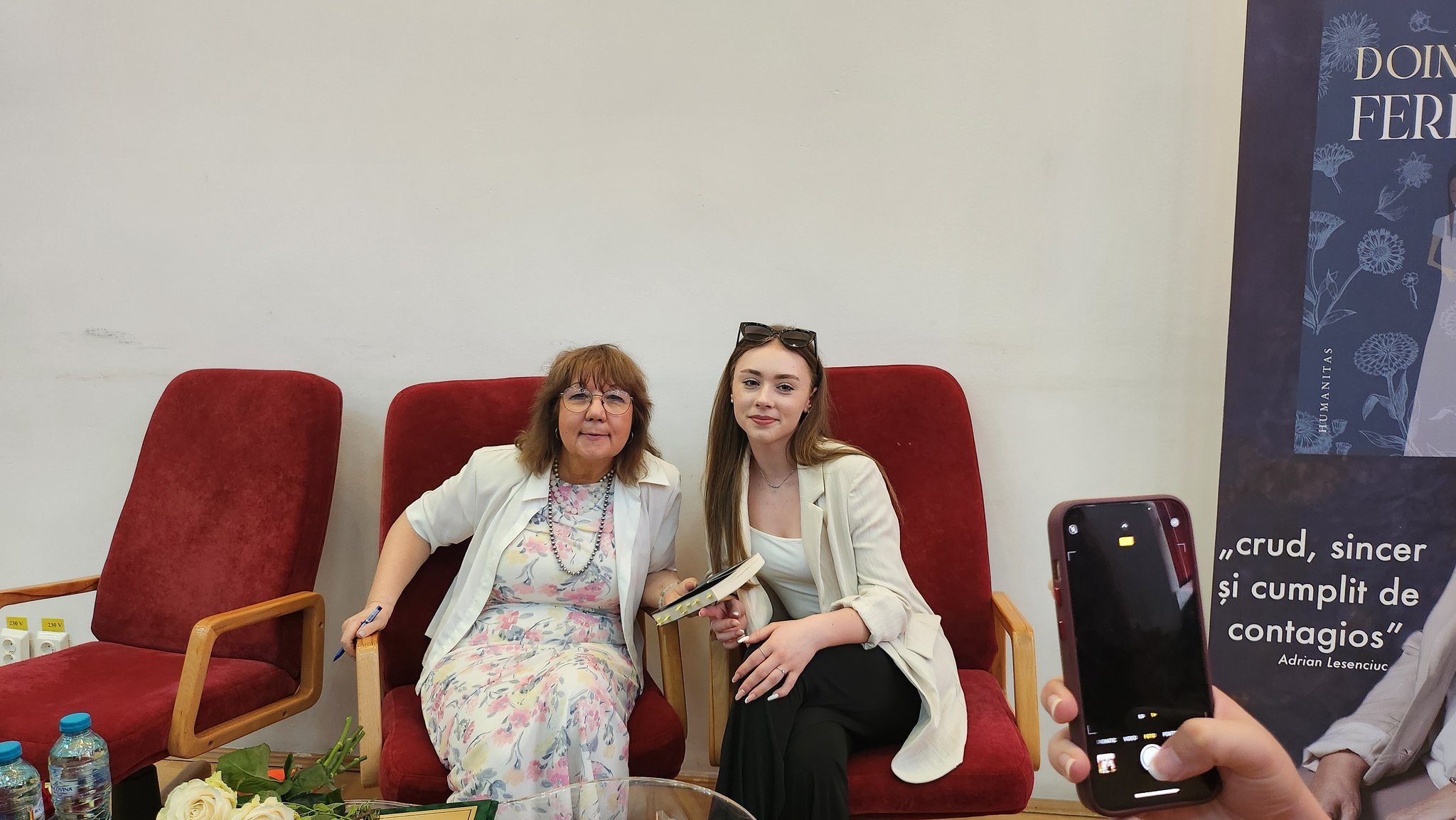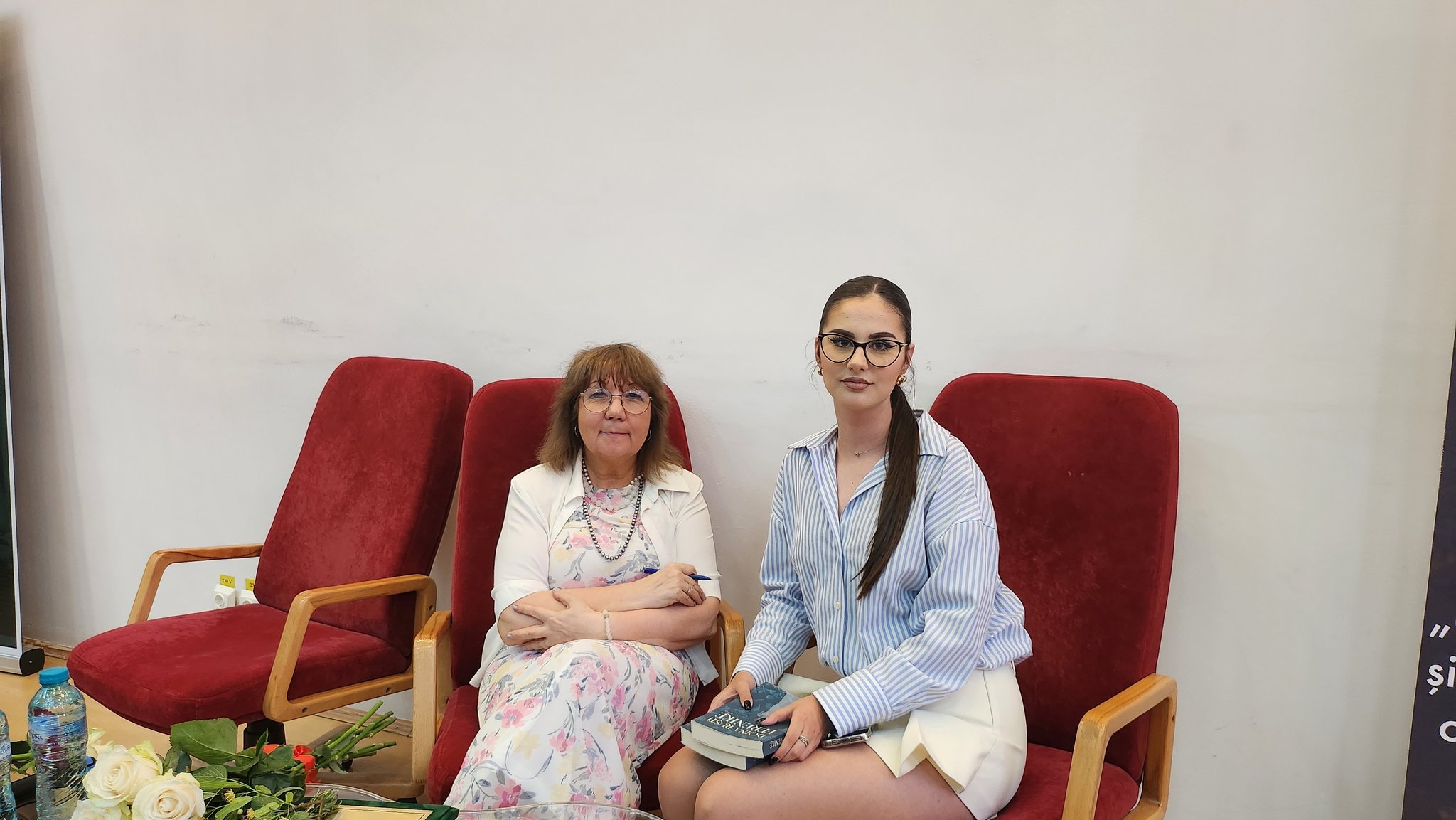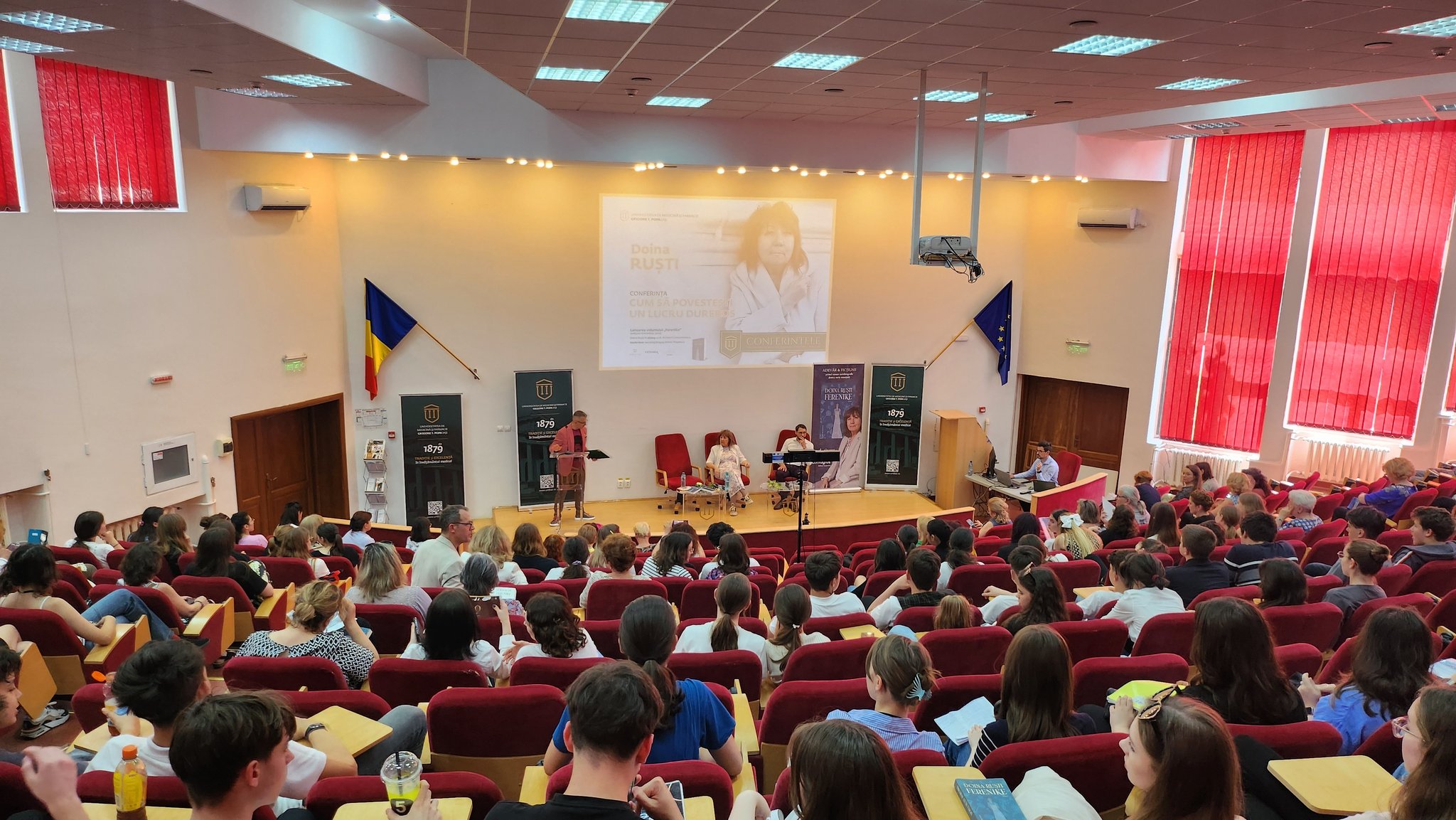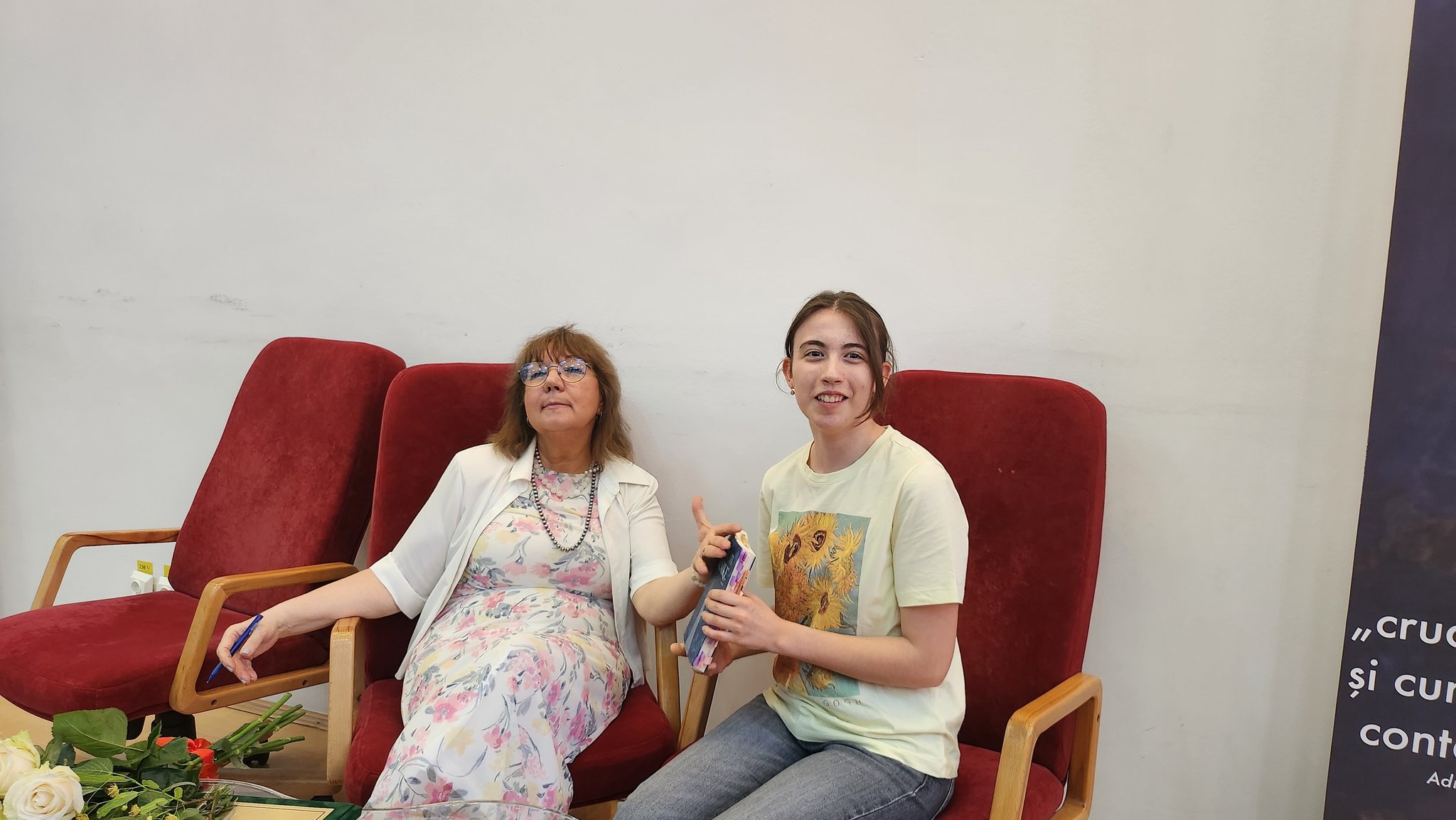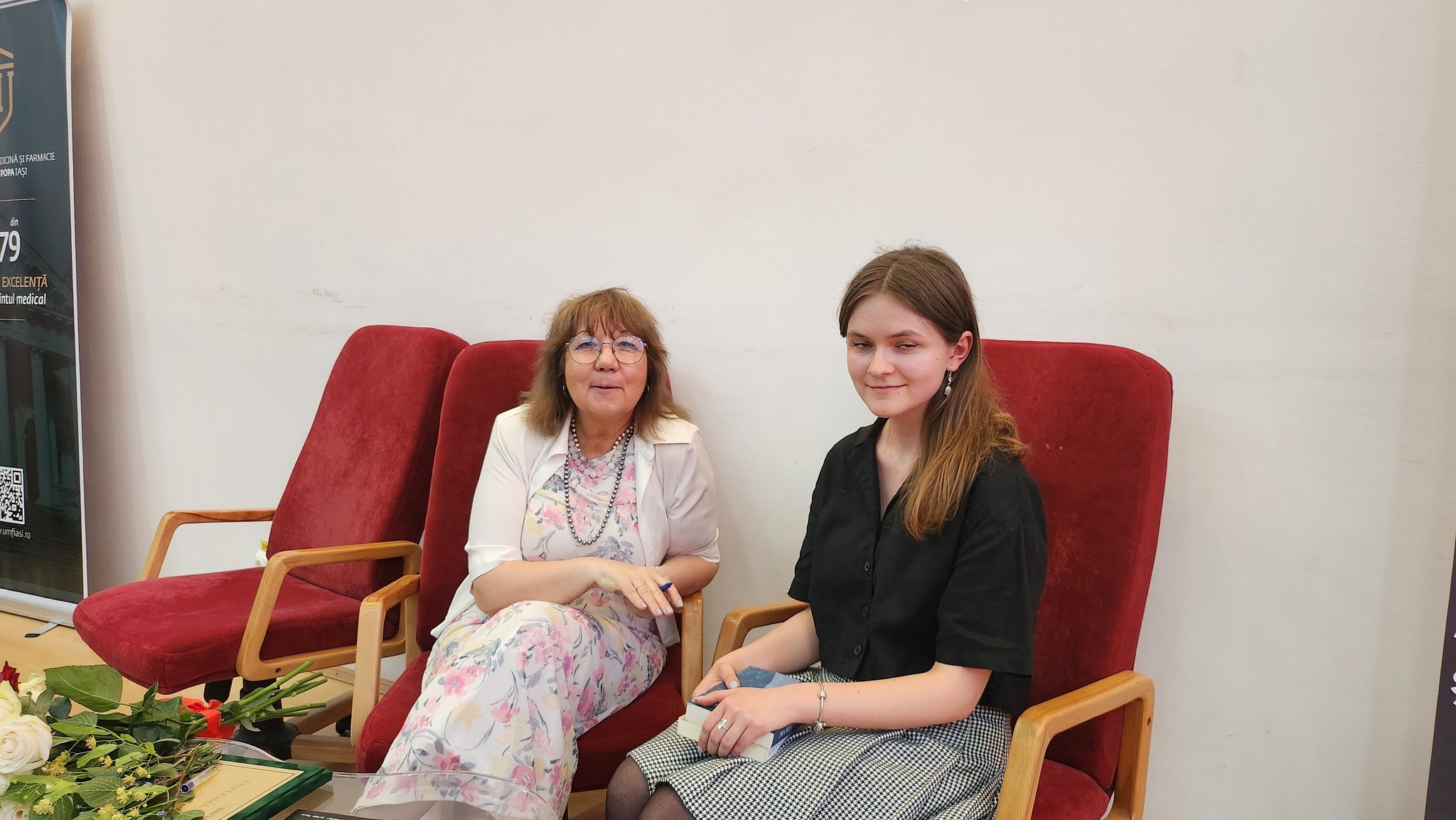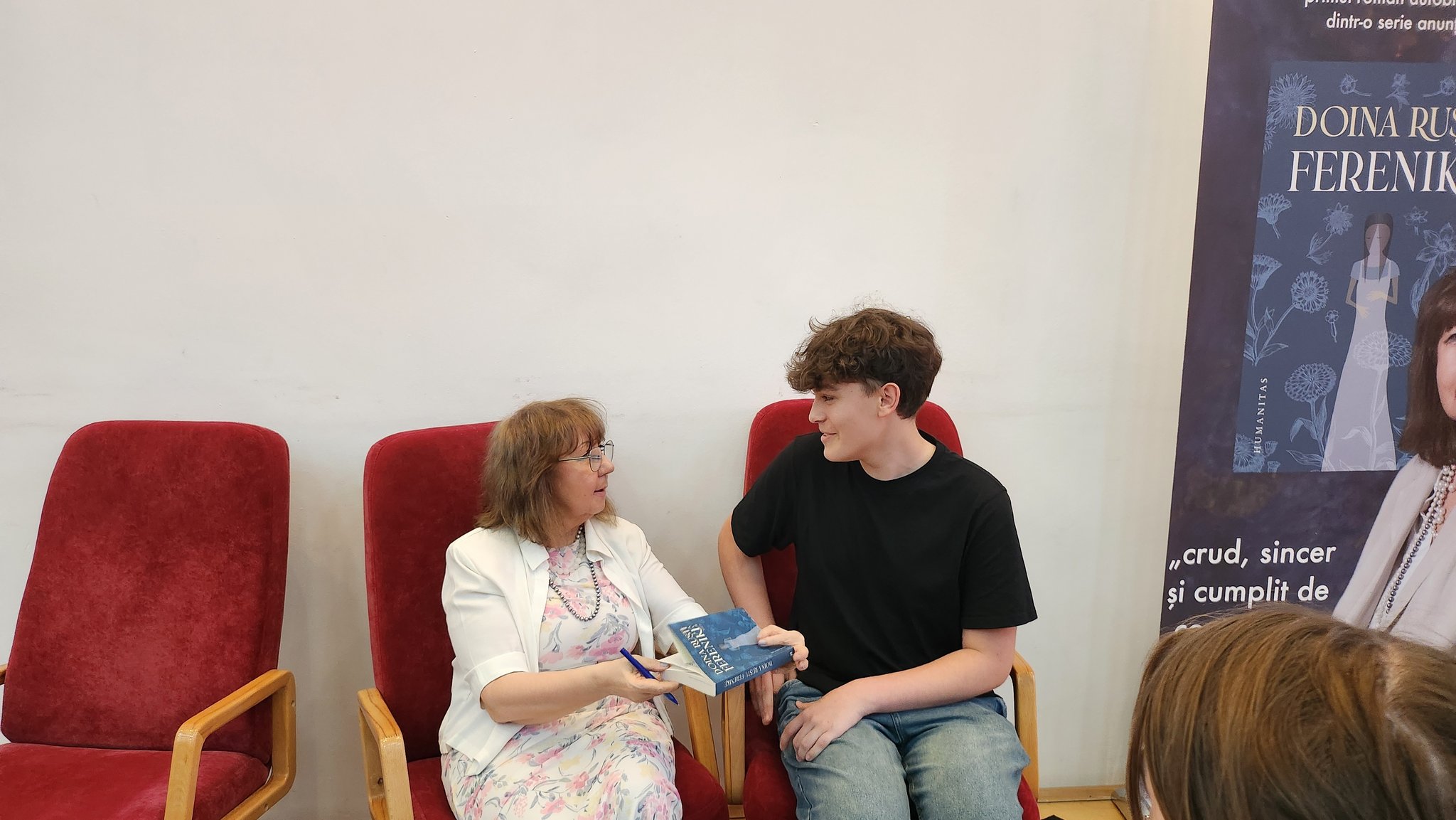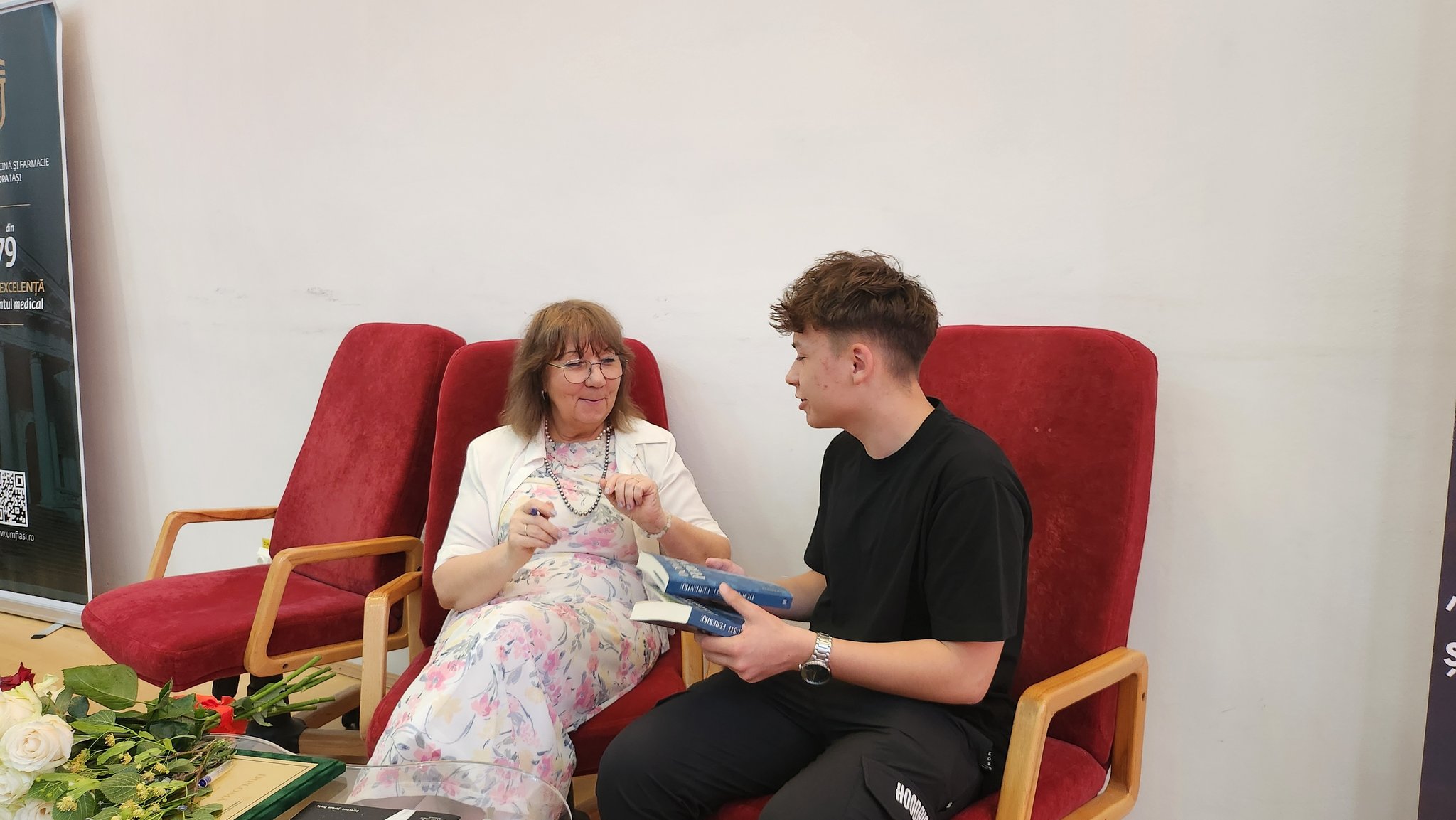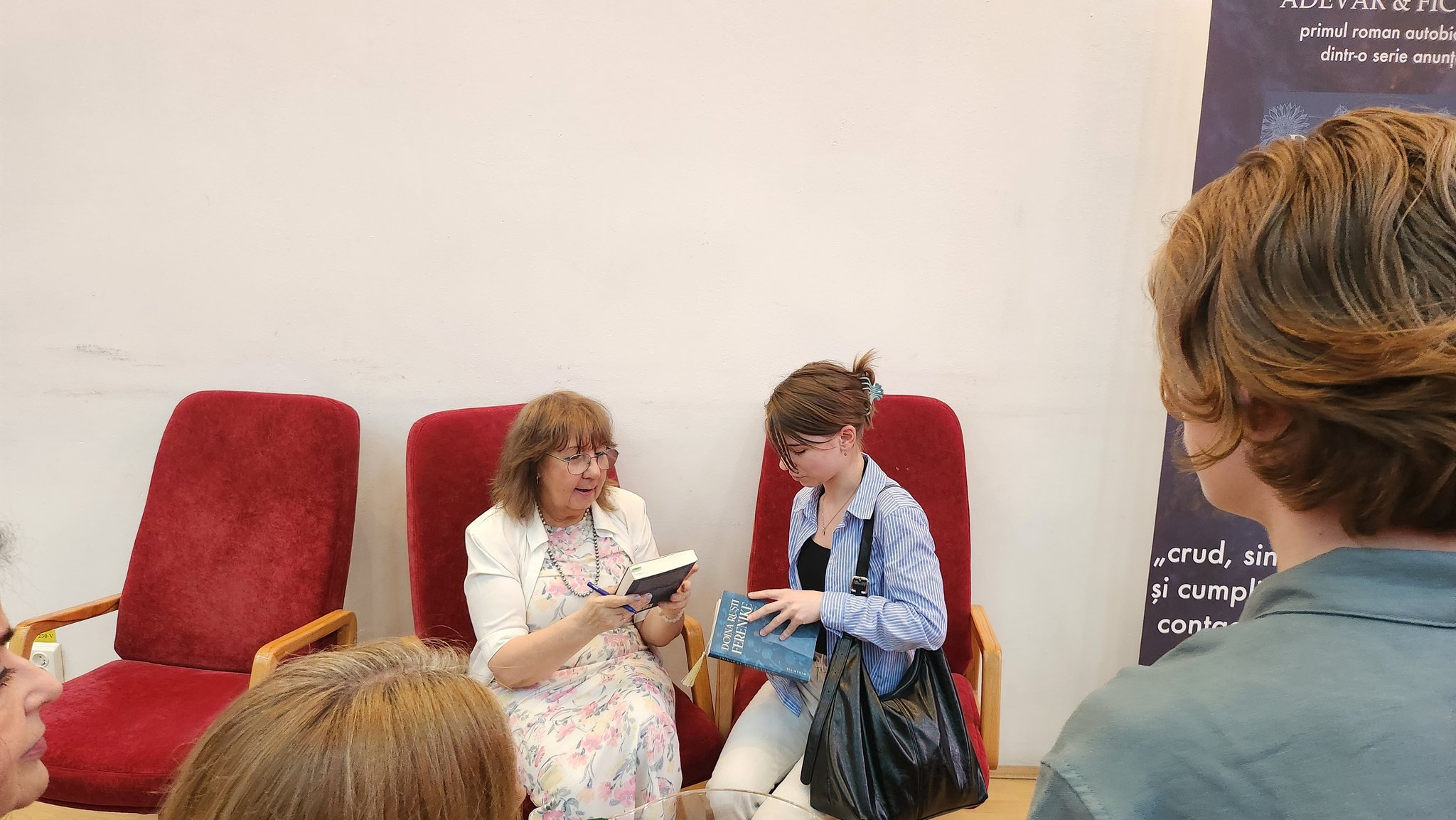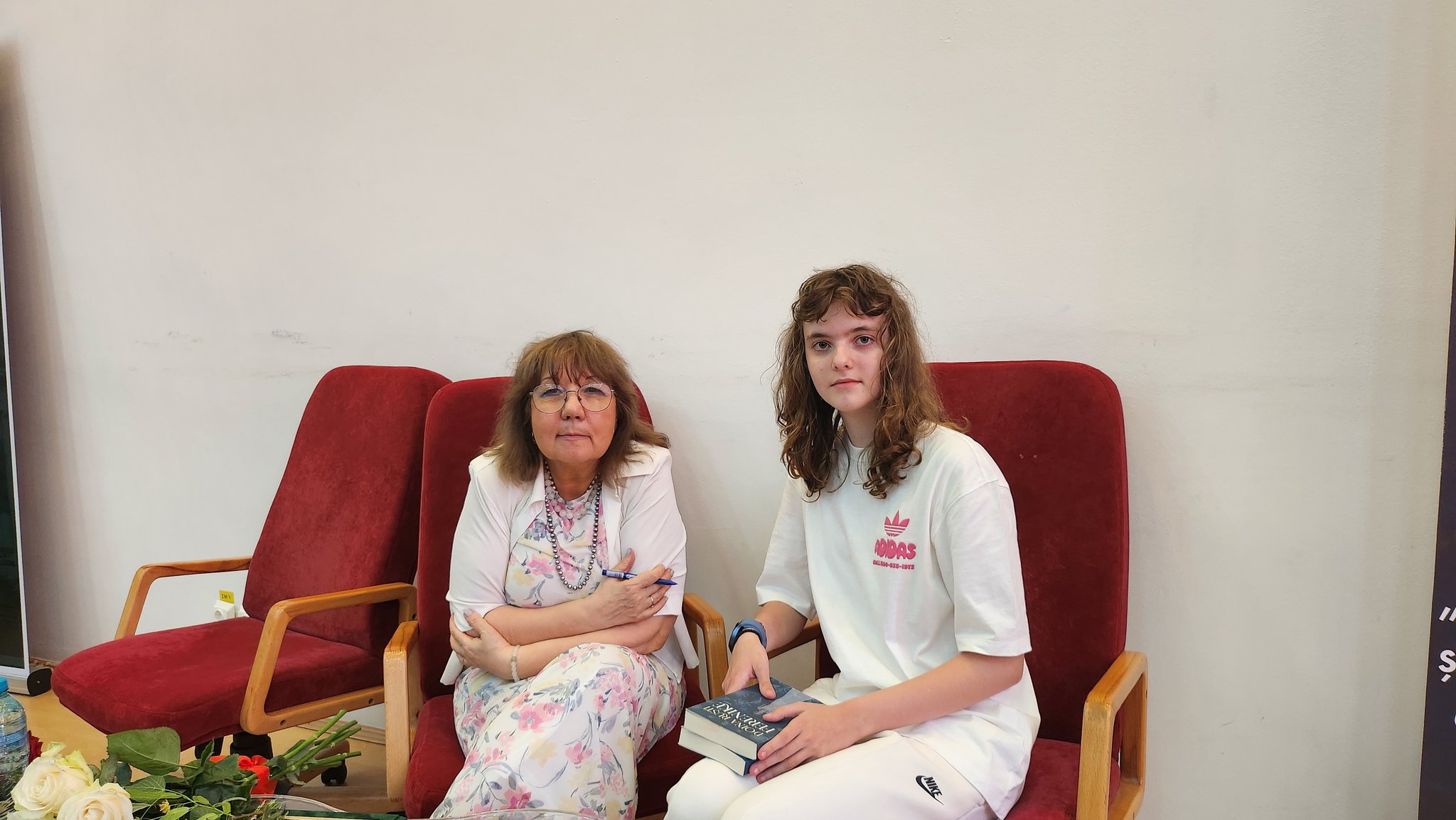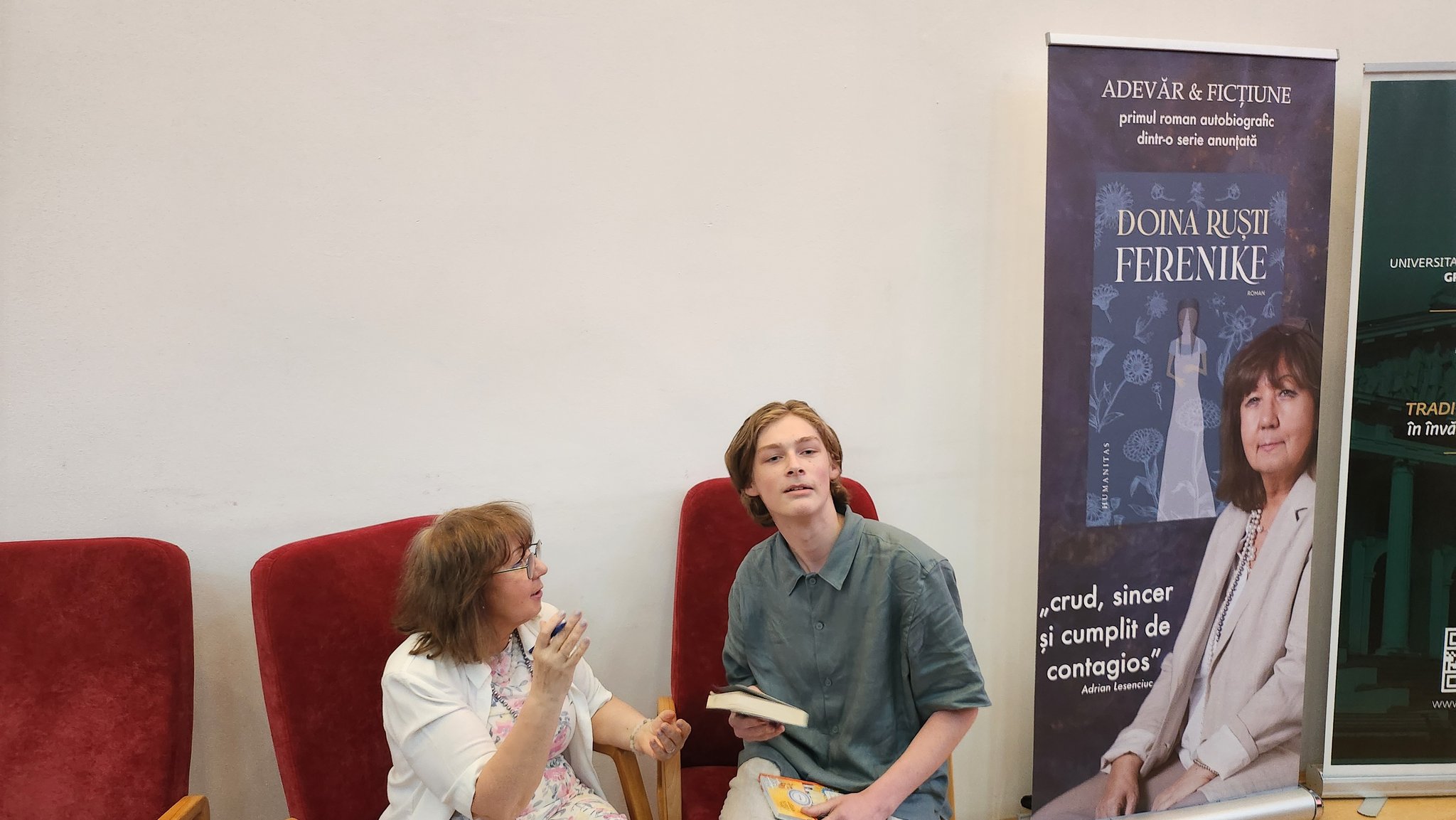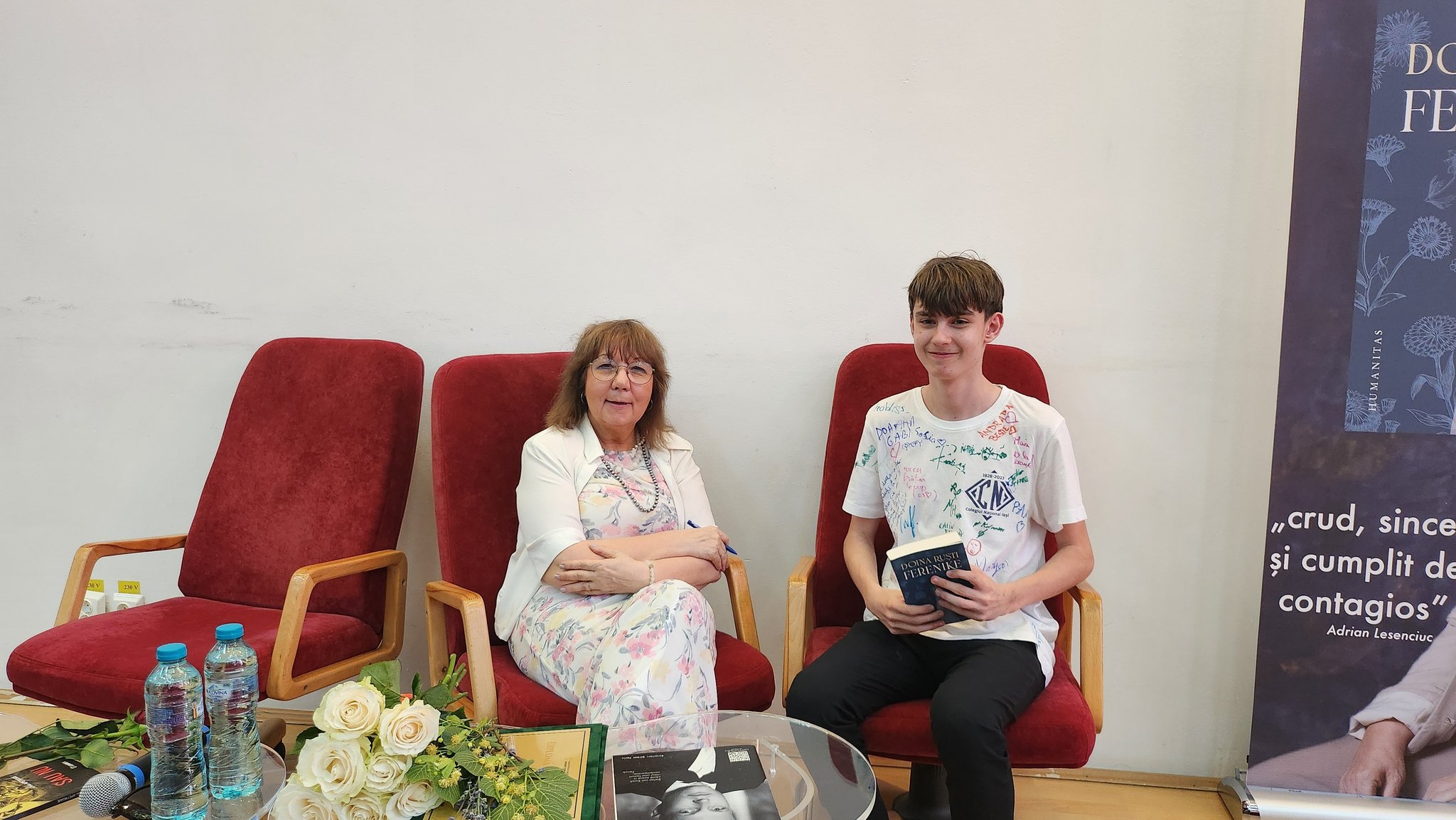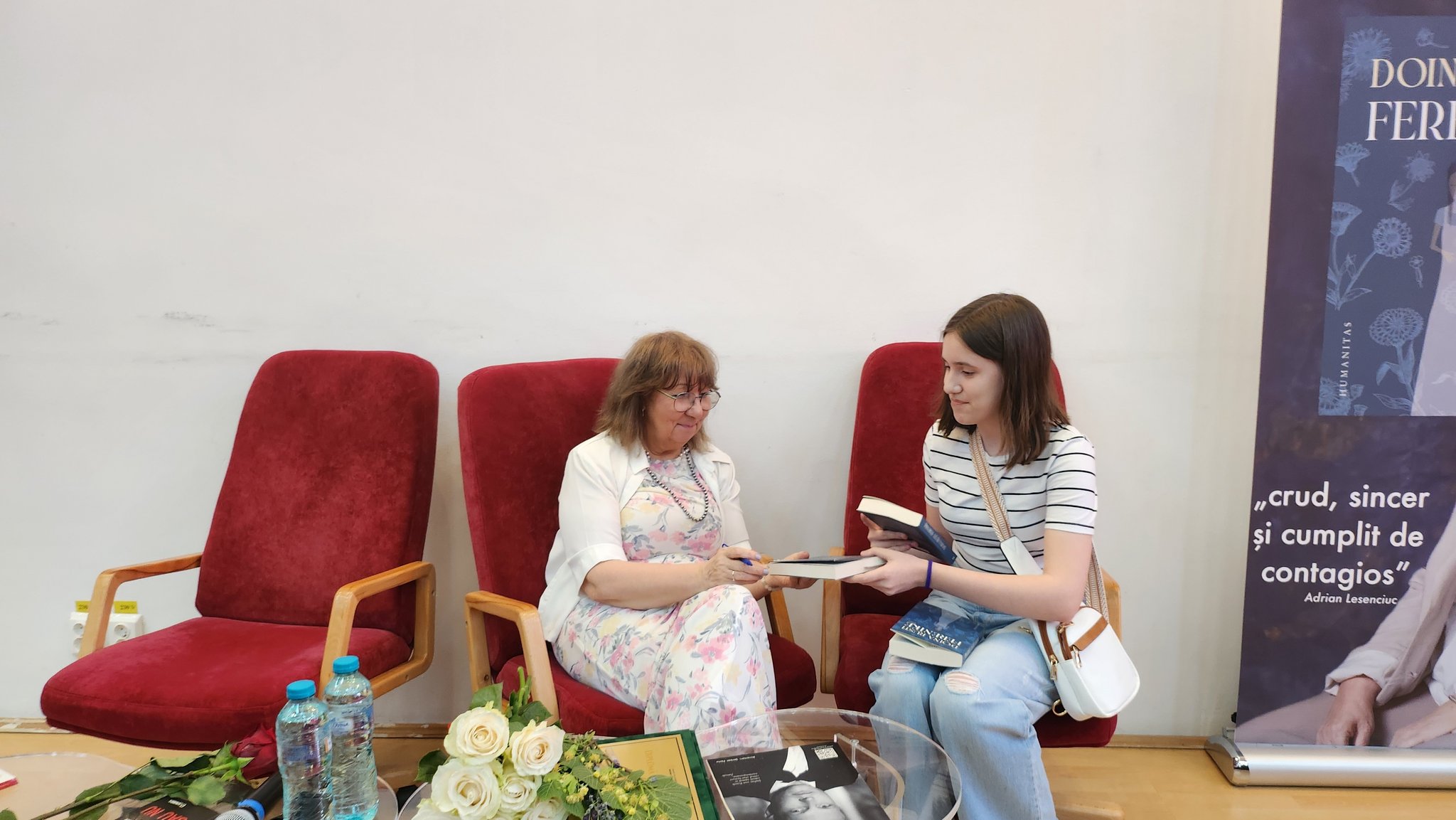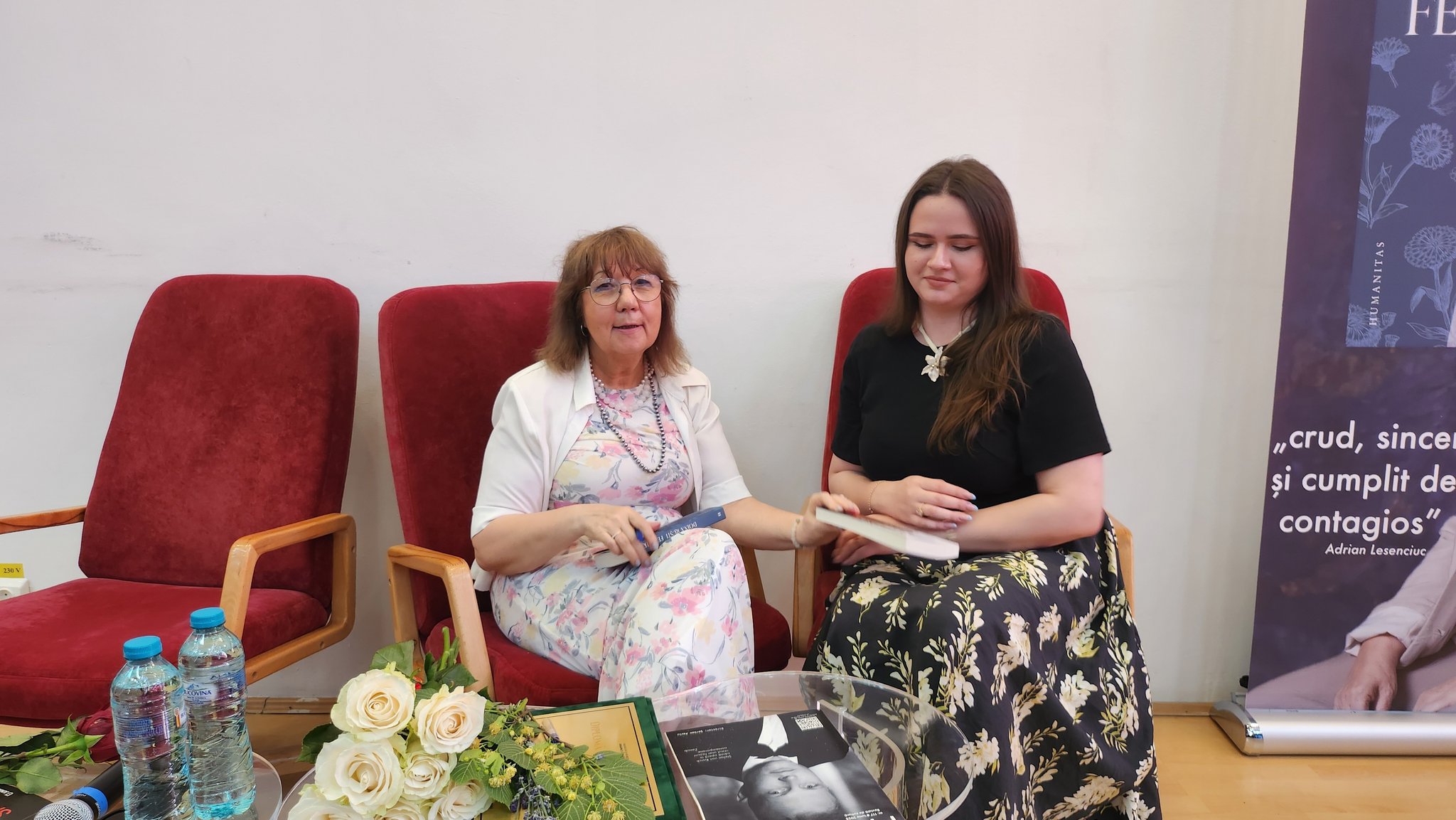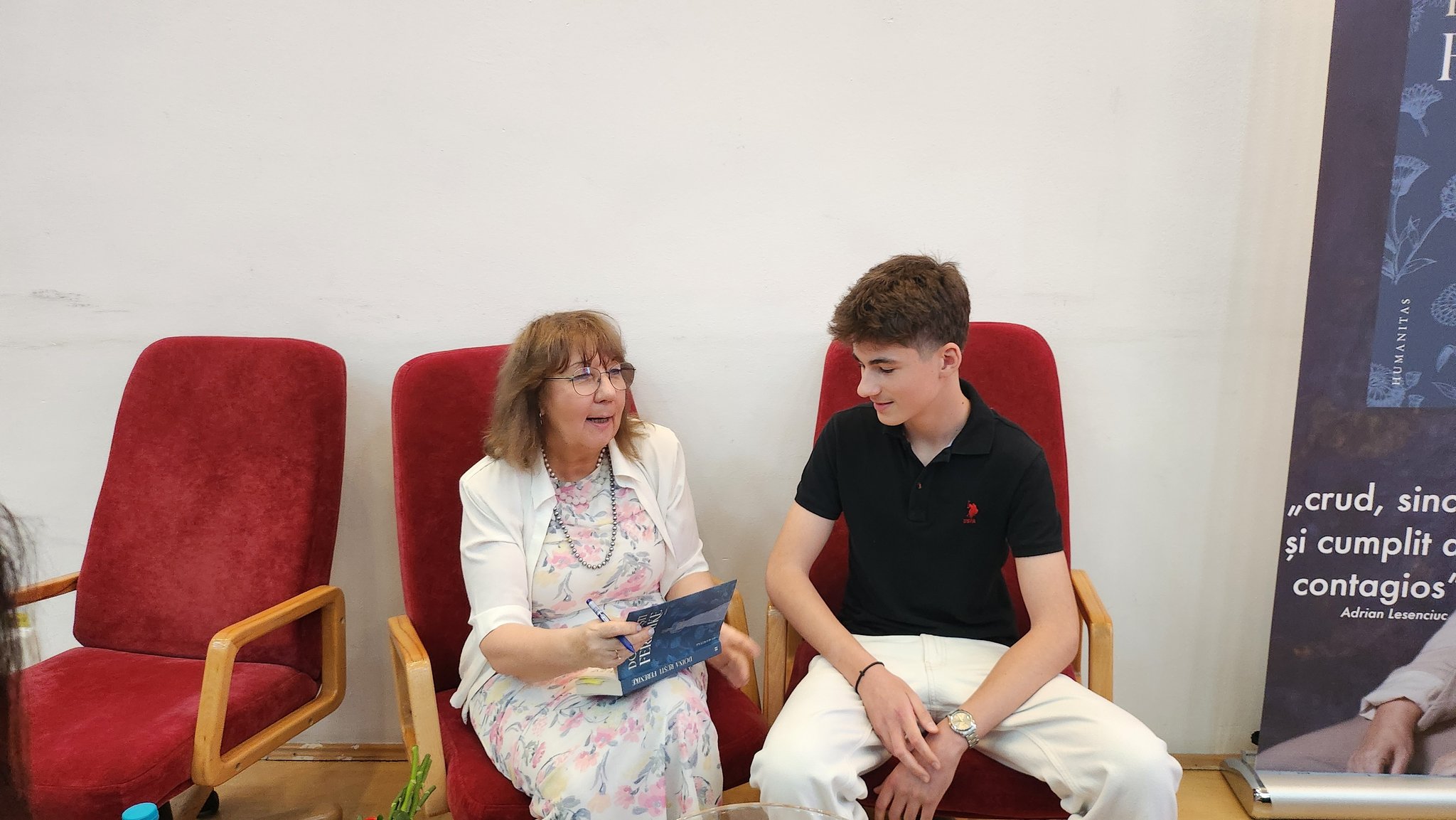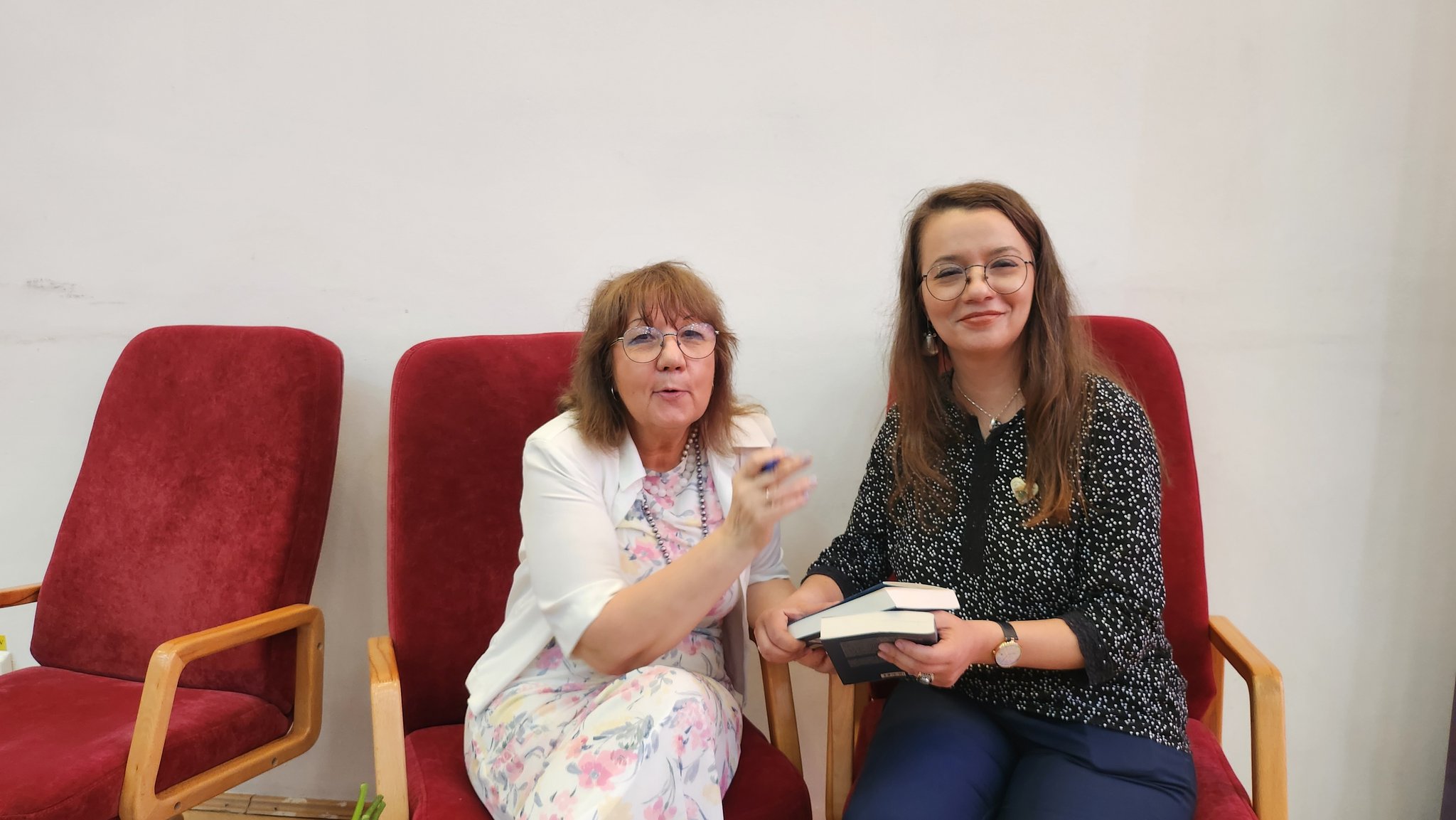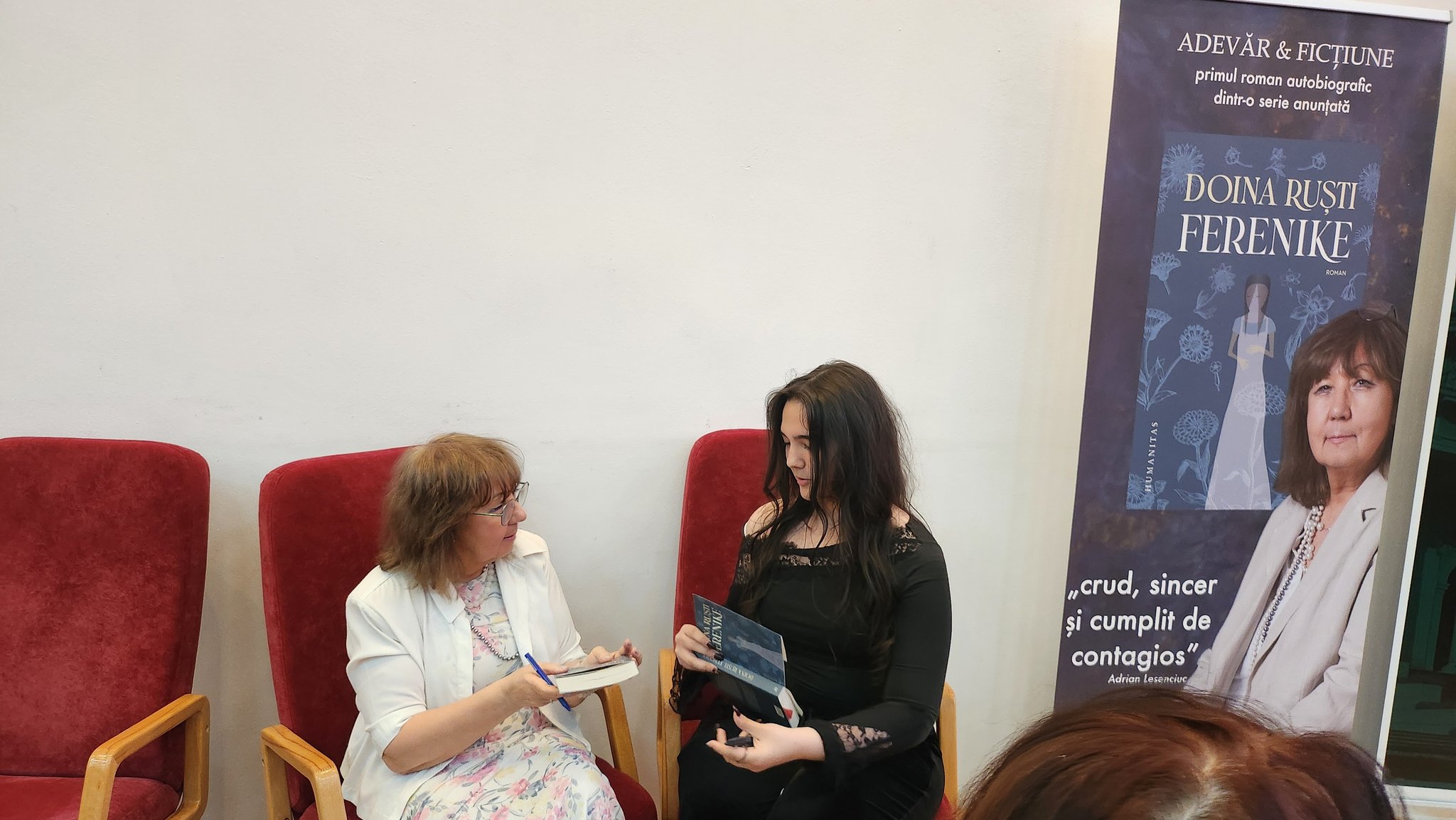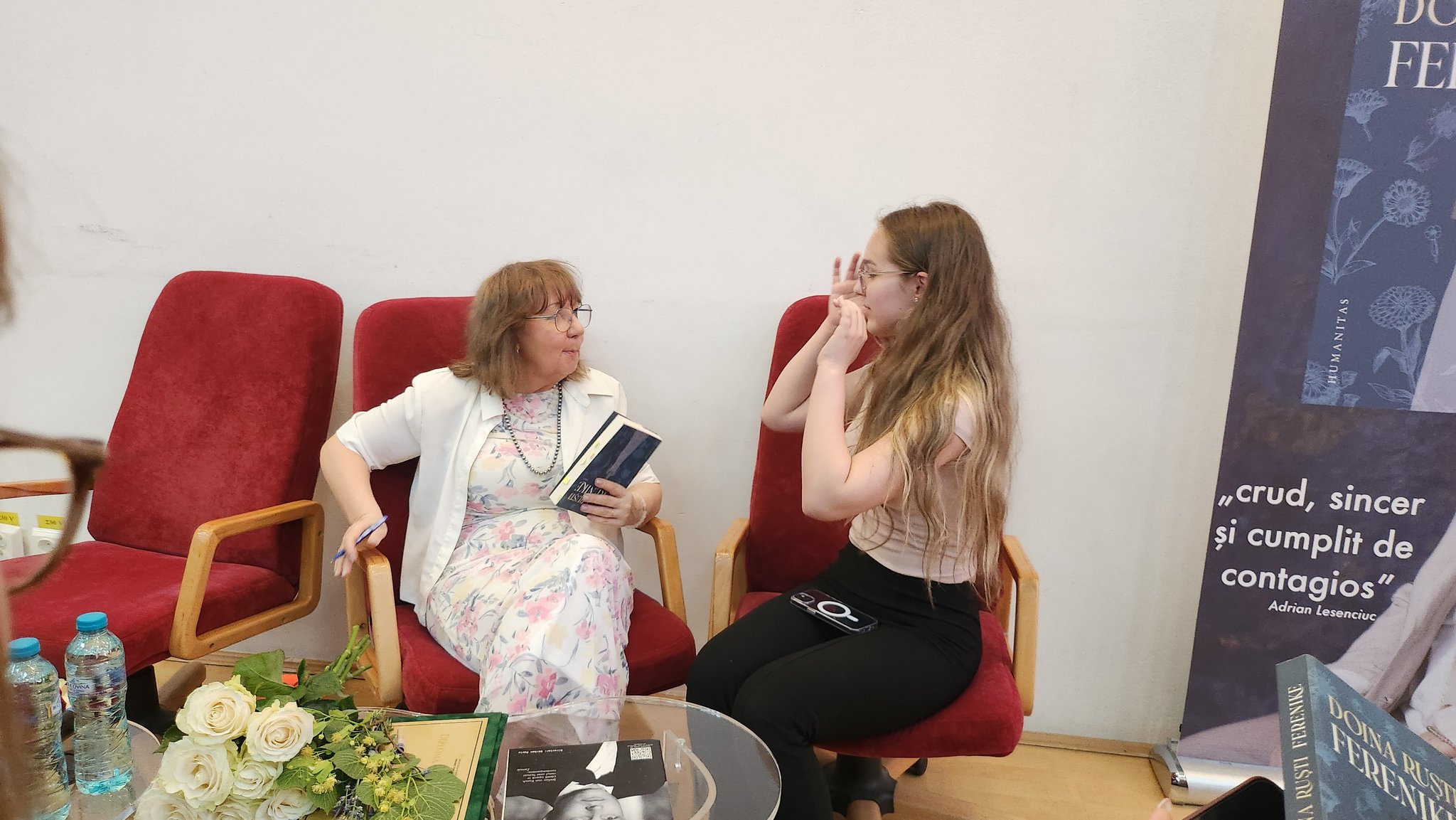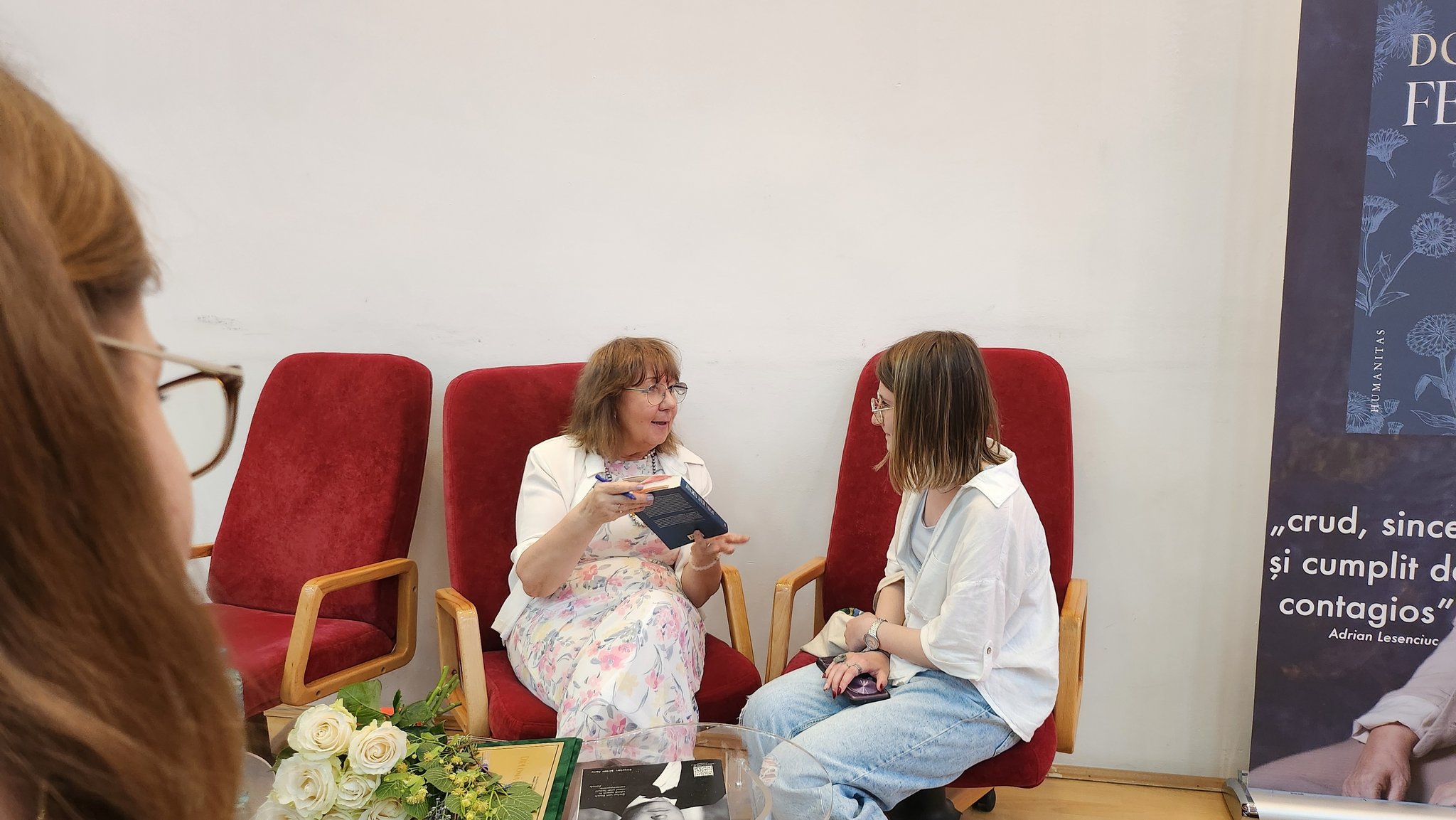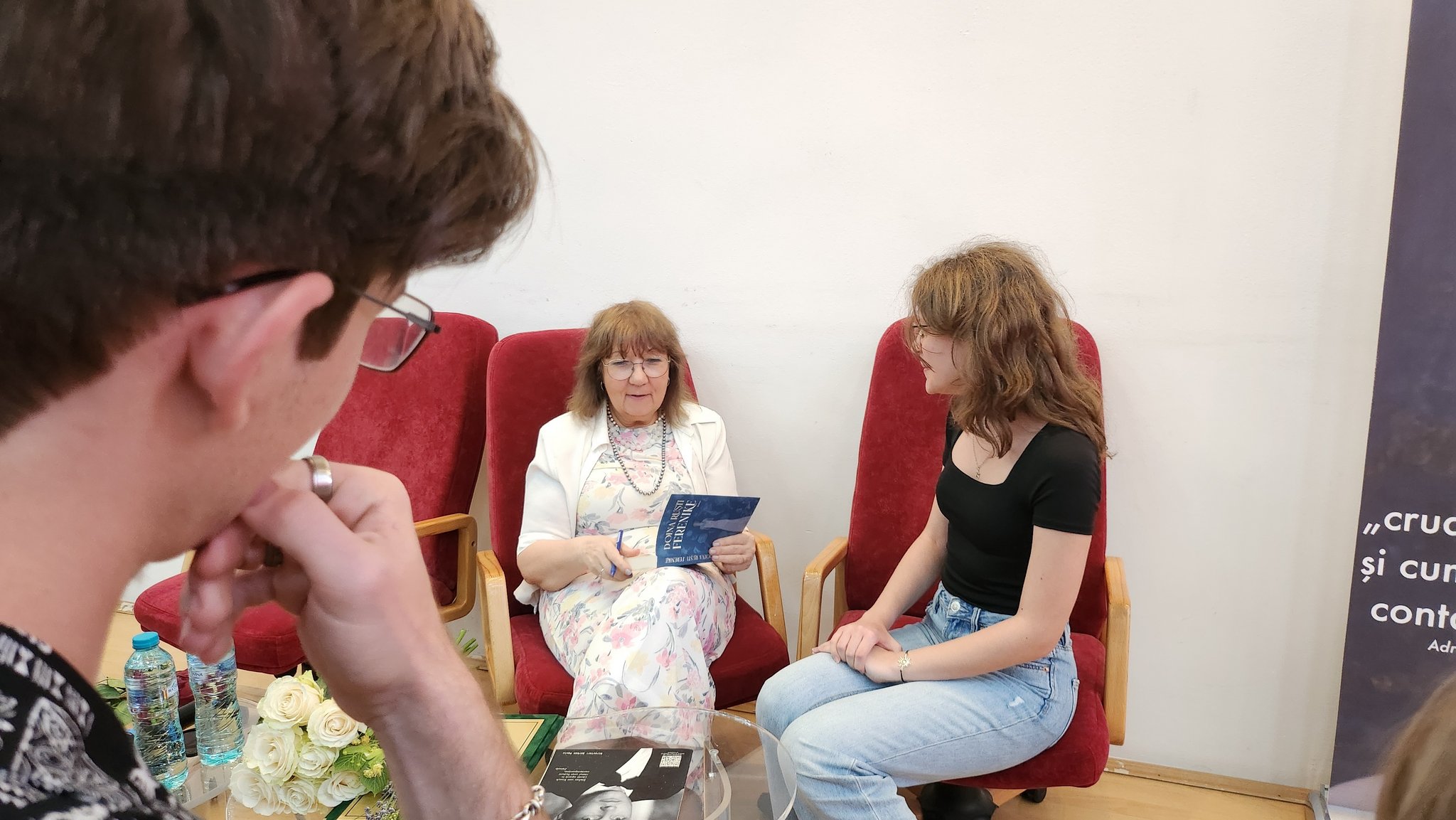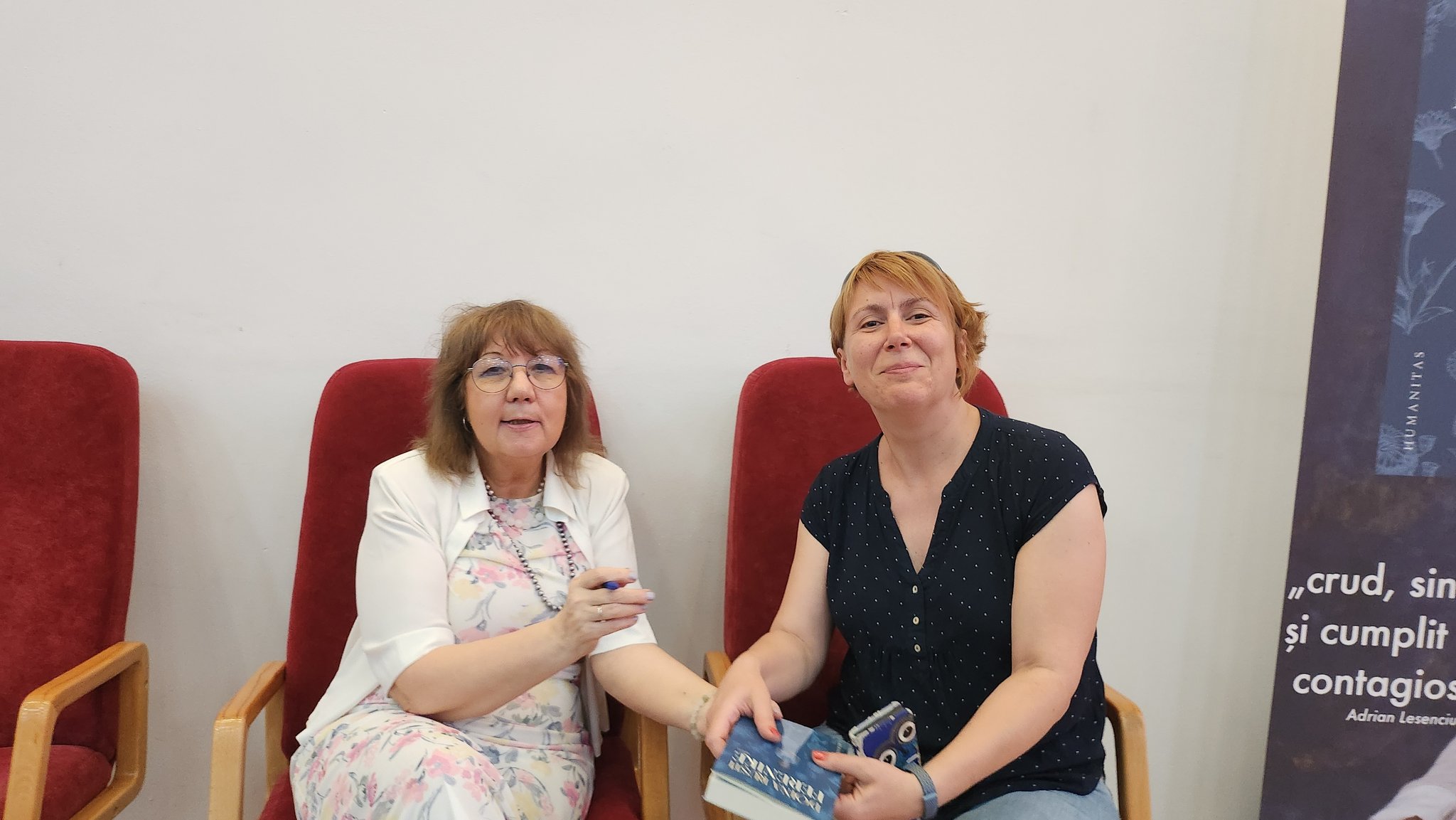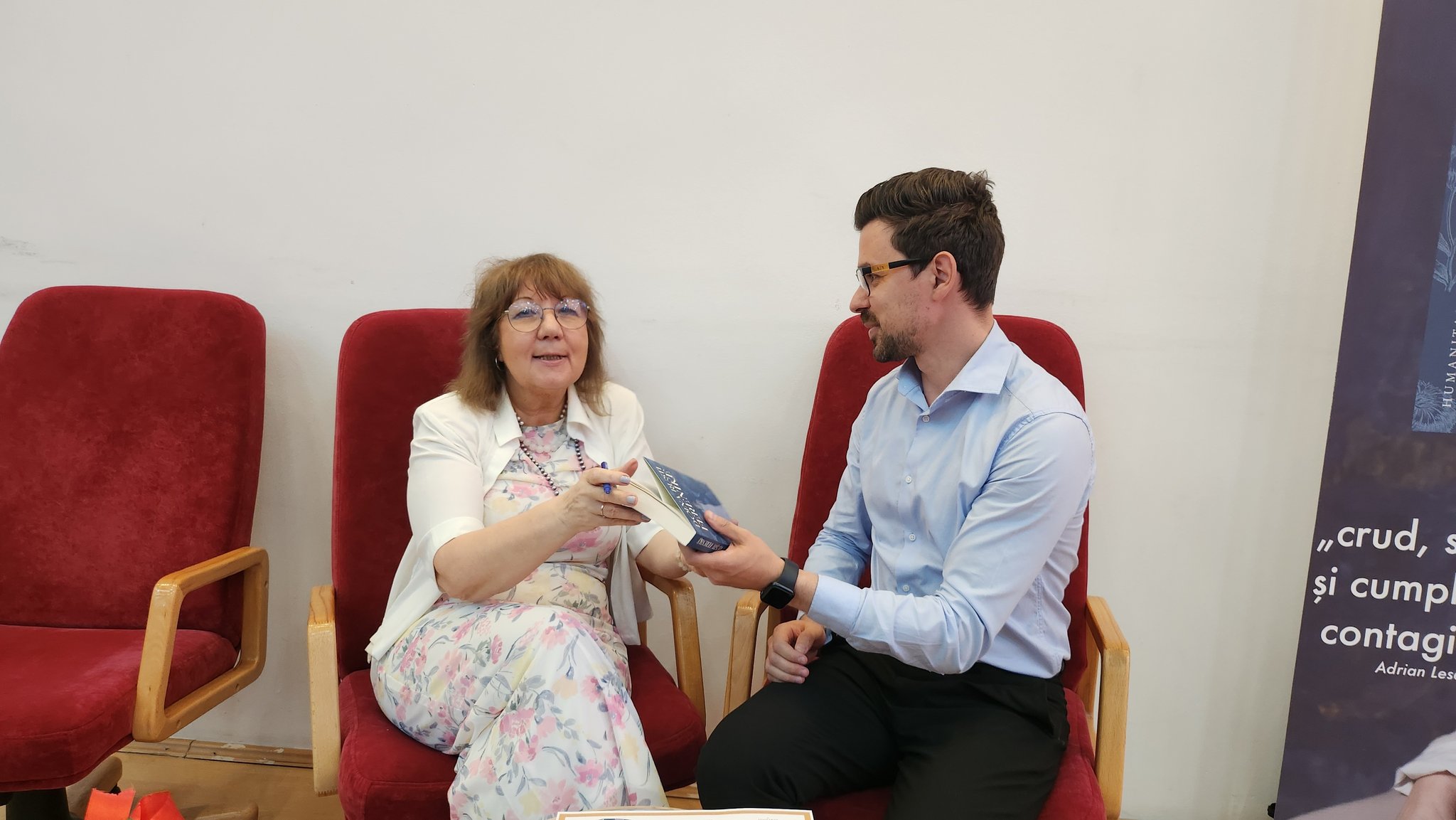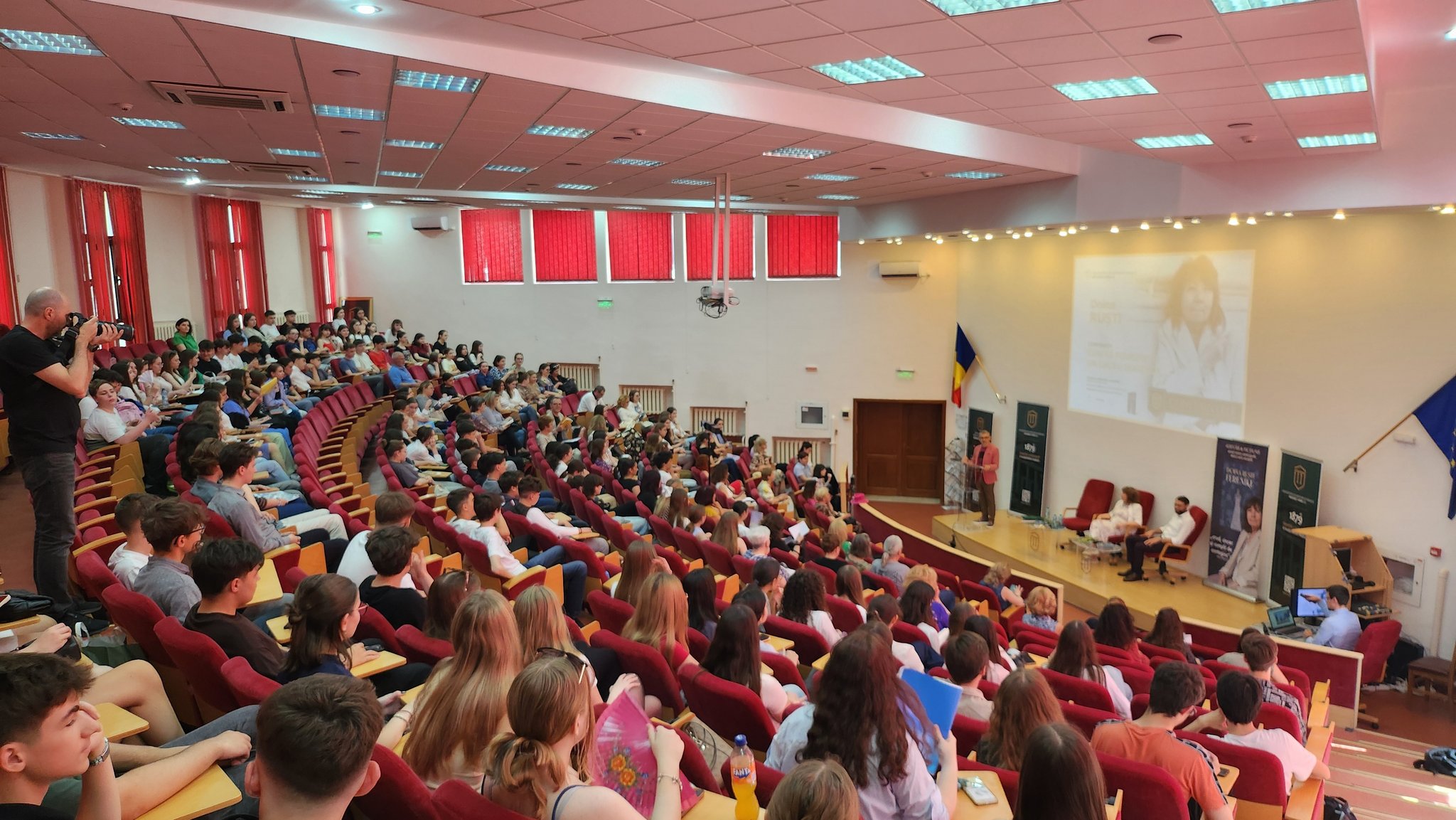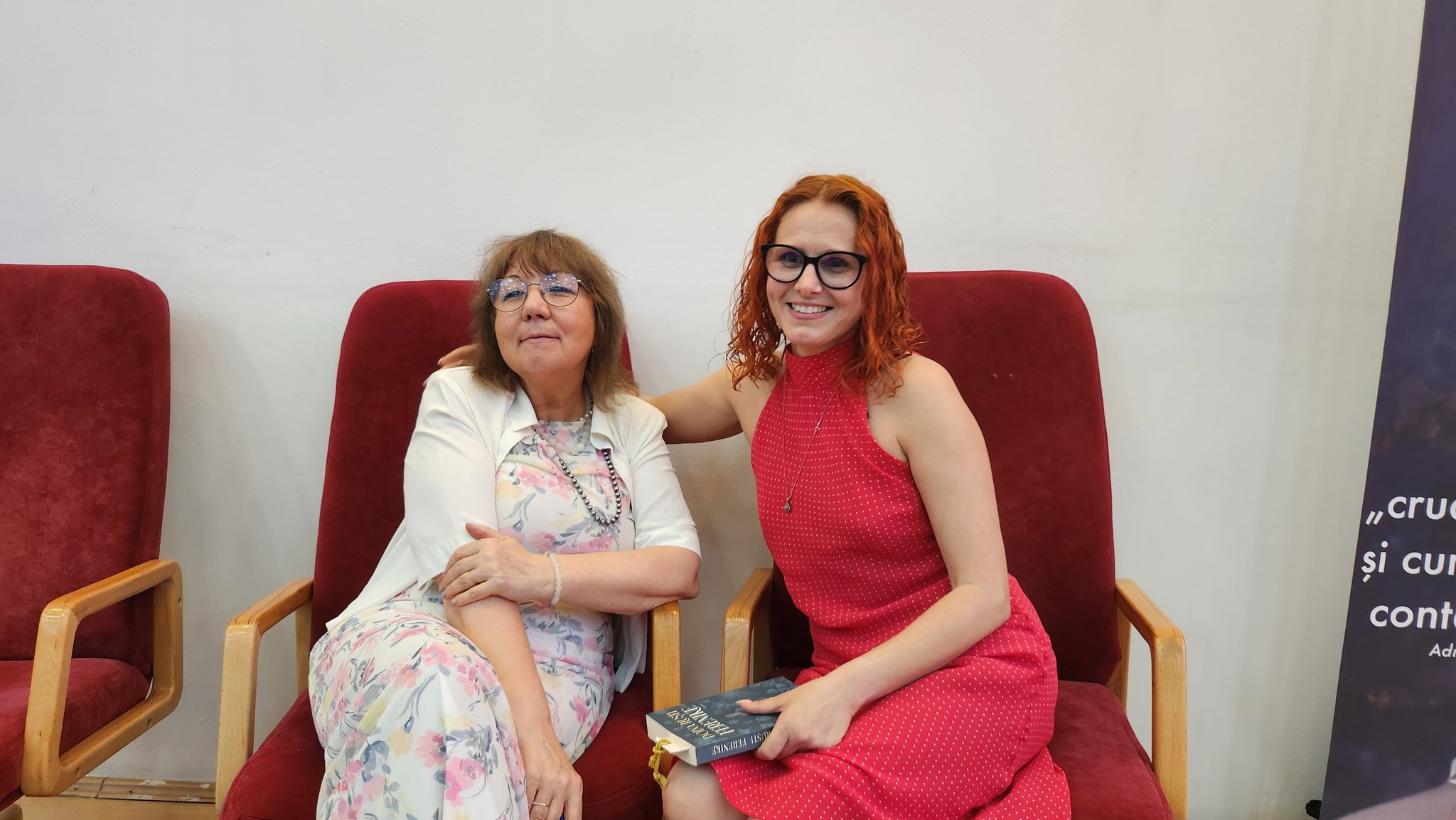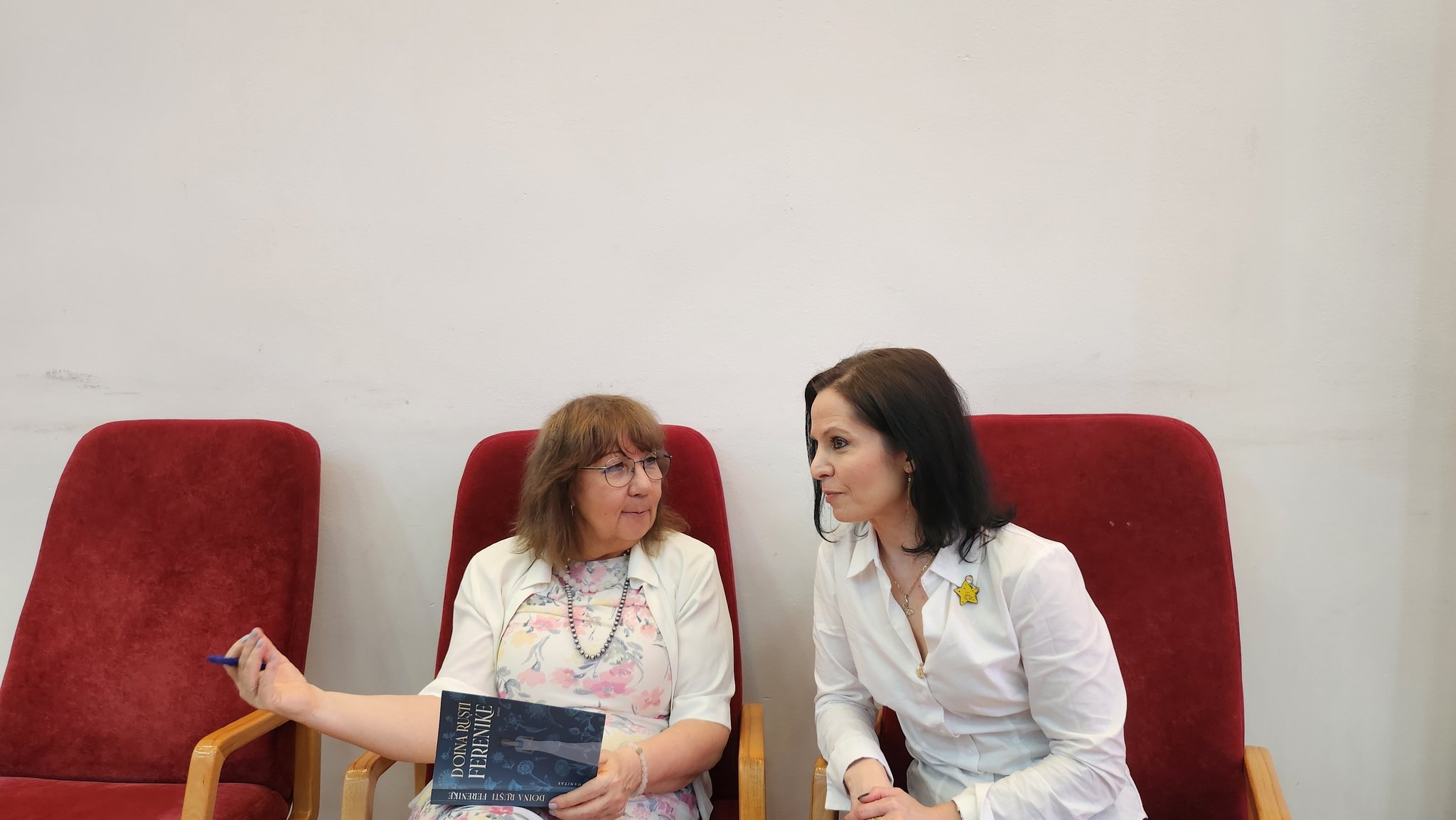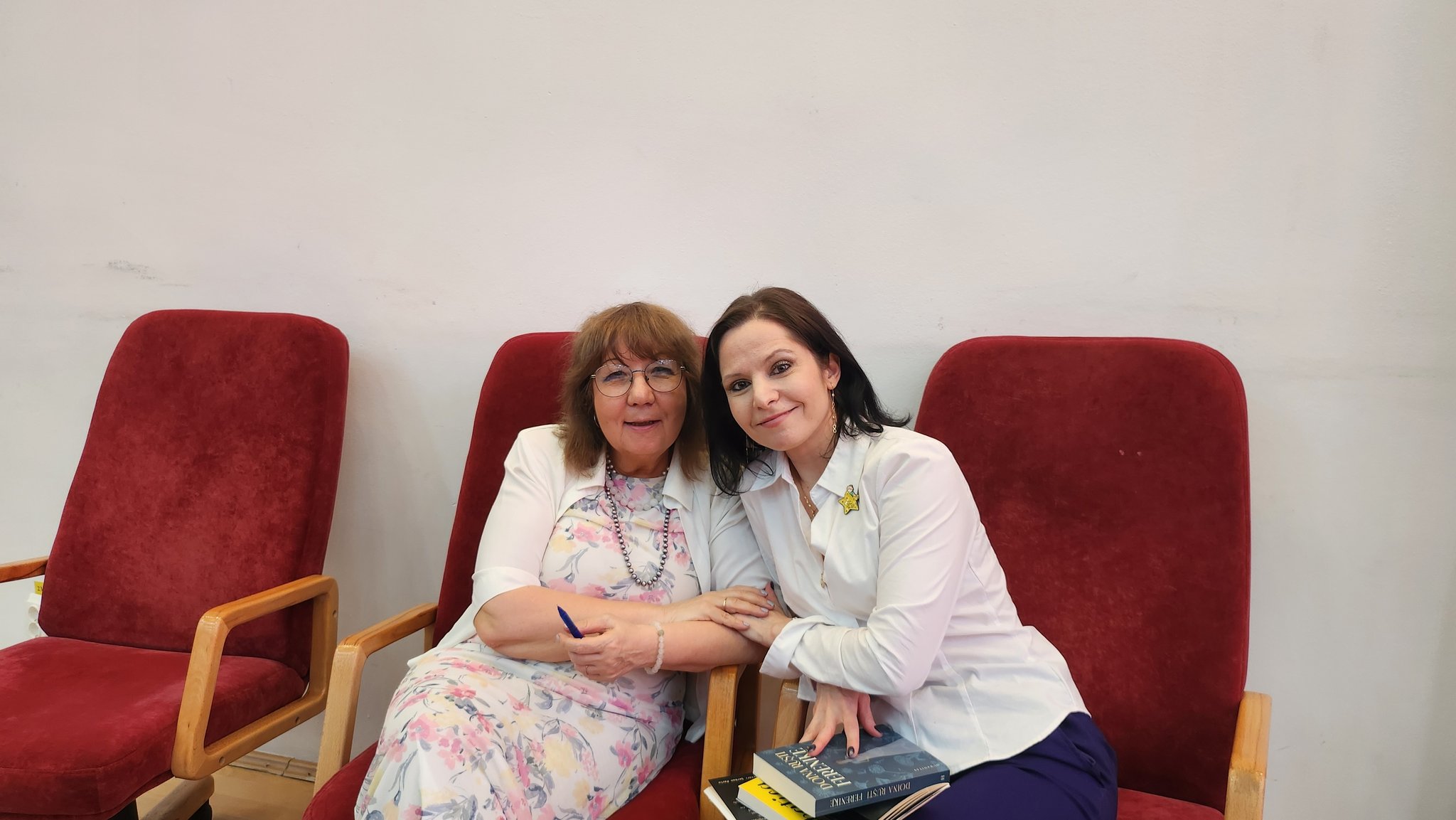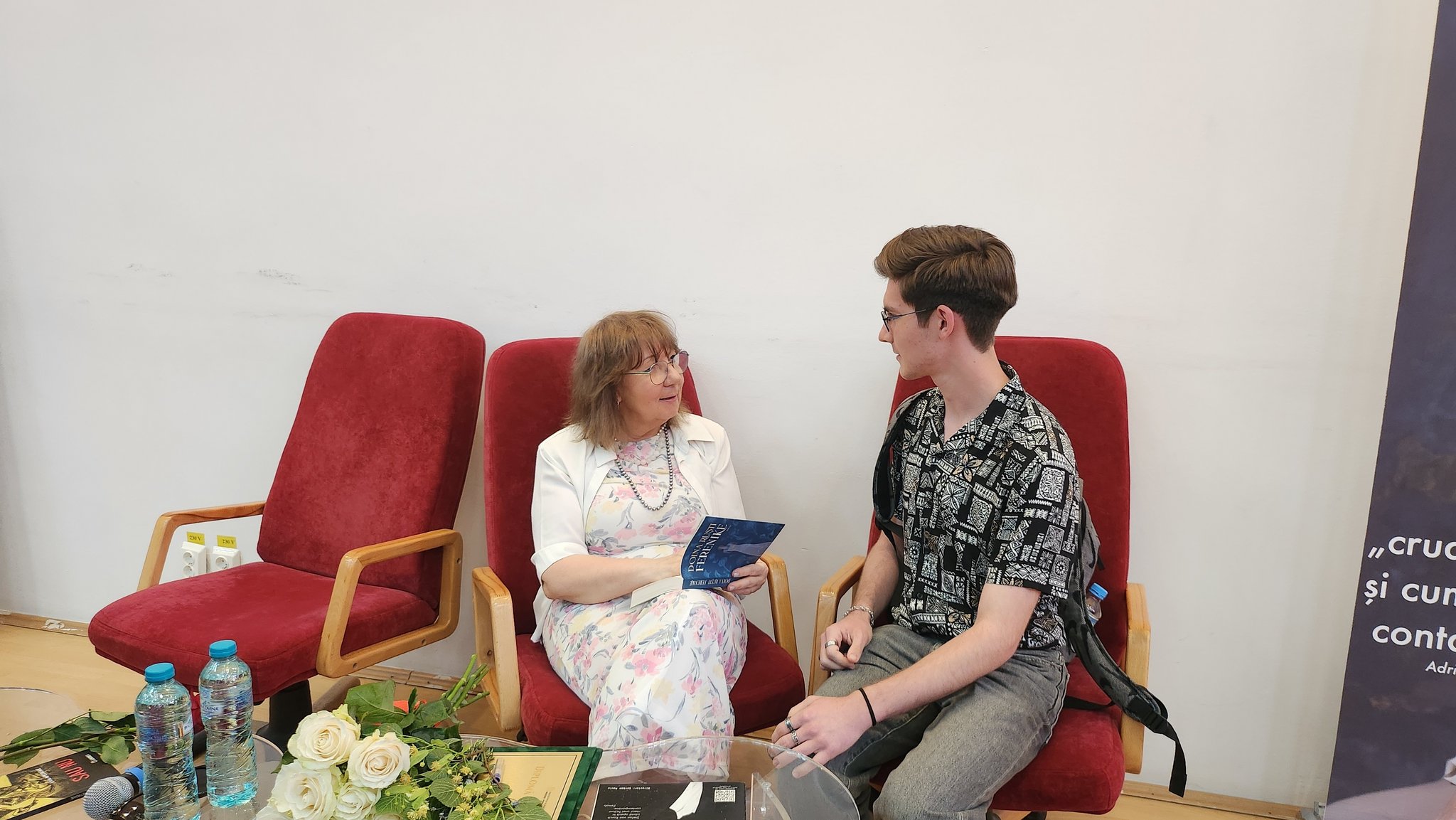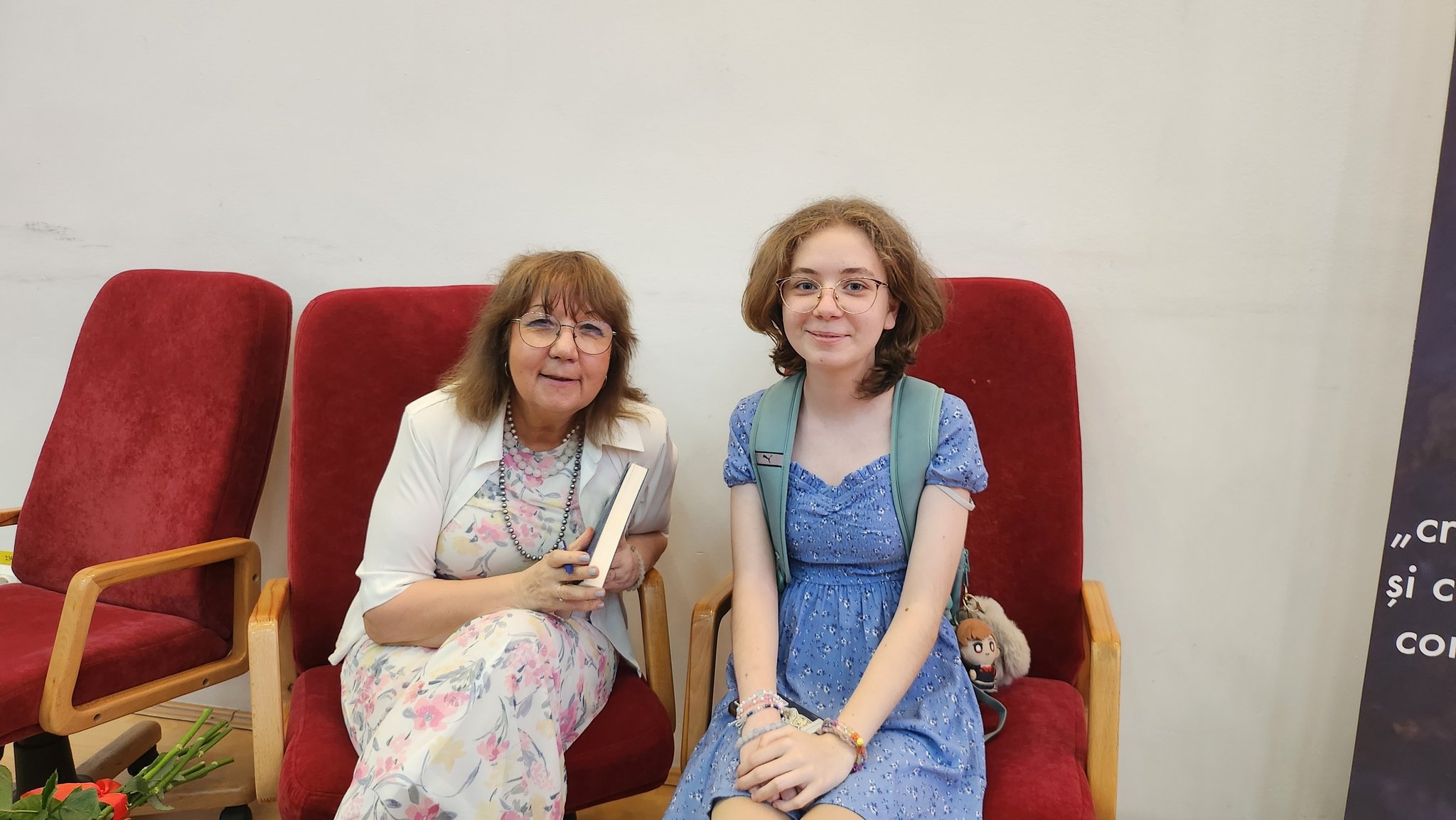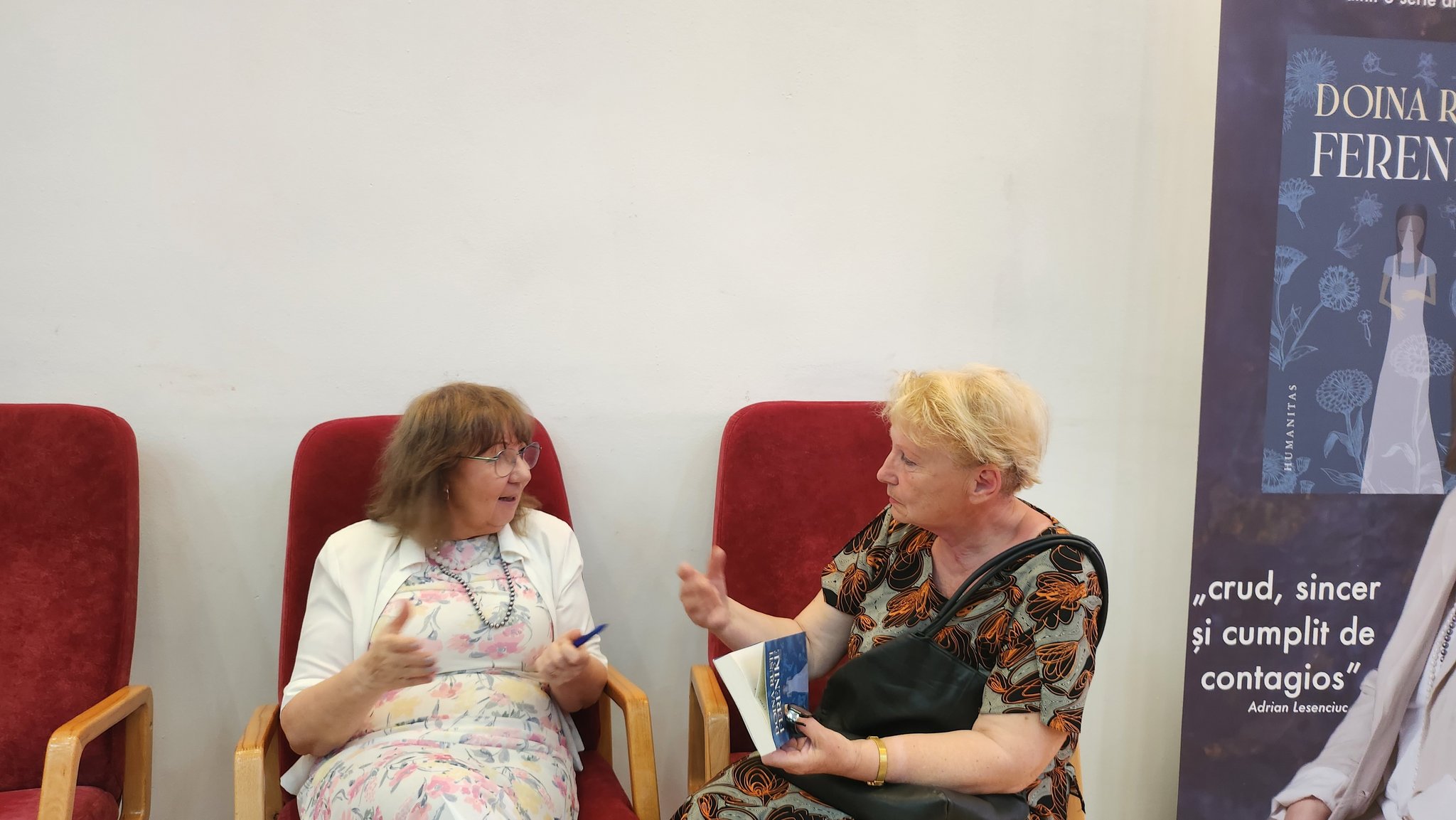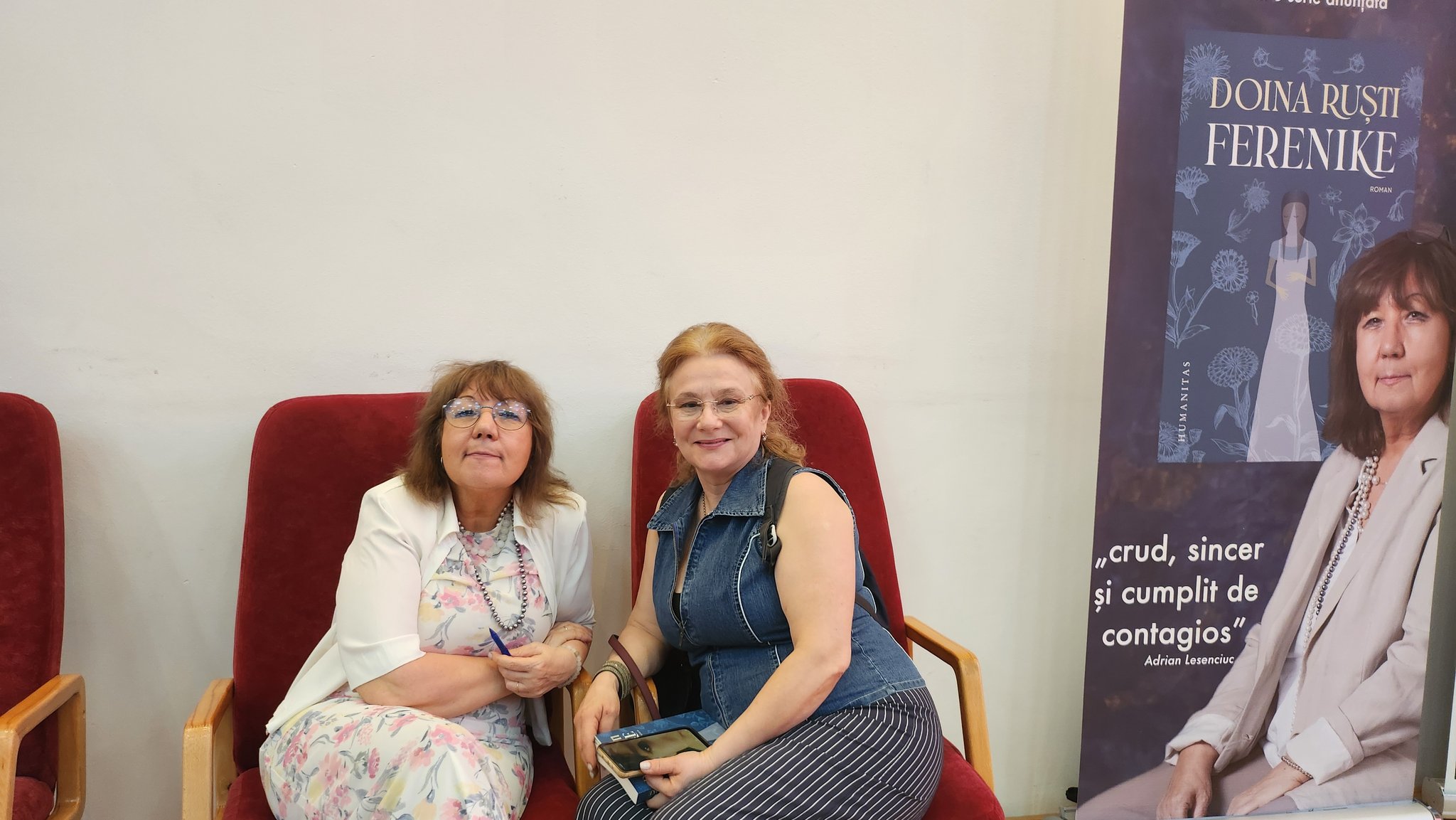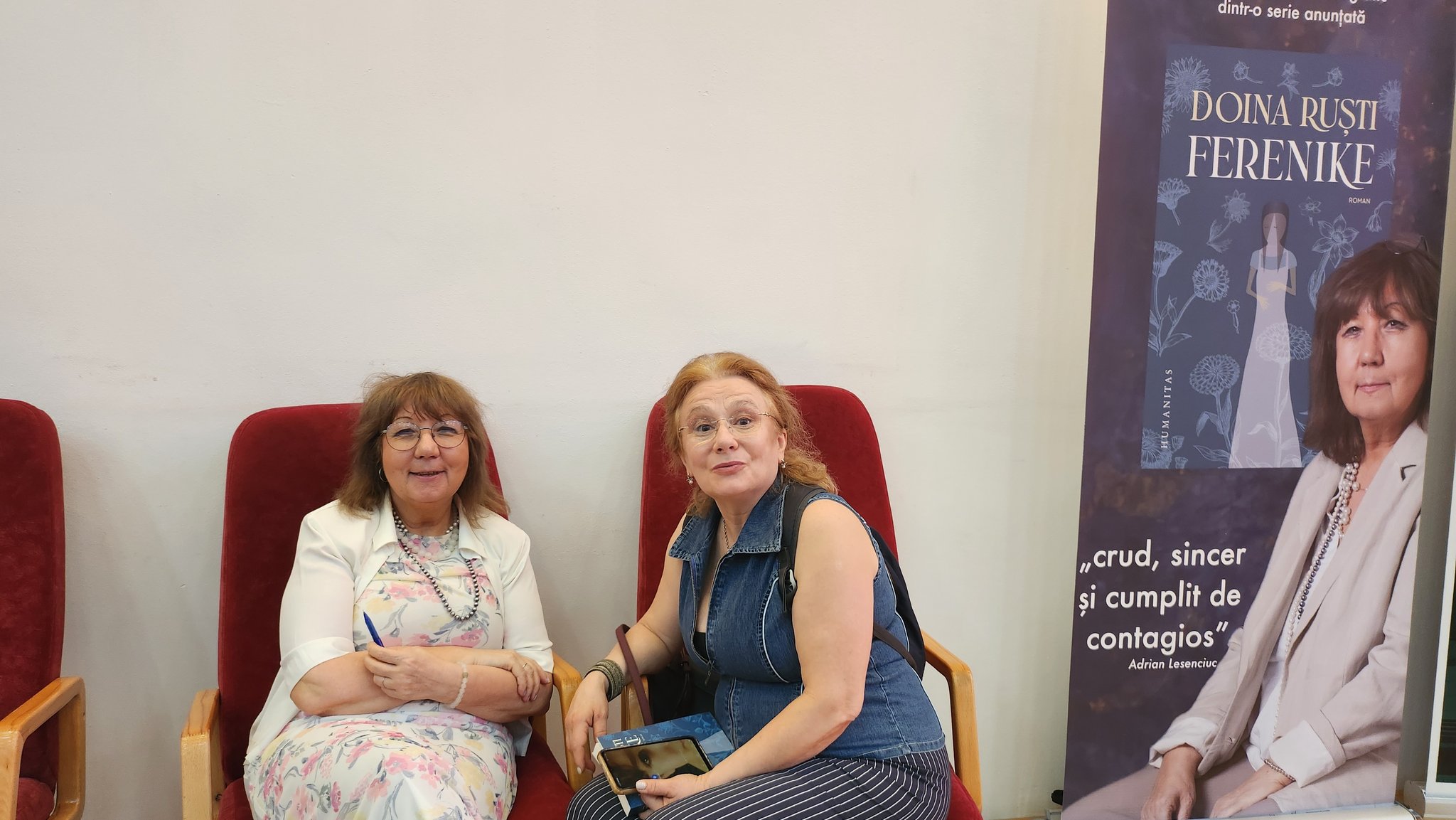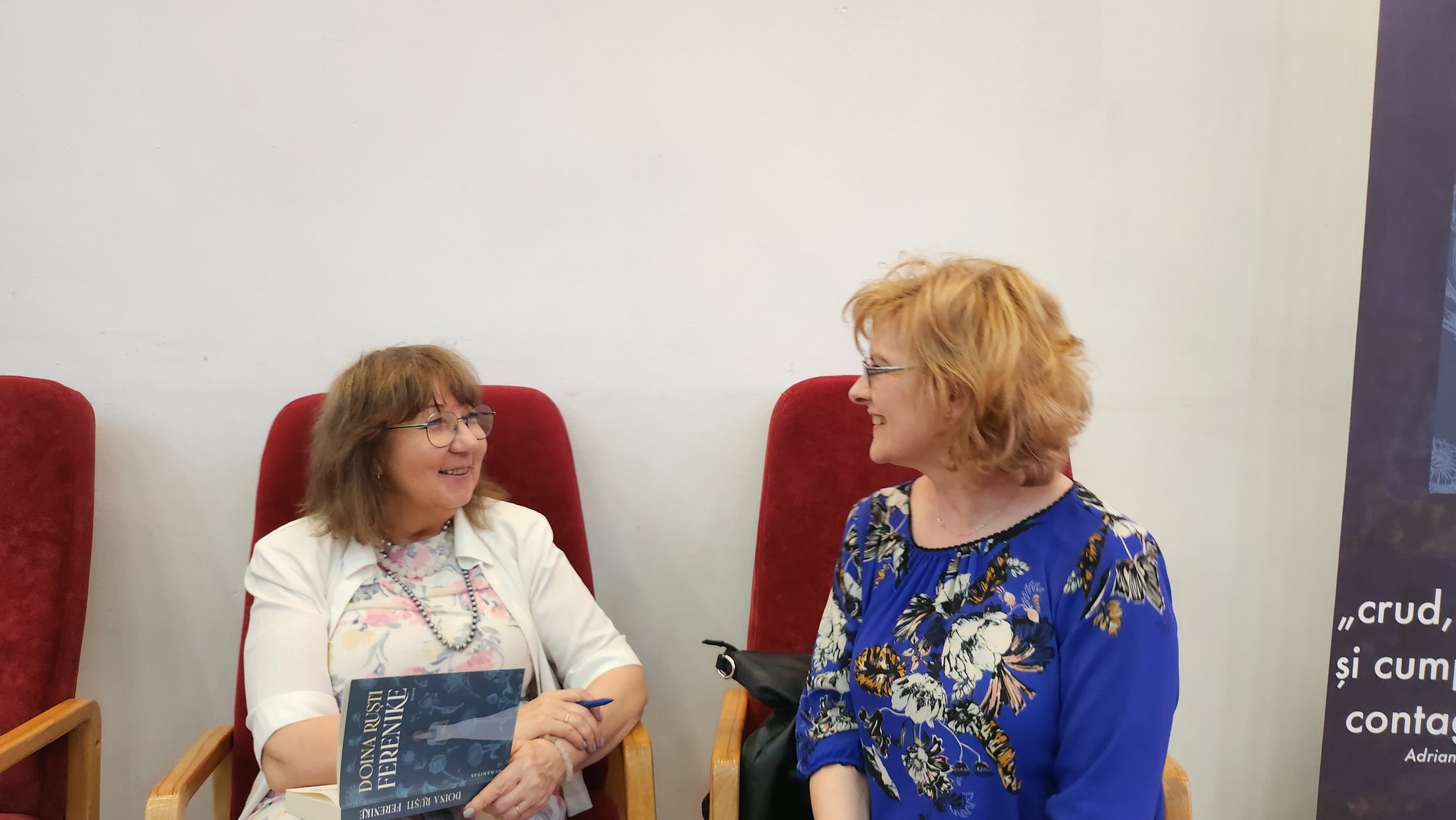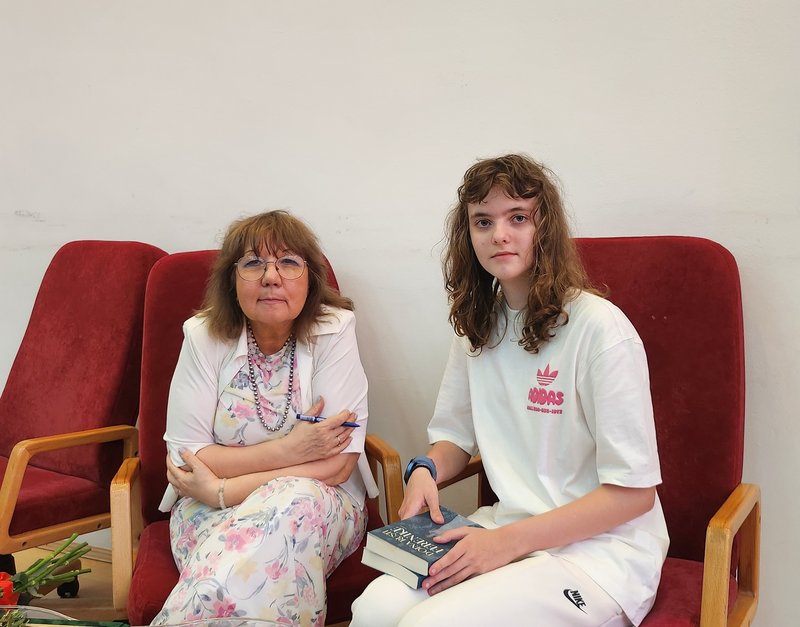
Photo gallery of the meeting at the end of the page!
Alexandra Aramă, 9B
On June 4th, I had the opportunity to attend the conference “How to Tell a Painful Story” at the University of Medicine in Iași, where the guest speaker was the writer Doina Ruști, presenting her new autobiographical novel Ferenike.
She began by introducing the story and explaining how she first learned about Ferenike, a princess from Rhodes. In Antiquity, when women were forbidden to participate in the Olympic Games, she disguised herself as a man in order to compete and preserve her family’s prestige. While translating a text in Ancient Greek about this historical figure in the 10th grade, the writer recognized herself in this fighter against injustice and the abuse of male power.
However, the being associated with Ferenike had appeared in her life long before the 10th grade. In her very first nightmare, a tall, imposing, cold figure — a demon of her own self — forced her to make a cruel choice: which of her parents should die. At first she refused to name anyone, but when she understood the gravity of the situation, she finally answered that she wanted Muc, her mother, to live, and her father, Cornel, to die. This marked the beginning of a series of terrifying encounters with Ferenike, who appeared only in decisive moments of Doina’s destiny. The spirit never came when called; it appeared only when it felt necessary.
The author spoke about the evolution of her relationship with Ferenike, which meant a shift in perspective regarding the demon’s power over her. At first she believed herself to be the slave of this merciless spirit, but in time she realized she was its master — that within her lived the monstrous force of the subconscious and of guilt. Doina Ruști said she learned to use Ferenike as a “trash can” in which she deposited all the painful, traumatic memories that marked her life.
Thus she transformed weakness into strength, escaping the cage of thoughts poisoned by suffering. Pain entered her life abruptly through the death of Tavică, her uncle and the person she idolized during the first five years of her life. His death remained a great mystery in the Stănculescu family: no one knew whether he drowned accidentally in the Jiu River or intentionally took his own life, as he had attempted before. Asked what Tavică meant to her, Doina Ruști answered that he represented her entry into life itself. She loved him deeply and treated him as an ordinary person despite his epileptic seizures, which filled the entire family with fear. Although his illness deprived her of much of her relatives’ attention, Tavică remained a symbol of early childhood filled with light and hope.
The author describes painful events not as unjust tragedies but as natural consequences of happiness. Ferenike becomes her weapon against external suffering and the source of inner suffering as well. She learned to accept her inner demon as part of herself and to use it as inspiration for her vocation: literature.
Tiana Bitta, 11D
How can literature soften the poison of wounds? How can we transform pain into words that heal instead of hurt? And above all, when is the right moment to tell a painful story?
All these questions floated in the air of the “George Emil Palade” Aula. Although the setting might suggest scientific lectures, Doina Ruști spoke to us about storytelling — which cannot cancel suffering but can heal and transfigure it from tragic into sublime.
For the writer, writing becomes not only an artistic act but also therapy — a way for truth to slip more gently into memory, dressed in metaphor. The novel at the center of the discussion was Ferenike, a sensitive story that explores childhood tragedies and emotional authenticity. As a true “bearer of victory,” Ferenike becomes a double of the author and a shadow traveling alongside every reader.
The meeting became a lesson in courage — the courage to speak about pain, and also the courage to know when silence is necessary.
Andrei Bălan, 9E
Ferenike is the inner voice inside each of us. A shadow that convinces us to do things we know are wrong. That shadow followed me and my classmates to our meeting with Doina Ruști.
The novel draws us into the heart of Comoșteni, where the Jiu River becomes a Minotaur demanding human sacrifice. Some classmates even suggested that Ferenike herself could be the demon of the river, given the signs of her presence long before her official appearance in the story.
The meeting was unforgettable. I learned that everyone has a Ferenike inside them.
Natalia Bîrlădeanu, 9B
Meeting Doina Ruști gave me a deep perspective on how pain can become story. The novel does not speak about the author’s drama itself, but about the transformations that turned it into Ferenike.
Ferenike is not an external character but an inner presence — not evil, but the rational voice that remains standing after everything seems lost.
The most powerful idea: when Ferenike appears, we must remember that we are her masters. We can transform pain into story.
Daria Bortică, 9E
I had the opportunity to attend a meeting with the writer Doina Ruști, a remarkable presence in contemporary Romanian literature, known for her ability to transform personal darkness into fiction charged with symbolism, shadow, and meaning. The event was not merely a book presentation, but a ritual descent into the depths of a traumatic childhood, transfigured into literature through a mirror-character: Ferenike.
Doina Ruști spoke with rare sincerity about her beginnings, about moments that marked her forever, such as the disturbing experience at the age of eleven when, in a morgue, she approached an unknown body without knowing whose face was hidden beneath the white sheet — and lifted it, discovering the lifeless, stitched face of her father. This image remained vivid in her memory, along with the sensations and gestures of those around her, who offered her apricots or sour plums, as if pain could be converted into sweet or bitter fruit.
The writer shared that she did not want to write a memoir — she detests memoirs, because they often fictionalize without truth. Instead, she chose to create a metamorphosis, a transfigured echo of trauma, a narrative in which Ferenikebecomes not only an alter ego, but an inner demon, the voice of the writer, an entity that first appeared in a dream at the age of ten.
Ferenike is not just a character. She is the dark, ruthless, merciless, empathy-less part. Yet paradoxically, she is not the master — she is the slave. Doina Ruști urged us, when reading the novel and sensing Ferenike’s presence, to remember that we, the readers, are her masters, and that every fragment of darkness is a story that has been tamed and locked between pages.
Beyond the story itself, Ferenike becomes a way of valuing pain. “Every pain must be placed somewhere inside you, not thrown away,” Doina Ruști said. She does not flee from suffering, but transforms it into creation.
In the novel Ferenike, the narrator’s inner emptiness is felt through the need to recover a shattered childhood, revived through small memories and seemingly trivial objects: a book, a fruit, a visual story. Beneath these everyday details lies trauma and silence about loss and death. Childhood is not merely remembered, but ritualistically invoked, with almost absurd hope. Even rain becomes a symbol of a complex universe of experiences, destinies and dreams — “millions of life experiences” pulsing quietly in daily life.
A key moment is the loss of childhood photographs, marking a profound rupture of identity. Not only images disappear, but the entire family archive — the personal story itself. Photography becomes a symbol of the light of the past; with its disappearance, part of the self is lost. The light that once fixed faces and moments fades away, and photography — the art of “writing with light” — becomes the symbol of an erased identity hidden in the silence of a generation.
This meeting with Doina Ruști was not only a dialogue about literature, but an encounter with shadow itself. A lesson about how, through writing, pain can become not a wound, but a story. And Ferenike is not simple fiction, but proof that sometimes, in order to survive, we must give a name to darkness and put it to work in our service.
Eliza Brătuleanu, 9E
Meeting such an important writer as Doina Ruști is a joy for all lovers of quality literature. Her talk felt like a storytelling session, as we learned details about her personal life and connected them with the almost miraculous events in the novel.
Ferenike presents the author’s childhood in the village of Comoșteni — a childhood filled with suffering but also courage, truth and the supernatural. In the talk “How to Write About Painful Things,” Doina Ruști explained the importance of confessing pain, which helps both her and readers understand the past. All the mistakes she made in childhood helped her become a strong and independent person. The book itself is a story of resilience and female power.
Ferenike is inspired by the princess of the same name, the first woman to participate in the Ancient Olympic Games disguised as a man. Suffering, guilt and regret exist everywhere in her life and in the life of every woman, though she feels relieved to have had the chance to write the story of her turbulent life.
What impressed me most was the story of how the writer met Ferenike — in dreams, as a bearer of hope and victory, a hidden divine instance in the subconscious. Each of us has our own “Ferenike,” even if we are not always aware of it.
The author also spoke about Tavică, who, though present in her life only for five years, became a model and the beginning of her life. His early death marked the end of an era, yet his essence spread into the people around him and helped her see goodness in everyone.
Family history is shaped by great history, by communism, which changed perceptions of many concepts. Doina Ruști spoke about censorship and about Iași as an essential chapter of her life, which will appear in her next book.
Ferenike shows that suffering has always existed — but what matters is how we learn to manage and release it.
Sofia Butnariu, 9E
The book Ferenike begins from a deep and undeniable reality. Doina Ruști says this book is deeply personal — “I often wanted to write a book about myself.” It starts from a profound trauma: discovering her father’s body in the morgue at age eleven. “That July day — my literature begins there.”
Ferenike symbolizes pain, traumatic memory, fear of death and inner struggle. The author sees this entity as a cold demon, yet one that is her slave, not the other way around. Once told and understood, trauma can become a tool of liberation.
As the author matures, Ferenike becomes a “trash bin,” a space where painful memories are placed. Every pain needs a place; otherwise it impoverishes us.
“How do you tell the untellable? If you tell it many times, you are freed — as if reborn.”
Literature becomes a way of transforming suffering into meaning.
Ferenike is not just a novel, but a camouflaged confession — about confronting death and turning suffering into creation.
Sofia Călugăru, 9B
This meeting felt like meeting the very girl from the novel Ferenike. In a world where time seemed suspended, we listened to the same child we had encountered in the book opening up before us and telling us about her life. The author mentioned that all her literature began on a July day, yet this novel reaches far before that moment, completing an image shaped by literature.
She said she does not want to write about memories, about what she remembers, but about what she could never forget. The novel thus becomes both a biography and a journal containing the deepest memories that continue to exist within her, now brought into the open and given their own form through literature.
Similarly, in the novel, after Tavică’s death, the girl creates her own character, Lo, writing Lo’s Journal and preserving the memory of the person she loved most, even though he was present in her life for only a short time. His existence left a profound mark, and she continues his story to this day.
The author said that Ferenike is about love — perhaps a synthesis of the people and experiences she loved, or the moment when she came to love the past that shaped her. In one scene, the girl walks with Tavică past shop windows; a strong light triggers his seizure, and she holds his finger until adults arrive. The moment shows her attempt to bring light into his life, even when it hurts him, revealing the deep love between them.
The novel tells the story of a family, a village, and a country under a totalitarian regime, seen through the eyes of a girl who observes everything from a distance. Later she returns to these memories with serenity and love.
Daniel Cheptene, 9B
Attending the June 4, 2025 conference by Doina Ruști was an experience that lingers long after it ends. Titled How to Tell a Painful Story, the meeting was intimate, warm, and emotionally charged.
Doina Ruști spoke about her latest novel, Ferenike, a text that blends autobiographical elements with fantasy, creating fiction that echoes everyday reality. Truth is one of the core principles of her writing — the consequences of events make the real difference.
One example is the scene where the wife of the militiaman accused of Cornel’s murder kneels before Doina, asking forgiveness. The novel is structured around an unspoken trauma revealed gradually through gestures, memories and sensations. It portrays characters shaped by the past but marked by a mysterious inner strength.
I was fascinated by how ordinary objects, places and gestures become carriers of meaning. The meeting taught me that a writer’s mission is to transform suffering into metaphor and that telling the untellable can free you — even make you feel reborn.
We left with the feeling that literature can be not only a mirror, but a bridge between people.
Ilinca Ciobanu, 9B
Meeting Doina Ruști will remain engraved in my mind because of the sensitivity with which she transforms fragments of childhood into a living world full of hidden meanings and disturbing symbols.
She spoke about how telling a painful story repeatedly can make you feel reborn, and how every suffering deserves a place inside you — otherwise you lose part of your existence.
The novel Ferenike is a deep journey into childhood and memory, a meditation on identity and how the past shapes the present. At its center is a girl standing at the border between reality and fantasy, childhood and adulthood, life and death.
One of the strongest aspects of the novel is the relationship with Tavică, who becomes a symbol of hope. His death becomes a turning point that amplifies the search for meaning and existential questions.
Ferenike appears in dreams as a bearer of victory, an alter ego and a figure embodying the dream of freedom and inner liberation. The novel is an invitation to introspection, healing and the courage to live with an open heart.
Ștefan Ciobanu, 9E
During the meeting, we learned about the painful yet liberating mechanisms of our inner darkness. At the center stood the novel Ferenike, in which the writer transforms suffering into art.
Ferenike symbolizes the painful part of ourselves that, if not understood, overwhelms us. The author said suffering must be transformed or sublimated into beauty. Ferenike is not an enemy but a reflection of our shadow, symbolizing death, trauma and pain — but also the potential for beauty.
For Doina Ruști, writing is a game, yet a game that becomes a profound form of freedom and creation. She writes not only to tell a story but to live it.
In Ferenike, she attempts to erase time, breaking narrative linearity so we feel rather than simply understand. Trauma becomes timeless, passed from generation to generation.
What impressed me most was her view of death: in a transient life, the only real victory is death. It transforms fragility into eternity and reminds us to live consciously, create and love, knowing that the ephemeral does not cancel the value of life.
Smaranda Cojan, 9E
I had the chance to take part in a memorable meeting with Doina Ruști, on the occasion of the launch of her novel Ferenike—an intense book in which the writer explores the borders between memory and trauma.
One of the main themes of the meeting was how do you tell something that cannot be told? Doina Ruști confessed that this book is, perhaps more than any other, about herself. Ferenike is not merely a fictional construction, but a facet of her own inner identity. During the discussion, she said something essential: “When you tell, again and again, something that cannot be told, you free yourself—and you can begin again.” This statement illuminates the meaning of the entire novel. Ferenike does not offer clear answers; instead, it proposes a ritual of repetition—of returning, re-telling, and transforming. Storytelling becomes an act of spiritual reconstruction, an attempt to turn pain into a new form of life.
More than a simple literary confession, Ferenike is a meditation on our need to give shape to the deepest silences. As the writer emphasized, each of us carries an inner Ferenike—a voice that knows what we never dared to say, and that accompanies us in the effort to understand ourselves, to rebuild ourselves.
Ana Luiza Cojocariu, 9B
To distill the polysemantic nature of literature, to reduce its vocation to a single fundamental principle from which the urgent need for inner meaning is born, becomes visible in the duality of the word—as the reflection of a dying soul that reveals itself to the world, vulnerable, in order to be saved. Once told, the word seems carried away by the wind; it loses its depth, its intrinsic resonance, becoming inseparable from a suffering it apparently disowns so as to free the human being from the burden of existence. Yet through writing, a metamorphosis takes place: the word becomes an allegory of felt pain, later abstracted conceptually to completion—bearing new spiritual valences that lead the human being toward the zenith of agonizing experience, purifying it without weighing it down, because it remains deeply rooted in the organic nature of being.
The purely literary tendency to transfigure every fragment of reality, reconstructing the whole world out of metaphors and infinite shades of the same word, is thus a general and timeless human revolt against the insignificance of feeling—and especially against suffering, so often irreversibly framed in obscurity. Out of an incredible fear of the ineffable and the unknown, suffering is denied its creative power. And yet it bears fruit: a thought that, though harsh, cutting, stripped bare before the world once written down, becomes wrapped in an auroral beauty—almost cruel in its sweetness, like ripe fruit, like a fragrant mirabelle—hiding, beyond layers of voluptuousness, the black, rotten pit: that fatal July day from Doina Ruști’s memory.
It becomes Ferenike: life as an allegory of death, a girl in a white dress who buries in the yard her doll stained with the blood of childhood and of innocence brutally killed—sacrificed at midnight so that her soul might rise far away, up to the lost paradise carried off by the waters of the Jiu.
She lives in each of us—in every dream, in every breath—with the same question on lips twisted into a sardonic grin, the grin of a child who still does not know what cruelty is: Who will die? Father or mother? Dreaming or reason? You—human of derisory desires—or the whole world? And the answer is always the same. The soul keeps dispersing, swallowed by suffering, and from the void it leaves behind another Ferenike is born, and another, and another—until there is no longer a human being (if there ever was one), only an immense matryoshka, another mirabelle with another pit inside—this time, luminous.
And yet Doina Ruști chooses not to be swallowed by the abyss of Ferenike’s empty eyes, by her inner darkness. Through the writing of the novel, she turns her into her slave—the golden core that shines beyond infernal layers which the reader strips away in horror, as if skinning a beast or even the self, to delight in the clarity of the very first memory: the flames of the sun glinting, reflected in the waters of the Jiu, back when neither the human being, nor life, nor death had yet received their ridiculous names. Who chose them? Would names of empresses have suited them better? The writer caught them with the gate open and, learning the secret of the world, decided to call them Ferenike—each one, in its own way, a bearer of victory.
Karina Comșa, 8C
The sweetness of the apricots in the ward of operated-on women interweaves with horror. It is no coincidence that Doina Ruști returns, in every one of her books, to the mirabelle. The mirabelle tree is the tree of fallen childhood, a sign of fate, of how memory can turn literature into a true treasure.
Childhood Memories by Ion Creangă is, as Doina Ruști says, a starting point for Ferenike—the first of her books that is about herself, told in the first person. The idea behind the book was to retell memories, to attempt a new kind of fiction that preserves the specific message of literature.
“How do you speak about something painful?”
Often, the things we do not want to disclose are things that cannot be told—embarrassing, shameful, things we do not want others to know. This phenomenon is linked to the human fear of being judged. Yet psychoanalysts claim that once we tell a painful thing, we can move past trauma more easily. Doina Ruști distances herself from this kind of “therapy.” In her view, a writer’s mission is not to throw at readers all the painful things that happened to them. Through Ferenike, Doina Ruști took the trauma she lived in childhood and transformed it into an account as sincere and real as possible—embalmed in the scent of the mirabelle tree and that July day. The best way to free herself from her “demon” was to write.
The entire message of the novel refers not to the writer’s drama, but to the metamorphoses through which the event passed in order to become Ferenike.
Arriving at the morgue where her former father had been dissected—left only a hollow shell, which represented his body—she was thrown out, looked at with horror because she had seen her father in such a painful, destroyed position. From that July day, Doina Ruști’s literature was born, on the very day she lost her father. The many metamorphoses of her life appear, in the month of July, as Cornel’s reincarnation in her stories.
Ferenike means “the bearer of victory,” but also the inner shadow everyone has: the writer’s voice, the person inside us, which for Doina Ruști materialized in a dream. Thus she creates her own alter ego—a demon born in her subconscious, which translates her deepest fears into dreams. Doina Ruști deposits her pain inside Ferenike, who matures along with her, retaining her human wholeness and turning suffering into value. Exposure to Ferenike’s horrors (the sadness produced by the states recreated by the subconscious) taught the writer to live in suffering—yet to remain her own mistress, proving stronger than the apparition from the dream. Each episode of her life did not remain intact, but evolved alongside Ferenike, who metamorphosed every stage, giving it a certain value.
Things are never simple when it comes to inner life. Her subconscious would not allow her to forget the book Mihail, the Circus Dog, whose “evolution” in children’s minds was kept under strict surveillance so it could be censored, in order to make a film based on it with an obvious propaganda note. Romania’s ties with Vietnam and the secret names created back then caused killings on an inhuman scale. No pain is isolated from the larger History.
“How did you cope with being an orphan?” the writer is asked.
In Doina Ruști’s case, the answer translates into the city of white skins (Iași). Being there from the age of fifteen helped her develop independence, living alone, without parents. Reading, libraries, and the city’s vast culture raised her, through refuge in a world where beauty endures—literature, art.
Doina Ruști says we live in the era of literature’s ending. Literature is undergoing an extraordinary transformation, because of new ways of reading: children forget the normality of simply leafing through a book. Despite this, she advocates for hybrid art.
Her work is the sum of repeated attempts to reveal her life as it truly was. Ever since she finished writing Zavaidoc in the Year of Love, she expected her audience to be mostly adults, but she was surprised by the many students who read the book—who staged the very essence of it. From literature are born various creative manifestations, made by young people whom Doina Ruști calls “formers of culture.”
Tavică represents Doina Ruști’s entrance into life. Guilt is fleeting because human beings are made to forget, yet her guilt—of choosing the death of one parent over the other—persisted. In the subconscious, everything we live combines metaphorically; this also happens in Ferenike, where the specter that gives the book its name is itself a secretion of the mind, born from the inexplicable process of taking possible dangers and translating them into dreams. Folkloric genius lies in composing stories from simple things, given that everything in this world carries a trace of narrative—even dreams. For Doina Ruști, literature is a game whose main rule is forgetting external reality.
There is no time in Ferenike, because what matters has remained the same. In response to the last question, Doina Ruști says she would not return in time, because through the experience of the book she has kept everything intact. Thus, the perpetual fluidity of sunny days in the childhood house in Comoșteni still draws guests today—through the piercing eyes of Ferenike.
Rareș Corneanu, 9E
Through the lecture given by Doina Ruști, held at “Grigore T. Popa” University, we broadened our confessional horizons, learning how one can tell something painful.
First of all, the writer explained that to relate an experience does not mean to heal it, because pain is only shared, not removed; the writer’s calling is not to burden the reader. Instead, one must keep those memories, because they are part of oneself, and let them mature—make them meaningful by metamorphosing them into the fabulous. The writer shatters them and scatters them, adding the fantastic element in order to soften suffering and offer the reader a more accessible story.
Through the novel Ferenike, Doina Ruști builds an entire authentic universe around the moment of her father’s death, which marked her whole life. That July day, when Doina finds her father dead after accidentally entering a morgue, becomes “a threshold” and, at the same time, the novel’s core.
Ferenike enters the writer’s life from the very beginning as a magical instance of the subconscious, working through its own hidden pathways. She becomes a face of death—the only part of life that truly wins, holding the destinies of those around her.
At the meeting at UMF, Doina Ruști addressed the subject of painful memories, explaining that one way to ease pain is to transfigure it into something more beautiful.
Maria Cot, 9E
An event that was more than a simple literary discussion—a sharing of pain and of healing through words—was the meeting with the writer Doina Ruști, as we explored together her autobiography and the ways in which we can overcome a traumatic event.
Ferenike, which is more than a name, is an inner shadow, a double of the inward self, a symbol of the pains we carry—and which, Doina Ruști says, must be allowed to mature inside us, not thrown onto others. “Every pain must be deposited within you; it has to grow along with you,” she said, emphasizing the idea that trauma is part of what we become and a testimony to our past.
Through telling, we can rid ourselves of traumas, but paradoxically we transfer them to those who listen. As Doina Ruști admitted with sincerity, literature is a form of liberation, but also a way of making readers witnesses to one’s own nightmares. Thus, Ferenike becomes a work of moral responsibility, one that makes readers resonate with difficult moments and confront them.
Doina Ruști emphasized that we are the masters of painful situations. We are not their victims, but the ones who decide how to integrate them into our own identity. It is a harsh lesson, but a liberating one—and perhaps among the most important lessons contemporary literature can offer.
In the end, Doina Ruști also spoke about the power of today’s generation—the generation that chooses its literature, that decides what deserves to be said and what can be forgotten. And Ferenike is, without doubt, a book that deserves to be listened to, read, and, above all, lived.
Octavian Coțofrea, 9B
Memory is one of the human forces that preserve life, that re-establish the past in the present and defy the forces of the divine that bring permanent destruction upon creation.
For Doina Ruști, memory becomes the enemy; it becomes destruction, bringing to the foreground all moments of apparent injustice. And yet the two are interdependent: memory can live only through the writer, and for her art, memory must have its say—thus creating literature out of ruptures.
In the novel Ferenike, one of the most significant ruptures in the writer’s life is presented: the death of Tavică. He was like a Christ-like figure, a model, because she tried to see the real person beyond illness, beyond all mental troubles—something others could not do. And yet even she could not truly “catch him with the gate open.” Everything about him was made of mystery, including his death. The fact that he dies in water is very important, because in water fire cannot exist—neither the flame in him, manifested as the desire to save people, nor the candle that is lit to guide the dead into the afterlife. Perhaps, in fact, it is better this way, because his soul will be able to wander through the world without worries, without the pressure of illness, without putting pressure on others.
The next rupture is the death of her father, which follows Ferenike’s question. In the book there is a feeling of guilt for the two deaths in her life, but at the meeting the writer mentioned that guilt is, rather, written into human DNA, surfacing sooner or later.
At the meeting with Doina Ruști we were able to see and understand the truth about what all these things meant for the artist—and at the same time who Ferenike is for her, and even who Ferenike is for us.
Casiana David, 9E
At the conference dedicated to the novel Ferenike, I had the chance to listen to Doina Ruști speaking about one of her most personal books. The writer says she identifies deeply with the main character, considering this story— a fictionalized biography interwoven with elements of the fantastic—the closest to her own life journey. Ferenike is not only a novel, but a form of affective reconstruction, a kind of “memory film” written with lucidity, sensitivity, and courage.
She says that literature is, essentially, a game of memory and meanings, through which one can look “from above reality.” The writer rebuilds the landscape of her childhood in Comoșteni, a village situated on a symbolic border between worlds—between the real and the fantastic, between life and death, between past and present. The community lives under a belief connected to the magical Jiu, and between myth and reality she recreates childhood events in which the mirabelle tree becomes a symbol of forced maturation.
In the summers of her childhood, the protagonist observes how pregnant women, once they became mothers, were transformed completely, losing their individuality and becoming part of a rigid structure dominated by the community’s expectations. The choice not to have children becomes both an act of rebellion and self-affirmation against the communist regime, and an attempt to gather memories and seek truth—as a way of paying for the photographs that disappeared in water.
In the novel, the writer is the witness and keeper of truth. By naming the characters inspired by her own family, Doina Ruști grants them a complete identity without shackling them to the role they had in relation to her. Through memories, stories, and writing, she pieces together fragments, combining them and reconstructing a lived reality transformed into literature.
The death of Tavică, who drowns in the “healing” waters of the Jiu, marks the protagonist’s entry into the hard life of premature maturation. She buries her doll—considered “demonic”—alongside him, so that it may be with him. This death becomes the trigger for a series of tragedies that shake the village: the father is killed, the two friends are murdered brutally, and witnesses disappear one by one.
In a dream the narrator sees Ferenike—the bearer of victory—who, at the Olympic games in antiquity, disguises herself as a man in order to participate. She becomes a symbol of cold rationality and survival at any cost. Doina is forced to choose which of her parents will die. This traumatic choice marks her deeply, and writing becomes a way of confronting the guilt of having decided the fate of her parents.
Doina Ruști also spoke about her duty to transform ugliness, pain, and trauma into artistic beauty. She explained that Ferenike is a projection of the rational part within us—that inner force which, in moments of crisis, cancels out humanity in order to survive. Ferenike is always victorious, but this victory is ambiguous, because “the only certain victory over life is death.”
She also says that any pain must be kept and understood, because it is an essential part of our becoming. Trauma, shame, guilt—everything is integrated into each person’s identity, bringing diversity. “Ferenike is the voice of conscience that forces us to look back, to acknowledge, to analyze, and to connect the personal story to the larger History.”
Megalomania, Doina Ruști says, can become a barrier to expressing trauma sincerely. By contrast, authentic literature is the one that dares to tell the truth, however painful. The writer is not only a witness, but also the one who helps us recognize within ourselves the dark part—so that we may integrate it and move forward.
Maria Dănilă, 9E
Doina Ruști’s novel Ferenike explores many essential themes such as childhood, loneliness, independence, and the power to confront ourselves.
In the book, Ferenike—a phantom-like figure representing the subconscious that appears in the narrator’s dreams at the most important moments—is described as “part of my most hidden part.” This shows the interdependence between the two feminine guises, because we all carry in our souls a small intimate fragment, ours alone, which can sometimes become a burden.
During the meeting, the writer spoke to us about that profound part of ourselves, about those untellable things we try to pass on to others by telling them, in order to free ourselves, to rid ourselves of that weight—as if we were passing through the waters of the Jiu, resembling a symbolic baptism, meant to heal our inner wounds, to purify our minds, hearts, and souls.
Doina Ruști says that we all have a Ferenike within us: an inner shadow that gives us no peace, a person materialized in a dream, tormenting us like a cruel demon without empathy. The solution she proposes is to metamorphose Ferenike into a “trash bin” where we store painful facts that have marked us. Every suffering must be given value, because it helps us evolve, to mature—otherwise it is as if we lose a part of ourselves.
She says that literature will give birth to other artistic manifestations, like a seed that is planted and then yields further fruit—fruit that nourishes our souls, hearts, and minds.
Both the novel and the meeting help us become aware of the importance literature has in self-knowledge and the discovery of the self.
Sebastian Deju, 9B
Doina Ruști’s novel Ferenike penetrates deep into the labyrinth of emotional memory, where childhood traumas, fears, and unanswered questions leave their mark. The world is seen through the eyes of a little girl trying to decipher the reality around her—a reality in which pain is silent, yet present in every gesture, in every absence.
One of the most charged moments in the novel is the death of Tavică, the girl’s uncle. The scene is unsettling in its simplicity and unease: although he had crossed the Jiu River countless times, that day Tavică seemed exhausted, drained of strength, and yet strangely drawn to a quiet that did not suit him. The people working on the bank tried to stop him, to help him, but he refused. He kept moving toward the deep, with a determination that gave rise to questions. This scene is not treated as a banal accident, but as an enigma—a death that escapes simple explanations. Those around him speak of an epileptic seizure or an act of madness, but nothing is certain. And precisely this ambiguity opens a path toward the deeper interpretation suggested by the writer: death as a form of resistance, as ultimate freedom. For Tavică, this departure seems rather the result of accumulated tension, of an inner struggle no one managed to fully understand. He was not a weak man, but he seemed to carry in him a restlessness difficult to keep in check—a kind of mismatch with the rules of the world he lived in. Episodes of helplessness, revolt, and illness often pushed him into extreme situations, and the narrator feels his death not as a simple tragic event, but as a deep wound that leaves traces of guilt. In this light, his death does not look like failure, but rather like a quiet way of withdrawing from a world that no longer fit him.
Thus the idea that “the only victory is death” is not linked to giving up, but to a form of reconciliation with oneself, to a stillness reached after a long fight. This death changes not only the dynamics of the story, but also the way the little girl perceives the world: its shades grow heavier, time fractures, and the need to understand becomes the need to tell.
Casandra Deliu, 9B
Ferenike—a little-known name, but one of immense significance. A woman who broke stereotypes and reshaped the ancient world. Nike, that is, the goddess of victory, represents— in a way— the writer herself, who overcame the obstacle of writing about something painful: a topic considered taboo, a sacrifice for the Jiu River. Doina Ruști mentioned that writing about ugliness is like throwing away a kidney, but people can live with only one. By throwing away the kidney we free a part of ourselves, just as by writing about something considered “ugly”—a trauma, an event that has shaped us—we release part of who we are.
She also says that pain must be used. Pain must be used so that you won’t have to feel that pain again, even if it is natural and our bodies are made to endure it—our hearts are not. One motif she mentioned very often is the mirabelle tree. This fruit tree has white blossoms, a tart taste, and bitter pits—three stages of a heart. White, delicate, pure in childhood, full of love; then the fruit’s bitter taste begins as we move forward in life; and finally we reach the fruit’s core, the bitter pit, witness to life’s ugliness. But from the pit a new plant grows, beginning a new cycle—from beauty into ugliness, and then again back into beauty.
Ioana Diaconița, 9B
Meeting the writer Doina Ruști and discussing her most recent novel, Ferenike—an autobiography of destructive death, but also of the spirit’s will—impressed me deeply through its approach to subjects such as the nature of the human subconscious, the way the soul’s time remains constant regardless of the flow of memory, and especially the metamorphosis of trauma into a creative source for a world of beauty in literature, all under the sign of truth, from an authentic perspective.
I was amazed to discover that the protagonist of the literary work—the little girl who cannot stop herself from looking those around her straight in the eyes, seeking with untamable curiosity to tear down the walls that keep people from being truly sincere in their lived experience—is one and the same with the writer’s adult self, carried along by resonance with the depths of the spirit, through that prophetic, fear-bringing dream of a tall woman, distant and yet profoundly familiar. The figure—or rather the shadow—is given the name Ferenike, a sign of death’s placid victory, but also a fluid side of the self, to whom is “offered” the possibility of choosing the path toward destruction: the apparition’s seeming indifference is later replaced by a shrill, almost maniacal laugh, by the hallucinatory smile of the woman who brutally killed her two daughters, guided by madness—or by the fear of the “monster under the bed,” merciless and without compassion. And yet Ferenike, a hidden instance within each person, also offers a feeling of protection: suffering becomes an anticipated landmark of existence, while fleeting achievements do not grant the illusion of an unattainable happiness.
The choice made in Doina Ruști’s dream leads to the death of Cornel, her own father, who ends up mutilated before the girl’s eyes in the morgue as a consequence of the games of collective history: not even his shadow remains beside the young girl, as if hurrying to depart toward another world, perhaps even taking off into space with Apollo 11—unlike the image of Tavică, a constant in the writer’s existence, who remains forever at her side. Cornel finally manages to escape any kind of earthly constraint, crossing the borders of life, which has become a burden, with fear and the sadness of unfulfillment at its center. In this case, can one not say that Ferenike’s act was well justified, that she accomplished what no other force would have had the courage or will to do?
A shift in perspective thus takes place: trauma makes room for the fantastic, for the unseen, which extends into beauty. Doina Ruști’s book becomes more than a string of painful events: it conveys the truth of the writer’s vision, affirming that the role of any artist is not to cast off pain through creation, but on the contrary, to transform sadness into a source of revelation for readers. This is highlighted in the work through suggestive symbols: the smell of apricots the girl senses after seeing the body split open in the morgue; the white heel with which the young woman rewrites her identity; and the writer’s very will not to have children, making her inevitably a fighter against the principles of the communist regime.
Meeting Doina Ruști and reading Ferenike were vital events for the part of my own soul unchanged by time: discovering the stories of characters like Tavică—militant for inner justice, eager to save the world from its own pain—and analyzing the “dark” side of the subconscious represented by the spirit that gives the book its name, I realized that no one can escape suffering, but along with it comes the fleeting happiness for which it is worth living at least one more day.
Daria Dobre, 9E
In the conference dedicated to the novel, Doina Ruști opened the discussion with an essential question: “How do you tell something untellable?”. For her, the challenge is tied to human megalomania and the fear of being judged, of exposing one’s inner world in a brutal way. Psychoanalysts would say: tell it, free yourself. But the writer says something else:
“It seems to me a matter of the utmost impropriety to burden your readers with all the devilries you dream at night…”
For Doina Ruști, the mission is different: to process pain, to turn it into metaphor—to transfigure, not to expose. The conference speaks about the tree (a symbol of destiny), the pen name Ruști (a link to Creangă), and the self-restriction of confession which nonetheless becomes narrative strength.
In the novel, Doina’s childhood is shadowed by a strange presence: Ferenike. As Dana Conea noted, she is “a tall woman of ice, authoritative and yet protective… a door to passing victory and to death. She is the bearer of fleeting triumphs and of the complete one.”
This fragment brings the theme into focus:
“Into the endless world of our interwar house came the echoes of a new and cruel time. Unnoticed, death and Ferenike entered my life.”
Ferenike is not merely an autobiographical ghost, but a symbol of a force that transforms you: like the woman from Rhodes—pherein nike, the bringer of victory—the narrator also constructs an inner strategy of survival. To prevail does not mean to detail the nightmare, but to make it part of a personal myth. The tree, turned into a symbol of destiny, grows roots and branches that become arms reaching toward transformation.
“How do you tell something untellable?” Ruști begins by hiding and filtering: “you don’t want it to be known”—and then she processes pain into fiction, giving it the form of a tree, a ghost, a ritual, a symbol.
The figure of Ferenike—mirror of the narrator: the crown, the presence, and the duality—victory/ephemerality. Like her, the girl-narrator does not say everything, but conspires with the southernness of the name, the pen name, with the symbolic tree, with the dresses that carry “all the names you would have liked to have.”
A symbolic exorcism: trauma—the father’s murder, the loss of childhood—is taken up as scene, as pretext. The horrors are not detailed; they become anchor points for narration. To tell in circles, as a memento of the sufferings of the past world, without driving them out through literary violence.
Ferenike does not demand identity, but permission: to mirror pain without exposing it brutally. More than that, she turns it into a strategy—like a tree that is reborn, like a little girl who refuses to be a victim. Ruști shows: trauma is not an object of spectacle, but fertile ground for metaphor—and the strongest symbol is the ghost that paints your victory.
Sofia Donici, 9E
Doina Ruști’s lecture was genuinely unsettling—in the good sense of the word. She spoke with disarming sincerity about how we can, in fact, speak about painful things. She did not avoid the subject; instead, she showed how literature, especially, has the power to give voice to suffering, to help us put into words what would otherwise remain deep inside us, misunderstood or uncommunicated. It is a perspective not only courageous, but essential if we are to understand ourselves and others.
After that, she spoke about her book, Ferenike, which she presented not simply as a story, but as living proof that art can confront us with uncomfortable realities. The moment she said, “If you don’t like how I wrote, it means you haven’t read me,” was not arrogance, but rather a direct challenge—almost as if she were telling us not to skim over words, but to feel them and understand them, even when they disturb us. It is also an invitation to deep reading, the kind that makes you think and makes you feel.
And at the end, that sentence—“the only victory is death”—hung somehow in the air. It seems bleak at first, doesn’t it? But if we think about it in the context of a discussion about pain and the cycle of life, it might be a reflection on how ephemeral our “victories” are in the face of the inevitable. Perhaps it is a form of acceptance, a release from constant struggle.
Doina Ruști’s lecture was not merely a presentation, but a genuine experience—one that forced you to think differently about pain, about literature, and, ultimately, about ourselves. It was a discussion that made you leave with more questions than answers, but in a good way.
Diana Drugu, 9E
The conference on June 4, 2025, titled “How to tell something painful,” marked the launch of Doina Ruști’s volume Ferenike.
The writer of this book—shrouded in a veil of mystery—revealed that Ferenike is an autobiography, and that writing becomes a divine sieve that transforms suffering, guilt, and pain into beauty. Doina Ruști explained that her ability to “catch people with the gate open,” simply by looking into their eyes, is not a fantastic element added to the character who portrays her, but a gift she was born with.
In the novel, Ferenike is described as a shadow of Cornelia, just as Fanfan becomes, after Tavică’s death, a shadow of the deceased uncle—representing what Tavică might have become had he remained alive. In this case, might Cornelia not be a future Ferenike—a phantom figure, a symbol of justice? I believe that Ferenike, seeing the girl’s astonishing ability to read people through their eyes combined with a pure sense of justice, chose her as a living apprentice of death, to take her place at the right time—like a herald of death, a phantom entity that chooses the next bearer of the morbid fate according to the principle of justice, uniting with Cornelia through the dimension of the dream, the oneiric space being a boundary, a bridge between the two worlds.
I also appreciated the idea of building the novel through the pure eyes of a paradisiacal guise. This creates an atmosphere both nostalgic and serene, and at the same time deeply disturbing. I considered the moment of the child’s innocence being profaned as truly tragic, radically changing the story’s perspective.
I found myself associating the death of Tavică—about whom Doina Ruști spoke in a different, much more serious tone—with the death of Shakespeare’s famous character Ophelia. That being of purity, caught in the battlefield of other characters, tried to bring each person’s sins and flaws into the open by offering flowers of various meanings before her death, helping the others heal. Tavică wanted to become a doctor in order, in turn, to heal people. Both deaths are wrapped in mystery and can also be interpreted as suicide. Both tragic figures meet their end in water, their deaths also becoming a symbolic baptism, a cleansing of earthly grime.
Emilia Florea, 9B
Doina Ruști’s novel Ferenike and the meeting with its writer made me think about many things: what we can forget, what remains in our emotional memory, and how we can work with our own memories. In a way, we were analyzing—one could say—the mind’s capacity: how it is formed, and how everything that happens to us affects us in different ways—us, the people around us, or those who will later encounter the effects of our actions. That, essentially, is what the book does.
The relationship between a person, forgetting, and what has happened has always seemed important to me—first, because the product of these three is our memory, and second, because through forgetting we can reshape events so that we remember only a reality we want to see, a reality that may be very different from what actually happened. And so we live, in a sense, inside our own memory bubble—a small part of what makes up the whole world—believing very firmly in something we are sure took place. When, in fact (true especially for subjective matters—most often the most important aspects of our lives), we have only interpreted everything, relying on various assumptions or prejudices we might have had about that situation.
Art, especially literature—story built on someone’s experience—gathers one or more such “incomplete” memories and, placed side by side, forms the reality of a collective, not only of an individual, coming closer to reality itself. Still, about Ferenike it has been said—and I agree—that this is not a text that tells us what happened, but what could not be forgotten. I find such a lyrical work genuinely fascinating, because at least part of it is as true as can be: it shows what lies at the base of a person’s memory and of their entire existence, not merely vague recollections, only a few of which matter for building a world.
One thing Doina Ruști said that stayed with me concerns forgetting and guilt: a person is made to forget, and the feeling passes; yet for her the guilt of having chosen—even in a dream—for one of her parents to die is permanently present in the book. Somehow, that first choice, forced by Ferenike—who may be an embodiment of destiny guiding her toward her role in life—remains a crucial point. Guilt may be the method through which the moment is not forgotten, preserving something that stood at the formation of the girl’s identity, the girl who continues to search for the truth (after her father’s death, wanting—as at other moments in her life—to know what happened), so that in this way she can reconstruct the world she lived in.
Ferenike, essentially, is for me a kind of mirror for every life: it shows the simple way our memory unfolds, this continuous current of recollections which, even if they do not resemble those in the novel, are still there and have been formed—and unfold—in the same way for each of us. The novel shows a world’s reality, reconstructed by a writer who returns in time through her own memory and the memories of others, and this seems to me what literature should be: a reflection of a reality that can, in fact, condense the whole world into a single story—rebuilding what was, bringing forth the foundations of the present.
Adrian Florescu, 9E
The novel Ferenike, signed by Doina Ruști and released in 2025, is a distinctive appearance in the landscape of contemporary Romanian prose. The book is not a simple confession or direct autobiographical account, but rather a finely crafted literary construction, with a dense, symbolic atmosphere in which personal pain is transformed into artistic reflection and poetic vision.
The novel’s starting point is a real experience: the death of the writer’s father, lived in childhood. Yet this event is not treated in the register of raw emotion; it is transfigured through controlled language, with a sober and poetic style that avoids pathos. Beyond the autobiographical element, Ferenike offers a meditation on how an inner identity is built in the face of trauma and suffering.
The titular figure, Ferenike, is not a conventional alter ego but a symbolic presence. This cold, rational entity—apparently lacking empathy—does not represent evil, but rather a defensive facet of the human being: a survival strategy that preserves balance in moments of crisis. She appears as an “inner shadow,” detached, able to face reality without being overwhelmed by it. In this way, the novel does not propose a rupture between reason and feeling, but a tense coexistence between them, held in a necessary equilibrium.
At the meeting with the writer, held in the UMF “Grigore T. Popa” hall in Iași, her position regarding memoir and trauma-centered writing became clear. Doina Ruști emphasized her rejection of a type of writing that burdens the reader, and argued instead for an approach that turns pain into an aesthetic act. From this perspective, Ferenike is not a book about suffering, but about the strength to shape it into refined, balanced, and profound discourse.
The writing is poetic, but not ornate. The narrative flows in a meditative rhythm, and the descriptions are rich with symbols and sensitive details. Rural spaces—houses, streets, people’s faces—are rendered with an intensity that goes beyond simple observation. They become living elements of an inner universe where reality and the imaginary intertwine subtly. The novel also draws on ancient mythology and culture in a modern way, avoiding the conventional. The name “Ferenike” is inspired by a strong female figure from ancient Greece, which adds an archetypal dimension to the entire literary endeavor.
Thematically, Ferenike is a meditation on identity, memory, and the possibility of building a stable, lucid self in the face of disintegration. It is not a novel of tears, but of lucidity. Far from proposing “writing as therapy” in the classical sense, the book explores the possibility that literature can become a space of inner reconstruction through art, not through direct exposure of wounds.
Ferenike is a deep and mature novel, written in a clear, poetic style that avoids clichés and easy dramatism. It proposes a different perspective on pain and memory—one in which survival is not an act of weakness, but a form of inner intelligence. Through this novel, Doina Ruști offers not only a personal story, but also an example of literature that liberates through refinement and lucidity.
Bianca Hrib, 9E
Meeting the writer Doina Ruști was, in short, an opening into another facet of life. Starting from the theme of the event—“How to tell something painful”—she spoke to us about her life, about Ferenike, and—an important subject for me—the metamorphosis of this entity. Before the meeting, Ferenike, the character and also the writer’s double, seemed nothing more than a spirit, a ghost attached to the young Doina in the book. But as I kept listening, I understood that this Ferenike is nothing else than the writer’s dark side.
At one point, Mrs. Ruști said that we all have a Ferenike, which I think is quite plausible. She also said she realized that she should not be Ferenike’s slave—rather the other way around—so that all the sadness and ugliness in this dark double could be turned into something beautiful, just as, in Doina Ruști’s case, childhood traumas became a captivating, opening story in which anyone can recognize themselves, in one way or another.
Another detail I liked: “Ferenike became my trash bin.” That is what the writer said about this double—almost malevolent, I think I could say, considering certain events in the book. Of course, she explained what it means for Ferenike to be her trash bin: the entity became a place where Mrs. Ruști could store or throw all her traumas, because if she threw them out of herself, she would lose a part of her own soul, of who she is; and if she kept them all inside, there would be no room for anything else. I think it’s similar to a room where all the walls are full of books, but you still have more books and nowhere to put them. What do you do—throw away books? No, because you need them. So what then? You build another room, or a shed, where you keep all the books you don’t need at the moment.
I find the idea of a double in which we can channel all our sadness, in order to use it for a better purpose later, very interesting.
Another topic addressed by the writer—this time starting from the audience’s questions—was Tavică’s importance in her life. Before the meeting, over a week of school and two days, we kept dissecting and discussing Tavică’s importance in the classroom; students from other classes also came to take part in the conversations. The writer answered (somewhat as expected) that she was only five years old when Tavică died, and that since her family were storytellers, they talked about him, so young Doina received an image that may have been altered compared to reality. Still, this is not a reason to accuse the writer of having told Tavică’s story too, painting him in Christ-like colors, because at five years old—when you’ve just lost someone dear and everyone else starts speaking well of him and honoring him—you believe the idea that the deceased was a saint. Maybe it’s not the objective truth, but it is reality lived through a child’s eyes, told after a long time and then offered to the public—as if the writer had offered a piece of her soul to be read, understood, discovered, and finally made public.
I don’t know enough things, I admit. But I believe and hope that meeting Doina Ruști was an occasion for emotion, impressions, and joy in general.
Maya Huțanu, 9B
Doina Ruști’s novel Ferenike builds a world centered on childhood, the pain of loss, and maturation. The death of the narrator’s father, Cornel, triggers the collapse of the old world and the beginning of a new chapter in Doina’s life, marking her deeply. Thus, Ferenike’s presence in her dreams and thoughts emphasizes the way she perceives and understands the world around her; practically, each meeting with Doina’s alter ego matures her without her realizing it. In Doina Ruști’s novel, Ferenike is not just a historical reference, but also a metaphor for inner strength that grows with every feeling of suffering and surpasses every limit of memory, remaining unforgettable throughout life.
Ferenike is that inner voice always present in Doina’s childhood and can be seen as the fear of letting go and forgetting the events that changed her, such as the loss of loved ones: Cornel and Tavică. She appears especially in moments of vulnerability and “dies” when Doina reaches adulthood, when she says that Ferenike becomes a simple place of storage for all the painful facts she has lived through. She also represents the part of the narrator that makes her sad at the end of the day, and yet makes it possible to move from one stage of maturation to another, giving her life meaning.
One aspect that impressed me is the narrative perspective: the child’s voice trying to understand the world, suffering, death, love, and injustice. With Doina’s dream in which she had to choose the end of one parent, Ferenike becomes the representation of death and emphasizes that shadow we always carry with us.
Doina Ruști’s novel Ferenike highlights the importance of choice—between safety and the unknown. This alter ego of the writer is in fact a symbol of all the questions and anxieties that accompany us from our earliest years until maturity, whether it appears sooner or later.
In the end, both the book and the meeting with the writer Doina Ruști made me think that each of us carries in the subconscious such a shadow which, no matter how much we try to ignore it, does not disappear.
Amelia Iacob, 9B
Recently I had the chance to attend a presentation of Doina Ruști’s novel Ferenike, a book that surprised me through its sensitivity, depth, and the way it explores the inner world of a character standing at the border between childhood and adulthood.
An essential figure for the protagonist is her uncle, Tăvică—not only a family member, but a true spiritual guide. Their relationship is built with great delicacy, and Tăvică appears as a steadfast ally, the only person who truly understands her. For the protagonist, he is a confidant, a close friend, constant support in a world that sometimes feels too cold or too complicated.
Tavică’s death is one of the most powerful moments in the novel. It is a deep emotional rupture that means not only the loss of someone dear, but also the beginning of forced maturation. The pain the protagonist feels is not only a reaction to grief, but also a moment of realizing how fragile and unstable the world around her can be.
In this context, Ferenike also appears—a symbolic, almost mythological figure. The name Ferenike comes from an Ancient Greek lesson Doina Ruști learned in high school, and refers to a princess from Rhodes who, around 400 BC, disguised herself as a man in order to participate in the Olympic Games. The choice of the name is not accidental: Ferenike symbolizes courage, the power to face reality, and the ability to reinvent ourselves in the face of pain.
For Ruști, Ferenike is a presence that protects us from suffering. The writer suggests that in each of us there is a Ferenike—an inner voice, an invisible force that saves us from disappointment and guides us in our darkest moments.
This figure also has a deeply personal meaning for the writer. Doina Ruști confessed that in childhood she witnessed her father’s death— a trauma that left deep traces and partly inspired the book’s atmosphere. Writing Ferenike was, for her, a way of facing that loss and turning it into literature.
For me, reading this novel was an emotional and revealing experience. Ferenike is not only a story about grief and finding oneself again, but also about discovering inner strength, about the importance of human bonds, and about how we can survive the hardest losses through imagination, memory, and the power of an inner identity that saves us.
Alexandru Mantu, 9B
After meeting the writer Doina Ruști and reading her work Ferenike, I was left with a few important ideas about maturation and the passing of time.
These ideas started from the writer’s answer to a question—about the fact that in her work there is no time, and that the person standing in front of us at the moment of the meeting is the same as the protagonist in the book.
Before the meeting, I described the demon Ferenike from the little girl’s dreams as a symbol of maturation, like the Mendebil in Mircea Cărtărescu’s work, who bears the same name. She prepares the girl for the problems of adulthood, beginning with one of the hardest: the death of one’s parents. A few months after the girl chose for her father to die, this happens, which shows that the demon Ferenike exists.
So if this demon is the symbol of maturation, it is the writer’s most mature version. Thus, Doina Ruști does not see herself as more mature than the child in the book, because Ferenike will always be more mature and more prepared for life’s trials.
In my opinion, no one can mature completely. In each of us there remains a memory, a thought, a habit from childhood that will never leave us—and that is a good thing, because if we gave up childhood, we would lose everything.
I’m glad I had the chance to meet the writer Doina Ruști, and I’m grateful that I realized these things about maturation.
Alesia Mihoc, 9E
For many people, the past is a place they no longer return to. Nightmares, suffering, and hard moments are hidden under the carpet of forgetting, as if their disappearance would make life easier. But for a writer, forgetting is never an option. In the novel Ferenike, Doina Ruști chooses to open the door wide to painful memories, inviting them to become literature—not to be rid of them, but to understand them. For her, each wound has value, and if you throw it away you lose a part of yourself.
At the center of this literary confession stands Ferenike, an inner voice that appeared in the writer’s soul when she was ten. She is not a simple character and not a mere invention. She is the part of her that feels, that remembers, that hurts. Ferenike does not comfort her; she drags her back, by force, into the darkness of those days no one wants to relive. It is a voice that does not forgive, that does not forget— a torment that gives birth to writing.
The name “Ferenike” is not chosen at random: it comes from an ancient Greek legend in which Ferenike was a woman who saved her son by taking part in a sports competition, even though women were not allowed even to attend. Her story remained a symbol of feminine courage and of the strength to defy prohibitions imposed by a world ruled by rules and fear. Doina Ruști takes this mythologically heavy name and turns it into an inner voice that embodies precisely that feminine power: a force which, though painful, refuses to be silenced. In the novel, Ferenike becomes not only a figure of suffering but also one of resistance—a presence that gives voice to the woman who does not give up, who assumes pain and transforms it into living memory, into written story. This mythological reference deepens the novel’s meaning, linking the writer’s destiny to an old, yet ever-current inheritance: feminine power that does not fear being vulnerable before challenges, but faces them—just as she managed to endure the deaths of Tavică and her father.
The writer does not want to drive this voice away; she lets it speak. Each memory becomes a fragment of the novel; each pain becomes a paragraph. Writing is not an escape, therefore, but a road back— a return to “that day in July,” the day that changed everything. It is as if the whole novel were built around that moment, like a tree grown from a single seed: pain.
Ferenike is also a shadow, as the writer mentioned in her meeting with the high-school students. Not two separate beings, but two faces of the same presence. One feels; the other analyzes. One cries; the other keeps calm, down to absolute coldness. But both live in the same body and pull— in different directions—at the same soul. The shadow is not an enemy, but a form of survival: lucid thought that accompanies pain, looks at it, breaks it down, but does not destroy it. It is reason which, though cold, helps preserve balance.
The novel shows us that pain should not be forgotten, but kept—not as a burden, but as a heavy treasure. Doina Ruști teaches that each suffering has its place, a drawer in the soul that should not be locked. On the contrary: that place becomes a sanctuary, the way we truly recognize ourselves. There sits Ferenike; there sits the writer herself. In a world that urges us to avoid everything unpleasant, to smile always, and to show only the bright side of life, Doina Ruști has the courage to write about the dark side. She does not use fiction to hide reality, but to illuminate it. Each page becomes a turned mirror—not the one that shows how we appear to others, but how we are when we close our eyes and remain alone with our thoughts.
Ferenike is more than an autobiographical novel. It is a dialogue with the self, a silent fight between pain and lucidity, between the voice that screams and the one that stays quiet. Through this novel, Doina Ruști offers an important lesson: that suffering, as hard as it is to carry, deserves to be lived, spoken, written—because within it lies our deepest truth.
Laura Nechifor, 9B
Starting from these words spoken by the writer Doina Ruști—and thanks to the interactive discussion we had with her—I was shown, once again, how powerful, valuable, and important memory is: our capacity to remember significant moments and things, to freeze time, and to keep images in our minds and in our souls.
The writer of the novel Ferenike confessed that she recounted the sad events that marked her childhood not in order to shock through them—through the exhibition of pain—but through the power of that suffering to metamorphose, like a worm turning into a butterfly. This explains again how beauty can always spring from suffering. All these events, though overwhelming for the young age of the girl-protagonist, give her the ability to be strong and courageous in the face of life’s challenges, to transform suffering and fear into her inner demon, Ferenike, with the help of fantastic elements. One concrete example is the loss of Tavică, whom the girl loved, understood, and even managed to “catch with the gate open” very easily—his death causes her pain, yet she inserts the story of the Jiu River which, according to folk belief, demands one human sacrifice each year. In this way, the fabulous symbol reshapes the painful memory into an exuvia—something she carries forever, something that becomes part of her.
Another important aspect mentioned by the writer is the day in July, which appears gentle, full of hope and happiness, in enticing fragrances—something that is never missing from any of her writing, even though it is never narrated in detail anywhere. In this case, Ferenike becomes an exception, because only in this novel does the writer recount that July day—yet she declares that this special day appears metamorphosed into a certain element in each of her books. I believe we all have, more openly or more secretly, such a July day: overwhelmingly warm and yet pleasant, a significant moment that stands as a symbol of freedom and happiness in our souls. Just as we all have our own Ferenike, an inner demon we should never try to get rid of, because it—along with all our other memories, beliefs, and thoughts—makes us who we are, makes up our authentic self. The “bearer of victory” (Ferenike) in each of us may be precisely the most crushing suffering we have ever lived through.
Doina Ruști also told us that she realized Ferenike had always been in her soul—a dark shadow of herself that accompanied her constantly. So I reached the conclusion that we all carry the burden of our shadow on our shoulders, but it completes us in the most perfect way, being directly connected to our emotional memory.
In the end, after meeting the writer Doina Ruști, I can say I learned that we all have a Ferenike inside us—one we must care for, accept as it is, and cherish, because it may save us when we least expect it.
Renata Norocea, 9E
Doina Ruști’s talk was both a literary and existential confession. The writer not only reveals her thoughts about the creative process, but plunges with lucidity and courage into her own traumas and memories, speaking openly about her book Ferenike. This novel becomes a form of personal and literary purification, a putting-into-words of what seems, at first, impossible to tell.
Doina Ruști underlines that she has written confessional texts many times, but Ferenike is the first in which she truly finds herself. In this sense, the volume becomes a release: if you speak a pain many times, the writer claims, you eventually detach from it—you transform it into something else, into story. This is also the symbolic nucleus of the novel: pain as a form of creation.
A special place in this construction is occupied by the figure of Tavică, an evocation of a very important presence from the writer’s childhood. Tavică is not only a memory, but a sensitive place in her heart. In the book, he is described as a boy to whom the narrator feels deeply attached and with whom she has a special connection, yet marked by epilepsy.
In a disturbing episode at Stafii, Tavică goes through a seizure and asks the narrator for a bottle of cherry brandy, which he breaks with the intention of hurting himself. This traumatizing scene—soaked in blood and fear—becomes a foundational memory for the narrator: a rupture of innocence, a first encounter with the idea of irreversible suffering, a guilt she would carry for a long time after. Later, Tavică, with all his fragility, dreams of studying medicine in order to find a cure for epilepsy, yet his tragic destiny is perceived as a symbolic sacrifice: as the legend says the Jiu demands one human head each year, that year he was “the chosen one.” His death changes the family’s dynamics from the ground up, and the narrator, like a “sponge,” absorbs all that pain, becoming the witness and the unseen bearer of a collective trauma.
In this atmosphere of suffering and helplessness, the mysterious figure appears: Ferenike—an entity both oneiric and mythological. For Doina Ruști, Ferenike is more than a simple inner projection: she is a voice of conscience, a rational force that accompanies her through the most unsettling moments. In a childhood dream, Ferenike forces the narrator to choose who should die: the mother or the father. The choice of the father—often absent and unfaithful, in contrast to the mother, who never left home—can be read not only as a psychological expression, but also as a symbolic premonition of an inevitable loss. This scene touches a delicate theme often present in childhood: the obsessive question “whom do you love more, your mother or your father?”, which becomes here a painful decision, with tragic echoes.
Identification with Ferenike gains new dimensions when Ruști tells the story of her first meeting with the name: in tenth grade, in an Ancient Greek class, during a lesson about the Olympic Games and the invisibility of women in antiquity. Ferenike—the woman who disguises herself as a man to reach glory (or to share it with her son)—becomes a symbol of the fight for the right to history, to identity, and to memory. For the young student, Ferenike is a sister-figure, a fighter, a woman who gives up a name but not dignity. This mythological portrait fuses with the dream-projection: a tall woman in a white dress, with “infinite eyes” and a face of cold gentleness—an image of a superior instance of the self, where reason and trauma, lucidity and fantasy, merge.
Thus, Ferenike becomes an inner archetype: the part of us that suffers, but also the part that conquers. She is at the same time the “trash bin” in which all the defining facts are gathered, so they will not be forgotten, and the “bearer of victory,” the only one that survives its own decomposition. She is the one who “makes us sad for no reason,” but she also offers the strength to keep going. Ferenike is not only the title of a book: she is an inner double, a form of feminine, psychological, and literary resistance—especially considering the historical context in which the action takes place, the communist period.
Doina Ruști’s talk about Ferenike is a courageous introspection in which the writer refuses to flee from suffering and transforms it into narrative force. Literature becomes, in her vision, not only art, but a form of lucid survival—a form of assuming and transfiguring personal pain into a discourse of universal value. Ferenike is about all of us: about our shadows, and about the struggle to give them meaning.
Andrei Obreja-Manolache, 9E
Last week, on June 4, 2025, at the “Grigore T. Popa” University of Medicine in Iași, I attended a meeting with the writer Doina Ruști on the theme “How to write about something painful.” The discussion started from Ferenike, the writer’s most recent novel, the first in a four-volume autobiographical series.
The novel Ferenike follows the story of a girl born in the village of Comoșteni, who lives her childhood under the sign of loss and trauma. The deaths of two close relatives and repeated family dramas leave deep marks on the protagonist’s soul and trigger an inner struggle to understand her own identity.
Ferenike is an oneiric figure, a projection of the subconscious. First appearing in a dream after childhood traumas, she did not remain only in the pages of the novel but became a constant presence in Doina Ruști’s real life: an inner voice, troubling and faithful, that accompanied her always. The writer transformed Ferenike from a weakness, a painful memory, into a value of her personality—an inner force that helped her endure even the hardest moments of her life.
The suffering in the novel takes multiple forms: from the irrecoverable loss of loved ones, to identity confusion, to the deep guilt of being placed in the situation of choosing which parent should die, and finally to the destructive effects of History on her destiny.
From the discussion with Doina Ruști, I learned her perspective on the relationship between writer and reader. She argued that literature should not turn the reader into a forced witness of the writer’s dreams or traumas, and that the writer has the duty to transform pain into story, not to transfer it brutally onto the recipient.
A powerful image is that of the smell of apricots, an olfactory anchor for a devastating memory. After seeing her father lying in the morgue, on a day in June, her family offered her apricots in an attempt to console her. This detail became a symbol of deep suffering, which the writer keeps in her soul—and which, along with that June day, is reflected in all her works.
Ferenike, who appeared in childhood dreams, was eventually tamed and embraced. Doina Ruști underlined that suffering, once denied or forgotten, leaves behind an existential void. Human identity, she stated, is made of a mixture of beautiful and painful memories that we should not deny, but carry in our souls with dignity.
The novel also shows how the communist period influences the life of the protagonist and her family and shapes the crucial decisions in their fate. The regime’s terror and political pressures run through the story and affect every step the characters take.
Asked whether a writer has the role of witness to history or creator of refuges for the reader, Doina Ruști offered a simple, direct answer: she has never asked herself that, and she sees writing as a form of play.
Meeting Doina Ruști showed us that suffering should not be pushed aside; it must be carried in the soul, because it defines our identity. I hope we will have the chance to meet her again.
Daiana Palic-Toma, 9E
Doina Ruști’s talk at the “Grigore T. Popa” University of Medicine and Pharmacy in Iași was more than a simple literary meeting. It was a painful confession, in which fiction and reality blended, shaping a world where literature becomes the only form of survival. At the center of this world stands Ferenike—a character who is not just an imaginary projection, but a living part of the writer herself.
A defining moment, both in the book and in reality, is the father’s death. Doina Ruști confessed with overwhelming sincerity that she saw him in the morgue. That image—cruel, merciless, yet true—was the beginning of an inner rupture that, over time, became writing. The father’s death is not just an incident, but a foundational wound, a silence that demanded a new language in order to be carried. This is how Ferenike appeared.
“Ferenike became my trash bin,” the writer said. Not in the vulgar sense of forgetting, but as a space where everything that could not be carried otherwise was gathered: pain, anger, guilt, silences. Each of us, Ruști says, has a Ferenike—an invisible character who follows us, a reflection of our unspoken sufferings. Though she seems to be the master, Ferenike is, in truth, our slave. On the surface she rules, but in fact she is subordinated to our pain and traumas. In her oppressive substance, we find the power to create her, in order to live with what we cannot change, but what cannot destroy us completely.
The talk was a sincere mirror, in which literature was no longer a story but a struggle: a way of turning death into memory and pain into understanding. Ferenike is not only a character, but an archive of the soul, where every moment—even the hardest—acquires meaning. And perhaps that is the purpose of art: to give meaning where, otherwise, only silence would remain.
Dimitrie Panțiru, 9B
Meeting Doina Ruști impressed me through the sincerity, calm, and depth with which the writer spoke about painful things in her life, and also about the role of writing in healing the soul.
Doina Ruști told us how writing helped her get through difficult moments. She said that although at the beginning it is hard to write about suffering, once you put it into words, the pain weakens. This could be felt in the way she spoke about her childhood: without tears, without revolt, but with a special calm. In this way, she managed to turn past sufferings into stories, and pain into literature.
Doina Ruști’s sincerity impressed me because it showed me that writing is not only a way of expressing beauty, but also a way of healing, of understanding, and of accepting one’s own life.
I also liked the writer’s view of the character Ferenike. She said that each of us has an inner “Ferenike,” a voice we consult, that guides us and helps us make decisions. I see this “Ferenike” as each person’s subconscious—a part of us.
An emotional moment was when she told us how, at the morgue, she saw her father, Cornel, dead. She felt that in front of her there was no longer the man she had loved, but only a body. This detachment also appears in the novel Ferenike, where the narrator constantly observes her father fading, losing his joy of living, the sparkle disappearing from his eyes. The novel becomes, thus, a revisiting of that loss, a way for the writer to return to the past in order to understand it. The book also carries a kind of guilt: the narrator’s guilt that she had to choose between her mother and her father.
I also liked how she spoke about Ferenike, the character who becomes a kind of inner voice. Doina Ruști said that each of us has a “Ferenike”—a conscience, a guide we consult. She transformed this figure, which at first seemed like a weakness or an uncertainty, into an inner force that helps her overcome hard moments.
Laura Pintilie, 9E
Recently, I attended a meeting with Doina Ruști, a celebrated writer in Romania, within the prestigious “Grigore T. Popa” conferences in Iași. It was a valuable opportunity to hear directly from the writer her explanations and views about her new novel, Ferenike.
The presentation brought this book into the foreground: a captivating narrative and, at the same time, deeply autobiographical—something that adds a special dimension to the entire work. This unique combination of fiction and personal experience gives the novel remarkable depth, inviting the reader to introspection. The way the writer managed to blend these two planes created a story that promises to be both a mirror of the human soul and a complex journey into its depths. Ferenike announces itself as a gripping read, a story where reality intertwines subtly with imagination, inviting you to discover new perspectives on memory and on what it means to be yourself.
The tragic moment of the writer’s father’s death— a shattering scene—not only resonates deeply in the pages of Ferenike, but also became a central point in the talk. Doina Ruști offered heartbreaking details, evoking the shocking image of her own father on the morgue table, immediately after the autopsy. This disturbing experience, at such a young age—only eleven—was, without doubt, defining. The reaction of those around her, who quickly pulled her away from the room and tried to calm her by offering her apricots, underlines their desperation to protect a child from a reality too harsh. Yet trauma remains trauma, regardless of others’ efforts. For a child, such a brutal confrontation with death leaves deep, irreversible traces. Even beauty—normally meant to console—can become torment when shadowed by such pain.
At the conference, Doina Ruști stressed the idea that you must metamorphose pain into the cell of your existence, a vital process of integrating suffering into the very essence of being. This personal testimony, artistically transposed into the novel, offers an emotional perspective on how traumatic childhood events shape one’s perception of the world and influence later life, transforming even the simplest aspects of existence into painful memories. The details shared in the talk added even greater weight to the meaning of the novel, underlining the indissoluble bond between personal experience and artistic creation.
In the novel, the protagonist is haunted by recurrent dreams featuring an almost ghostly fantastic character named Ferenike. This mysterious entity appears in crucial moments, confronting her with impossible choices, such as choosing one of her parents to die. Yet as the narrative unfolds, we can see that Ferenike is not merely an isolated oneiric apparition, but has been present throughout the protagonist’s life in various forms, symbolizing inner forces and transformative experiences. This enigmatic presence makes me think that even the doll Clara—her favorite and most beautiful doll—could be an early representation of this Ferenike, a harbinger of bad things. The passage—“the doll that would dominate all the other dolls, the beneficial demon of my childhood. And yet, a demon.”—highlights the ambivalence of this figure: dominant and beneficial, yet with a dark, demonic side. Moreover, the doll Clara accompanied Tavică’s death, being buried immediately after his passing so he would not be alone, thus strengthening the symbolic link with the somber aspects of existence. At the conference, Doina Ruști clarified Ferenike’s meaning, describing her as the person inside us, rational to the point of decomposition, but also the face of death; that is why I believe Ferenike is, to a certain extent, the protagonist herself. The protagonist, from an early age, stares insistently into people’s eyes to “catch them with the gate open,” to see who they truly are, but no one ever speaks about her own gate—and perhaps that is why Ferenike appeared, as a manifestation of her depth, of ours, as a universal force of the subconscious that confronts us with hidden realities of existence.
Thus, Ferenike becomes a metaphor for the complexity of the human psyche, for the constant struggle between emotion and reason, between life and death, and for the way identity is built through confronting one’s own shadows and the inevitable. She is the one who always hides in the human essence and reveals herself in details that seem unimportant in the present and crucial in the future. Who knows—perhaps she was present at the meeting too, inside one of us.
Eliza Prodan, 9E
For me, meeting Doina Ruști was certainly an experience I will not forget any time soon. Not only because I met such an important writer, but especially because of the way she spoke. Before the meeting, I still had a few questions, but afterwards my way of seeing the novel Ferenike changed. I left with the feeling that a book can be more than a story: it can be a form of release, a box in which a person puts all their pains and turns them into meaning.
Doina Ruști told us that Ferenike is not just a story, not something that appears only in a simple dream, but a force. She described her as a demon, a trash bin, a part of herself—yet not as a dominant figure, but rather as the writer’s instrument. I was very impressed by this idea: that suffering should not lead you—you must master it. Not as something purely dark, but as an attempt to understand pain, as a part of you that you cannot simply take off.
A scene that stayed with me from the book was the one in which the protagonist dreams of Ferenike and must choose who will die: Muc or Cornel. Choosing the father does not come from hatred, but from panic, from instinctive fear. Doina Ruști spoke about this at the meeting: how pain manifests by force through this character, how Ferenike is a part of you that comes and makes you feel more than you can carry. For me, that dream was like a mirror—a mirror that shows not who we are, but what hides inside us: a more mature, more rational part. The protagonist meets Ferenike at the age of eleven, when maturation begins. After she meets her, she says: “I entered 1969, a full year, forever a boundary between my lives.” Meaning that her life before was the child’s life. Ferenike is a part of her that feels too much and can no longer carry others’ sufferings. She is a spirit that tests the soul, that puts it to the trial.
Another aspect that caught my attention—and that I understood better after the discussion—is that the protagonist chooses a name for herself: Carmen. I think this name, Carmen, is the girl’s attempt to have something of her own—pure. Her father gave her names like Josefina, Ecaterina, etc., but those were imposed names. Carmen is chosen. It is enchantment, but also reading: the girl reads the world around her, sees beyond appearances. So Carmen could be this power of hers. In a fragmented family, this act of choosing a name can even be seen as an act of survival.
Another thing that impressed me in the discussion was when she spoke about Tavică’s importance. I understood that he was not important because he died, but because he was the gate through which the girl entered life: understanding pain, illness, death. After his death, she gives him the doll Clara, a part of herself—the part of light, calm, and strength. Clara is not just a toy, but an idealized double of her, a hope. I felt that Doina Ruști also sent us this message: that we must keep our own Clara—meaning the part that illuminates us, that keeps us alive—because it could be a pact between life and death.
Also, something I noticed often in the novel is light. In the hardest moments, a ray of light appears—sometimes through the window, sometimes inside the girl’s mind. Light is hope, safety, a sign that the past is not lost. It might even be the doll Clara.
Meeting the writer helped me see Ferenike as more than an ordinary book. It is like a confession, deep, hidden in metaphors, names, dreams, and spirits. It is a book about how we learn our pain, but also about how we choose not to remain its prisoners.
Cosmin Rizea, 9B
Doina Ruști’s novel Ferenike is a profound journey into the universe of childhood, remembered through the eyes of an adult who reinterprets the past with lucidity and sensitivity. The real space of childhood—the village of Comoșteni—becomes a symbolic, almost mythological place, where events and feelings acquire weight and meaning, and identity is built in successive layers through pain, revelation, and dream. In this context, the symbolic character Ferenike appears as a projection of the narrator’s subconscious: a cold, lucid alter ego, a voice of reason that comes precisely in moments of vulnerability.
Ferenike appears only in dreams, when the boundaries between reality and the unconscious fade, and she accompanies the narrator in the struggle with her own traumas and profound questions. In such a dream, Ferenike tells her: “You must choose. Where you cry, you cannot stay. Crying is a rust.” This line, seemingly simple, expresses the separation between emotion and reason. Ferenike offers no comfort; instead, she forces the narrator to assume her pain and turn it into decision. Here the novel’s central idea takes shape: the formation of the self does not come from taking refuge in emotion, but from a cold, mature confrontation with reality. Crying, in this case, becomes a natural stage, but also an obstacle prolonged over time.
I had the chance to ask the writer a question during the meeting at the medical faculty, and her answer was revealing: Doina Ruști confirmed that Ferenike is indeed an embodiment of reason, comparable to the narrator in Dostoevsky’s Notes from Underground—a character lucid to the point of cruelty, dissecting every emotion in the attempt to reach truth. Thus, in Ferenike as well, the theme of choosing between reason and feeling is central: the narrator must learn to integrate this cold, just voice into her own becoming.
Ferenike is therefore both guide and demon. Doina Ruști even calls her “a cruel, inflexible demon,” yet a necessary one. We cannot escape this inner voice, because it is part of the mechanism of maturation. Ferenike is what remains in us after emotion burns out: a kind of rational conscience that does not forgive, but that builds. Eliminating this part would mean, as the writer said, “to remove a kidney from ourselves”—a mutilation of one’s own identity.
The novel’s question remains: should we allow Ferenike to overwhelm us and tear apart our identity, or—out of fear of her—do we choose to destroy ourselves, trying to push her away?
Maia Rînzăscu, 9B
The meeting with Doina Ruști, entitled “How to tell something painful,” moved me deeply because the details from the writer’s life matched every moment in Ferenike. At the same time, I felt that throughout the talk Doina Ruști shared all her sufferings with us, opening her soul to everyone in the room. This is an example that helps us understand that no matter how hard a moment in our lives may seem, the mere fact that we had the strength to tell it to someone shows we also have the strength to get through it and move forward, whatever happens.
One of the writer’s interesting confessions was that the name Ruști is a pen name taken from Ion Creangă’s Memories of My Boyhood, and that book was also the starting point toward Ferenike. At the same time, as can be seen in the novel, Ferenike has followed Doina Ruști since childhood, and this alter ego was—and still is—the main character in her life.
Everything began with the death of her father, Cornel, after Ferenike made the protagonist choose between her mother and her father. After that came Tavică’s death, taken by the spirit of the Jiu, hungry for human sacrifices. Ferenike appears most often in moments of fear, but later becomes only a trash bin where Doina Ruști deposits all painful memories, as she said at the meeting. In tenth grade, the writer read the legend of Ferenike and then had the revelation that this was also the name of the demon in her dreams—suggesting her spirit as a fighter.
I also noticed that Doina Ruști has the same ability to read people and to catch them with the gate open, just as she did in the book. Yet at this talk, she opened her own gate so that we could enter and learn how much we can from her sufferings.
The meeting fascinated me through the sincerity with which she told everything, and I felt like an episodic character in one of her dreams with Ferenike, searching for this spirit all around the room. But perhaps we are our own Ferenike, sabotaging ourselves on the road of life only so we can learn from mistakes and evolve.
Sebastian Teodoru, 9B
Meeting Doina Ruști impressed me through the deep connections between the writer’s life and the novel Ferenike. This is a symbolic novel in which every element—from the names of characters and places to objects and situations—carries a hidden meaning. The title, Ferenike, which in Greek means “bringer of victory,” expresses a constant tension between winning and defeat, between hope and disappointment.
The character Ferenike represents an essential part of every human being: an inner force that brings sadness, but also an intuition of the future. Through self-control, this energy can be channeled to create something beautiful and profound. Ferenike is linked to every stage of the girl’s life, building an inner archive that shapes her character and identity.
Tavică becomes an image of life—a life with purpose—seemingly fulfilled once one reaches the age of the person who was lost. Likewise, the doll received from Cornel reflects an idealized image of the self, a projection of the girl’s aspirations. In this way, her existence takes shape as an effort to create a complete being, one that reflects her desires and offers her a vision of the future.
The way the writer remembers a sad chapter of life—the death of her father—through the smell of wild apricots and apricots captivated me, highlighting the profound power the essential senses can have over memory and human experience.
Alexandra Timofte, 9E
In contemporary literature, we have reached a paradox in which an author’s suffering is supposed to be thrown onto the reader, undiluted.
In her new novel Ferenike, Doina Ruști approaches terrible subjects, horrifying stories based on her own life, yet these do not increase the burden of the one who learns them—on the contrary, throughout the narrative, the nostalgia, smell, and taste of a summer day belonging to childhood do not change. Born from a river of tears, the Jiu could not kill Doina Ruști’s memories, nor could it close the gate she always kept open—at least to her own self.
During the conference, she said she learned four things, and Ferenike is the first of them. Ferenike is the one who makes us sad at sunset: moira, inner demon, and the only one who always carries victory—death. The next three lessons have not yet been revealed; they will be the subjects of the following volumes in this series. But the writer offered the audience a small hint: the next book “is about love.”
Ferenike is the manifestation of Romania’s history within a smaller, personal history, belonging to a tiny village. Although the name “Ruști” is a reference to Ion Creangă and his childhood stories, Doina did not see herself only as a storyteller of memories, but also as a storyteller of magic, of the universal presence of myth in the everyday life of ordinary people—through the Jiu, through candles, through sacrifices, through death. She is the girl who searched every bookstore and library to find the book Mihail, the Circus Dog, and when she finally managed to get it, she could not finish it. She is the woman who, in order to oppose dictatorship, to rebel against the chains that turned man into animal, refuses to have children, to offer more slaves to a world belonging to the cruel. The bearer of victory—this ghostly apparition, a resurrection of animal instinct, fear, and the evil within human nature—becomes a trash bin, a box that gathers all painful moments which the writer cannot throw away, because to part with that suffering would be to part with a part of herself.
One of these moments is also narrated in the book: a July day when the girl’s father is a patched piece of flesh, unrecognizable compared to the person she knew. A child’s play inside a morgue leads to the confrontation with a reality that is not sweetened, not covered in holiness or black mourning clothes. It repeats the bottle of cherry brandy, the blood lost in alcohol and in broken, sharp shards that tear the skin—another loss, another final piece, the only photograph taken by the waters, just as the Jiu takes lives.
When you spend a life in solitude, the only person to whom you open the gate is yourself. I therefore thank, from the bottom of my heart, Mrs. Doina Ruști for opening her gate to us, without hiding places, allowing herself to be admired, examined, observed—with weaknesses, but above all with an inner power and strength that she offers her readers instead of lived suffering.
Miruna Ursanu, 9E
Writers have the capacity to build the skeleton of a thought—a world from a single piece. For this reason, literature proves to be, primarily, fiction, because it begins with an idea, a waking dream, gathering both stories and information.
Ferenike has its foundation in the writer’s own history, representing an autobiography. The ability to confront the past also means victory over it, because you cannot fight pain as long as you have not absorbed it. In Ferenike, pain is converted into a temporary form: into a shadow called Ferenike. She becomes the writer’s trophy, emphasizing the ephemerality of pain but also the success of surpassing it. This idea may explain the writer’s desire not to have children: precisely because she did not want to extend the existence of pain, she did not want to project it into the future, into the unfolding of her own history.
Ferenike, the novel’s secret character, begins to exist with Tavică, the protagonist’s uncle and favorite. Throughout the novel we see fragments of her as a hunter. In the book, the writer receives the name “Artemiza,” the goddess of the hunt. The name is not defining, being mentioned only once. These imaginary roles build her identity across the novel. Through these names we can infer that the protagonist and Ferenike are, in fact, the same person: Ferenike hunts her in order to define her own structure. Thus, the book narrates a struggle between person and pain—a struggle without a definitive conclusion, because you cannot win forever against pain, but you can make it fade.
A key moment in this confrontation is the meeting with Ferenike. Doina Ruști (real name Doina Cornelia Stănculescu) meets Ferenike in a dream—the very origins of literature. There she is forced to make a decisive choice between the mother’s death and the father’s death. This confrontation helps the writer become aware of pain’s presence. The existence and disappearance of Ferenike are linked to death, proving pain’s inferiority in relation to the human being.
Doina Ruști says Tavică’s death was a liberation, precisely because it collapsed pain and metamorphosed it into a form of inner freedom.
Ferenike is, therefore, a decisive transformation: the transformation of death into liberation. The only way to obtain victory is to understand the origins of pain and to confront them. Doina Ruști claims that “the only victory is death,” so she had to transform the deaths of family members into a form of salvation—so she could keep at least a fragment of the family’s history inside herself, more precisely in this book.
Ingrid Vrabie, 9B
Ferenike, Doina Ruști’s autobiographical novel, is a journey into the unknown, a map of a family’s memory that fights destiny with each passing day. Defending herself against the cruelty of the surrounding world, Doina does what she knows best: she watches people, finds their gate open, and analyzes them—the vulnerability of others becoming the means through which she discovers life. Yet she does not realize that her most frightening nightmare is waiting: Ferenike, the death inside her own soul.
Many children have wondered at least once whom they love more: their mother or their father. Obviously, the answer changes every time the question appears. In Ferenike, this does not remain only a hypothetical scenario. How can an eleven-year-old girl choose which parent will die? How does she realize that the nightmare is, in fact, a prediction of the future? So many questions, and yet no correct answer—knowing that if she chooses her mother, Cornel’s whole world will collapse and she will lose both parents, and if she chooses her father, she will continue to live without the person she loves most in the world. Pain and constant panic overwhelm her after Ferenike’s first appearance. With it come other signs of Cornel’s death, such as his suicide through burning his poems and the beauty preserved inside them. Through smoke and ash, nothing could be seen except the grin and distant eyes of a father on a road from which he could no longer be saved—a road toward death, toward freedom. Cornel ends near Tavică, his brother, whose future was taken from him too early. Death is the supreme force that waits for no one and forgives no one; and in such a world, Doina finds no refuge, so she begins to write, hoping memory will heal wounds still open.
For the writer Doina Ruști, the July day when she sees her father dead is the method through which she frees herself, the starting point of her literature. Although it is not always mentioned explicitly, that moment is present in all her works. On that day, everyone tried to distract her from the fact that she had entered the morgue by offering her apricots—so their smell left its mark on her soul, following her wherever she goes, just like Ferenike. She also confessed that her novel tells the first of the four things she learned in life: about the painful part of us that overwhelms us—this being Ferenike herself.
Jun 11, 2025
Thank you. I read your opinions with emotion, and, forgetting completely that it was about me, I let myself be carried by the beauty of the sentences, the firmness of the arguments, the attention to detail. I look forward to seeing you again—and I’m posting here a summer dream, good to keep in the Romanian literature textbook. 😘
About the novel Ferenike