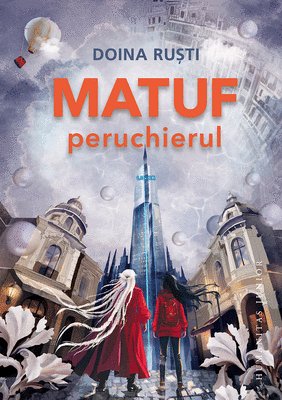
The historical setting of D.R.’s novels is merely a broad, approximate framework, allowing the narrative to slip effortlessly into a kind of ahistorical, magical time, where a world of overwhelming authenticity comes to life. More
Dumitru Mircea Buda
Critical Reception
The closest point of comparison is David Mitchell’s Ghostwritten, in which nine narratives move from one place and consciousness to another, while peripheral characters and seemingly minor events forge the connections between them. In Cloud Atlas, Mitchell similarly nests six stories within one another, moving across different historical periods and genres. Yet Mitchell’s architecture is visibly constructed as a network or a symmetrical mechanism. In Doina Ruști’s work, the shifts in narrative voice seem to arise from within the story itself: a character enters the narrator’s field of vision and, almost organically, takes over the right to tell the tale.
Another possible parallel is Jennifer Egan, particularly A Visit from the Goon Squad and The Candy House. Egan moves central characters to the margins and brings to the foreground figures who seemed secondary in earlier chapters. She also shifts registers and narrative forms according to the consciousness of each character. In Egan’s fiction, the result is a social and emotional network; in Matuf, it is a chain of cause and effect. Each narrator does more than carry the story forward: each alters its past.
Through its journeys across centuries and the way distant destinies converge into a shared history, the novel may also recall Emily St. John Mandel’s Sea of Tranquility or Anthony Doerr’s Cloud Cuckoo Land. In Mandel’s novel, time is traversed by an anomaly that calls the very nature of reality into question. In Doerr’s, five characters from different eras are connected by the survival of a book. In Matuf, what binds the centuries together is neither a manuscript nor an abstract anomaly, but a living street, inhabited and endlessly remade.
The novel’s layered construction of reality may also bring to mind Christopher Nolan’s film Inception, particularly in the way each level transforms the meaning of the one before it. The resemblance, however, is architectural rather than thematic: in Nolan’s film, the descent takes place through layers of dreams, whereas in Doina Ruști’s novel, the movement occurs between historical periods, memories, and successive versions of the same world.
Yet Doina Ruști differs from these models in the importance she gives to the spoken voice. Her narrators are distinguished not simply by what they know, but by their rhythms, vocabulary, comparisons, humour, and ways of perceiving the material world. Nane notices food, clothes, and gestures. Ani notices brands, behaviour, and social codes. Beyond these distinctions, there is a narrative rhythm that keeps the reader firmly engaged in the unfolding story.
Each character has a spontaneous movement of their own, a distinct way of deciding what matters. Doina Ruști does not distribute a single voice among five bodies; she creates five different ways of defining reality.
Elena Simion, Cultura, September 24, 2026
The novel puts forward a powerful idea: revelation is born not only of brilliant minds, but also of mistakes, imperfect copies, and misinterpretations. The posthuman future imagined by Doina Ruști has no pure beginning. Its revered Creator is gradually stripped of his sacred status, while the substance of the myth turns out to be a family history distorted by time. The civilisation of the people of light is not the work of a sovereign intelligence, but the result of an unintended collaboration between two memories and countless accidents. Ultimately, every god is a reconstruction, and every creation a copy that has forgotten its original.
But beyond these ideas lies the story itself, the most important element in Doina Ruști’s novels. Here, too, she remains faithful to it. The novel’s architecture and its five impeccably crafted voices complement one another beautifully, moving at a brisk pace, without digressions or pauses. Its meaning emerges through the overlapping testimonies, much like the successive layers of Lipscani Street.
Yet what is ultimately at stake in the ending is not technology, but morality. I won’t give away any spoilers, but the ending is genuinely impossible to foresee. Instead of a heroic conclusion, the novel offers a quiet emancipation.
Matuf, the Wigmaker is more than a historical fantasy for teenagers. It is a crossover novel about artificial intelligence, but also about memory and the myths that the future constructs from fragments of the present. Beyond time portals, magical wigs, and people of light lies a profound question: if we discovered that our world had come into being through an error, would we try to correct it, or would we learn to live in it?
Mara Vlad, Ficțiunea, No. 132, 2026
A novel of transformation and time travel, Matuf, the Wigmaker proves to be a work of fiction steeped in elusive mystery, period atmosphere, and metaphysical unease. The disappearances defy explanation, memories of previous lives are lost, and even the Creator himself falls victim to a band of Scoundrels. Everything unfolds at a breathtaking pace, and no one can truly grasp the gravity of the consequences that mistakes may bring. Yet the feeling that remains at the end is that good prevails, even by indirect paths and through means unknown to those outside the story.
Mihaela Nicolae, BookHub
I was reading Matuf, the Wigmaker with the admiring wonder of a seasoned reader, struck by the versatility of its style: from the rich sensory refinement of the Phanariot world as seen through the eyes of Nane, the curious teenager who will travel through time, to the fast-paced perspective of Ani, herself a teenage girl, who must explore an era already alien to the modern world she inhabits in order to help Nane, the wanderer; or to the reflective tone of Matuf, who brings together the perceptions of a future world—concepts, observations, analyses—unexpectedly shifting the angles from which we understand it.
I say I was reading because I was already well past the halfway point and was looking forward to the ending, making predictions, as I usually do.
The meeting in the Great Hall brought a new perspective, through which I came to interpret the rest of the novel.
Three beardless men wait at the crossroads of summer, catching travellers in their nets. Stories unfold and come to an end, yet their evanescent silhouettes continue to hover in the memory of events, bearing witness to illusion and seduction.
In the company of these three beardless men, I followed the story to its end, paying closer attention to the words from which the story itself flows than to the sequence of events it recounts.
Mona Coțofan, Timpul


