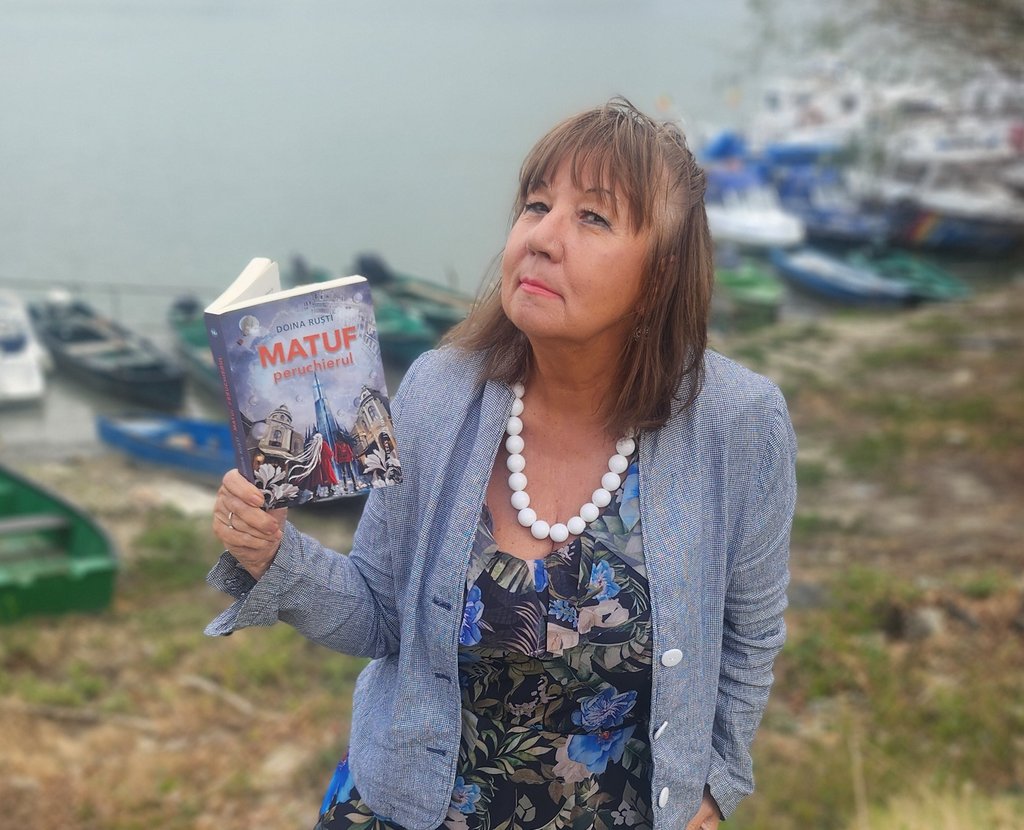
In Revista Cultura, Elena Simion publishes an extensive review of Matuf, the Wigmaker, focusing especially on the construction of its six stories, the continuous shift of narrative voices, and the way Phanariot Bucharest gradually comes into contact with a post-AI world.
The review, entitled “Six Stories, Five Storytellers, and a Single History in Motion,” begins with the mystery of the wigmaker who appears on Lipscani Street during the reign of Nicolae Mavrogheni and moves toward questions of artificial intelligence, memory, identity, and posthuman civilizations.
Read the full review in Revista Cultura
For Elena Simion, one of the novel’s central achievements lies in the architecture of its voices. Matuf, the Wigmakercontains six stories and five storytellers — Nane, Ani, Zinca, Linor, and Matuf, who returns as narrator in the final section — but these voices are not simply placed side by side.
Each storyteller first appears as a character in someone else’s story, only to take over the narrative later. And with every change of voice, reality itself changes.
Nane sees Matuf as a possible sorcerer. Ani meets Nane in contemporary Bucharest and tries to explain him using the categories of her own world. For Matuf, both of them belong to a primitive biological humanity. Zinca reaches a time in which the previous worlds have already become history, while Linor, in turn, alters everything the reader thought they knew.
None of the storytellers possesses the complete truth. Each sees the world from within their own place and time.
Elena Simion memorably describes this feature of the novel: rather than placing the same voice inside five different characters, it creates “five criteria of reality.”
“Although the street separated us, I could see his eyes fixed on the window, and for a moment I thought he smiled at me. I dropped the curtain at once. Of course he had seen me, after the way I had been staring. I glanced again through the curtain, with the feeling that the wigmaker’s eyes were still fixed on my window. Good Lord, I thought, could he actually hear my thoughts?”
— Matuf, the Wigmaker
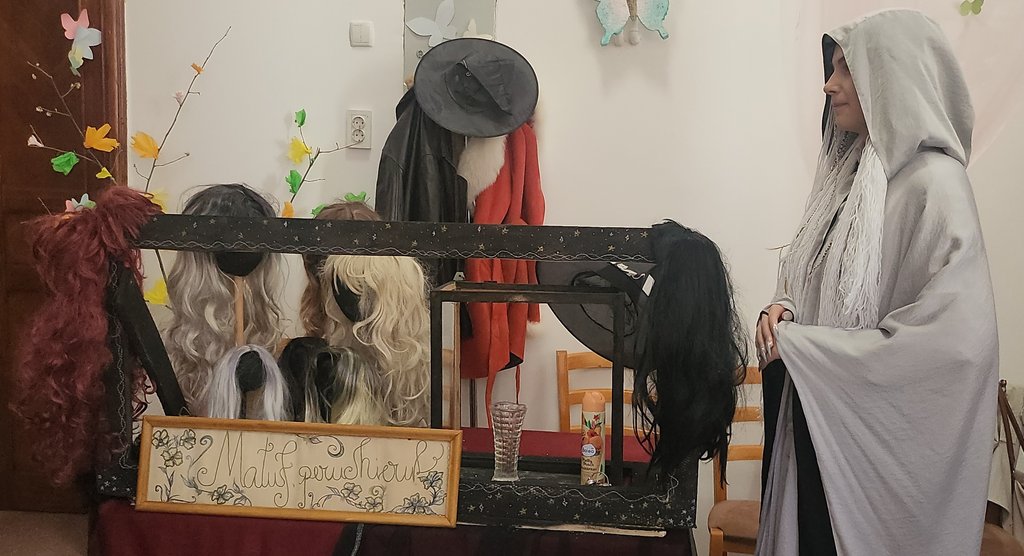
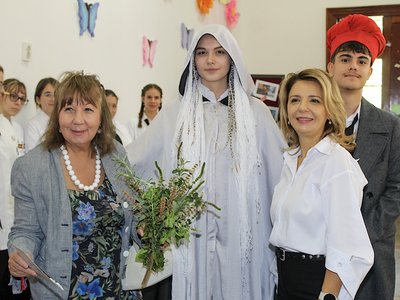
Children dressed as characters from Matuf, the Wigmaker, Costache Negri National College, Galați
Everything begins in a historically recognizable Bucharest. Bread and pumpkins are baking, sleighs pass through the streets, merchants open their shops, children go to lessons, and on Lipscani Street an unknown wigmaker appears, with white hair braided into small plaits.
In Elena Simion’s reading, the fantastic emerges precisely from the ordinariness of this world. The anomaly does not interrupt everyday life. It mingles with smells and daily routines.
Nane, the first storyteller, knows no more than the reader. He watches, guesses, hesitates. Matuf’s mystery is born from this limited perspective.
But the novel does not remain for long within the story of a sorcerer in Phanariot Bucharest.
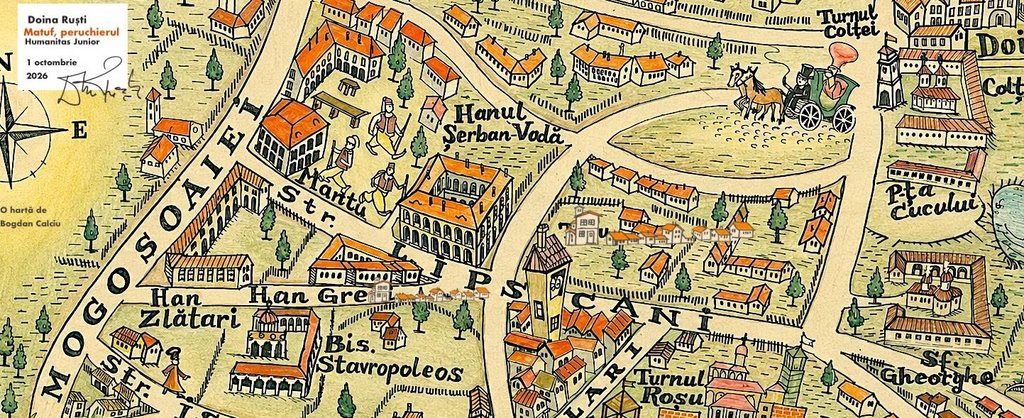
“My piece looked glazed with amber, while Rățoi’s was nearly burnt, just the way he liked it. As we took our pumpkin, I stole a glance at Zinca. I could see her vaguely, talking to her father somewhere deep inside the tavern, and it seemed to me that every now and then she was looking my way. She had taken off her collar, which meant she would spend that day in the kitchen, and for a moment I thought of her fingers, unbelievably long, chopping onions.”
— Matuf, the Wigmaker
The move into Ani’s story abruptly changes the perspective.
Nane arrives in contemporary Bucharest. The world that had until then represented the full reality of the novel suddenly becomes impossible, while what the reader recognizes as the present appears to him monstrous and incomprehensible.
Ani has a phone, uses social media, and speaks the language of her own time. For her, Nane is the anomaly.
Elena Simion sees more in this encounter than a simple comic effect. Every age considers itself modern and tends to believe that it possesses the most advanced form of the world. Seen from the future, however, Ani’s technology will also become archaic.
This leads to one of the questions the review draws from the novel:
“Does what we call progress really represent superiority, or merely an age’s inability to see its own provisional nature?”
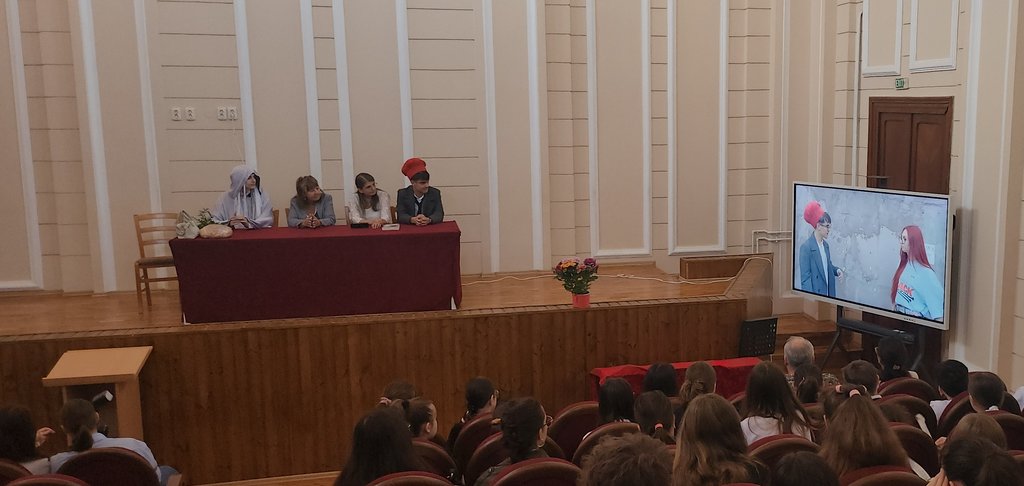
A film about the meeting between Nane and Ani, made by students from Costache Negri National College in Galați.
When Matuf begins to tell his own story, the convention changes once again.
The wigmaker who seemed all-powerful in Nane’s eyes turns out to be vulnerable, sentimental, sometimes awkward, and himself subject to the rules of another world.
“This is where one of the novel’s most fertile reversals occurs.”
— Elena Simion, Cultura
His white hair is alive. It can enter people’s minds, and this detail contributes directly to the construction of the conflict.
Although the novel began on a street in the age of Mavrogheni, it transforms into a fiction about archives, hybrids, memory, and posthuman civilizations.
“Master Limes was standing in front of the house, hovering at a certain distance, just enough to show us the respect that, at the time, I was fully convinced I deserved.
When I arrived, he smiled at me, probably exactly as he had smiled at those who had come before me, then showed me with his eyes where my place was. It was not difficult to find. I immediately saw my name, written in blue lights above the disc the master had prepared especially for me. I stepped into the middle and waited for the others to arrive, all of them, like me, candidates for Cycle I.”
— Matuf, the Wigmaker
One of the most interesting aspects of the review is Elena Simion’s attempt to place the novel’s construction alongside several important forms in contemporary fiction.
Her comparisons concern not the subjects themselves, but the architecture of the story.
The closest model, in her view, is David Mitchell, especially Ghostwritten and Cloud Atlas.
In Ghostwritten, stories move from one space and one consciousness to another, while peripheral characters create connections between narratives. Cloud Atlas, in turn, crosses different periods and genres through six interconnected stories.
Elena Simion also notes an important difference: in Mitchell, the mechanism of construction appears as an elaborate network, while in Matuf the shift of narrator seems to grow from within the story itself. A character enters the field of vision of one voice and, in the following section, begins to speak in their own right.
Another comparison is made with Jennifer Egan, especially A Visit from the Goon Squad and The Candy House.
Egan also moves characters from the margins into the centre of a new story and radically changes the narrative register according to the consciousness speaking.
Jennifer Egan – The Candy House
The difference identified by the reviewer is again significant: Egan’s novels create a social and emotional network, while in Matuf the voices form a causal chain. Each storyteller not only continues the story but also changes the meaning of what came before.
Through its movement across different periods, Matuf may also recall Sea of Tranquility by Emily St. John Mandel, where lives separated by centuries are connected through a temporal anomaly.
Emily St. John Mandel – Sea of Tranquility
In Matuf, however, the connection between times is not an abstract anomaly.
It is a place.
In Cloud Cuckoo Land, Anthony Doerr follows five characters from different periods, linked by the survival and transmission of a book.
Anthony Doerr – Cloud Cuckoo Land
In Doina Ruști’s novel, Elena Simion observes, the different times are connected not by a manuscript but by a street that is inhabited and endlessly rebuilt.
Lipscani (video)
“The value of the book lies first of all in the way it turns its ideas into action. The novel does not set human beings against artificial intelligence, nor does it interrupt the adventure in order to demonstrate its theses. Questions about freedom, memory, and identity emerge from the destinies of the characters, from their mistakes, and from the way the story passes from one voice to another. The complexity of the construction enhances the pleasure of reading, while the spectacular worlds traversed generate, at least from my perspective, emotion.”
— Elena Simion, Cultura
In the conclusion of her review, Elena Simion sees one of the novel’s distinctive features in the bringing together of two territories rarely found within the same story: the sensuous, concrete Phanariot imaginary and post-AI fiction.
Between them lies the same street, the same need for story, and characters who, each within their own time, try to understand what is real.
Six stories thus build a single history in motion.
Elena Simion
“Six Stories, Five Storytellers, and a Single History in Motion”
Revista Cultura, 24 September 2026
Doina Ruști, Matuf, the Wigmaker
Humanitas Junior, 2026
All reviews of Matuf, the Wigmaker