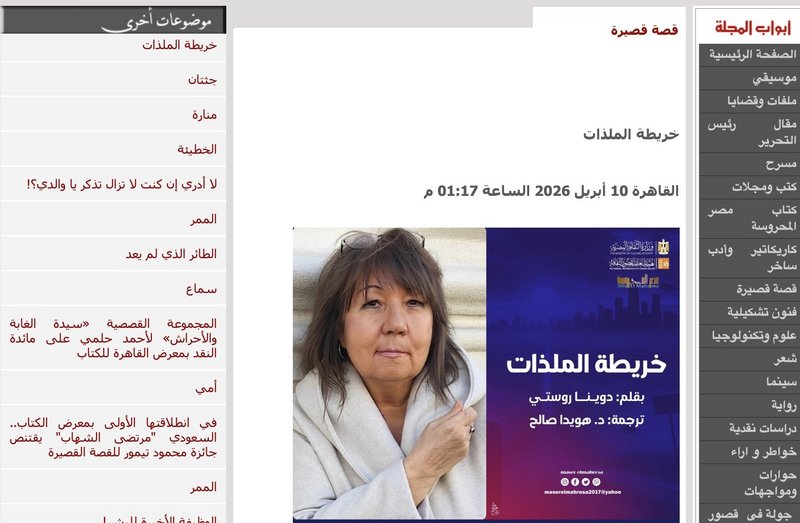
Romanian novelist Doina Ruști is now present in the Arab cultural space through the publication of her short story The Map of Debauchery, recently translated into Arabic and featured in the cultural magazine Misr Al-Mahrousa in Cairo, one of the significant platforms of contemporary Egyptian literary life.
The translation is signed by Dr. Howaida Saleh, a prominent novelist, essayist, and translator, known for her contributions to contemporary Egyptian literature and for her critical work addressing major themes such as feminism, marginalization, and identity, but above all for her dense, powerful prose.
Author of numerous volumes — including Girls’ Love, Amrat Al-Dar, Room 13, Houses Inhabited by Spirits, Passageways of Loss, Three Paths to Happiness, and Beit Al-Kholoud: The Secret Life of Farida Al-Mufti — Howaida Abdelkader Saleh is also a professor of aesthetics at the Faculty of Theatre in Cairo and editor-in-chief of the cultural magazine Misr Al-Mahrousa. Her work as a translator includes, among others, Oscar Wilde, as well as contemporary American fiction.
Misr Al-Mahrousa is a cultural magazine supported by official institutions in Egypt, with wide circulation in literary and academic circles. The publication promotes contemporary literature, critical studies, and intercultural dialogue, bringing together established authors and emerging voices from the Arab world and beyond.
The publication of a literary text in such a magazine marks an important opening toward a new readership and strengthens the presence of Romanian literature within the global circuit.
The short story The Map of Debauchery was first published in 2023, in the volume The Libertine of Gorgani (Litera). Here, Doina Ruști revisits her central themes: the city as a space of temptation, eros as a form of knowledge, and alterity.
The narrative begins in a marginal, memory-laden place — a garden grown over the ruins of an old cemetery — where the destiny of Elina, a young maker of ceremonial headgear, is radically transformed by a mysterious encounter. From that moment on, the city alters its invisible structure, reducing itself to a few essential points that become a secret map of passion and initiation.
Written in a dense, sensorial style with fantastical undertones, the story explores the fragile boundary between reality and inner experience, in a Phanariot Bucharest reimagined as a territory of seduction and metamorphosis.
“Everything began behind St. Sava Church, where at the time there was a patch of wild growth, a remnant of an old cemetery. A few old stone crosses could still be seen. There, beneath a blueberry bush, began the immortal life of Elina, the maker of ceremonial caps.
Married for only a few months, this woman — who through her deeds would come to draw a map of rare pleasures — made a daily journey through the city, for her husband was a renowned hat-maker, so devoted to his craft that every cap he created was a masterpiece, a rare object.”
Read the full short story below.
This publication confirms the sustained interest in Doina Ruști’s prose across diverse cultural spaces and continues the international trajectory of her work, already translated into numerous languages.
The Arabic publication adds a new dimension to this circulation, opening her literature to readers in the Middle East and strengthening the dialogue between literary cultures.
This publication is part of a recent dialogue between the author and the Arab cultural space. Over the past year, Doina Ruști has appeared in Cairo-based publications through interviews (Al-Mahalla, Harf , Misr-El-Mahrousa)) and editorial collaborations, giving this translation an additional significance: it is not a debut, but the consolidation of a literary relationship currently taking shape.