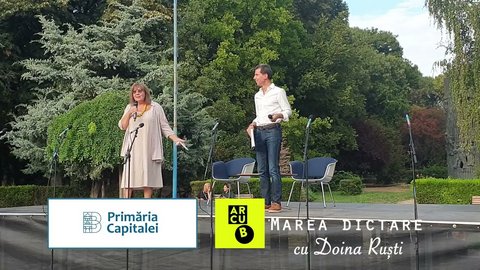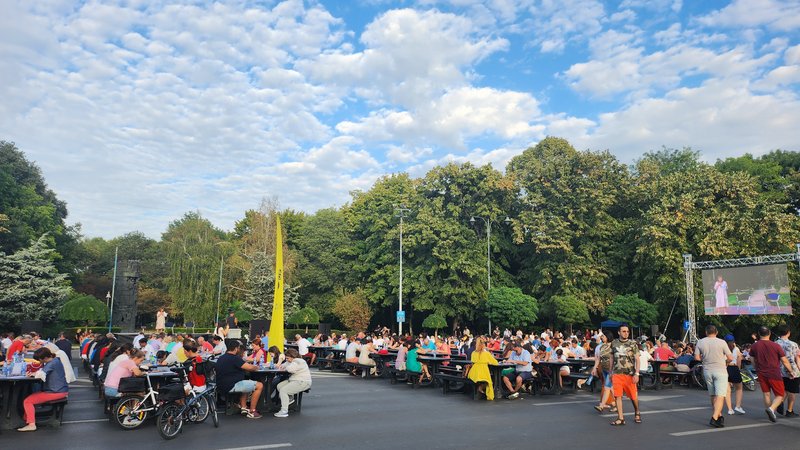
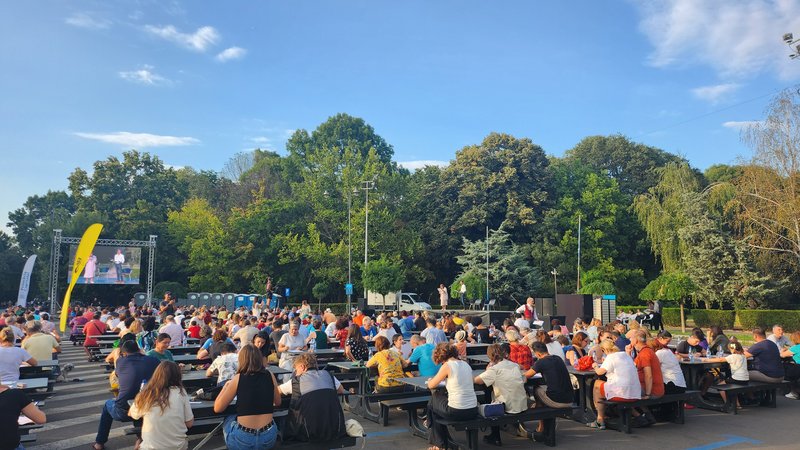
On a late summer afternoon, literature stepped out of the book and became a collective act. Around 600 people gathered on Șoseaua Kiseleff and wrote, at the same time, following my voice.
The meeting took place on Romanian Language Day, in 2023, as part of one of the Capital’s most beloved programs, Open Streets. I was invited to lead a public dictation—simple, yet rare: a way of restoring the direct connection between writing and hearing.
This invitation made me see myself arranging words, dressing them in silk garments and sandalwood hats, so that once they reached the people gathered on the avenue, they might change their clothes, re-dress them in other silks and velvets, and the next day, meeting these words again in the city, I might feel the true value of our encounter on Kiseleff.
So I wrote a story especially for this moment, about the miracle of encounters, in the Bucharest noons of all times.
The story is called The Greyhound, and I offered it, in a shortened version, to every brave person who came all the way to the avenue to write by hand.
Today I have decided to place it here, in its full version—as an album photograph, as a literary act, as a museum object. But above all, as a bond of blood that can no longer be undone.
THE GREYHOUND
by Doina Ruști
Written especially for Romanian Language DayAmong the goods sought after in the Ottoman Empire were the greyhounds bred in Wallachia—hunting dogs, also known as quail hounds, slender, delicate, agile, and capable of forming deep bonds with their masters. I learned this from several documents listing gifts for Ottoman officials, great admirers of greyhounds, who were convinced that among the quails there lurked a spirit of poisoned noons, one that only the Wallachian greyhound could capture.
In any case, I have read so much about these greyhounds that we might as well place them in mythology, alongside dragons.
My interest in greyhounds begins with a complaint filed by an arnăut, who claimed that his quail hound had disappeared. The man owned a beloved dog, who accompanied him on walks and hunts—one Anton, that was the dog’s name—tall, ash-white, with human eyes.
On a Tuesday, in the year 1740, Anton vanished from beside the steps, where he had been lying until then, curled like an Armenian pastry. The master (his name had been erased, and I did not trouble myself to recover it) was calmly smoking on the house steps, thinking of whom to sell the fifty quails he had recently caught, when, around noon—when from the gardens the ghosts of boredom rise lazily—he suddenly realized that Anton was nowhere to be seen, although the trace of his tail, which had swept the ground, clearly showed he had not been gone for long.
The complainant ruled out the possibility that Anton had simply wandered off: even if his mind had not been entirely present, his eyes had gone nowhere—he would have seen, he would have sensed the movement, if there had been any. Under the circumstances, things were not normal at all. Something unclean was at work. Anton was not a dog to stray aimlessly. If whistled for, he would come even out of a snake’s mouth. There was between them a bond more than human; that is why he sensed that something grave had happened to Anton. All the more so as, not long after, he saw at some distance a bird with large eyes, with a bluish extension along its beak, giving the impression that it was smiling. Where has one ever seen a smiling bird? It was a demon, one of the many apparitions of our Bucharest noons.
The complaint of the arnăut was not taken seriously. The clerks at the Divan’s chancery smirked and made impolite remarks. The document has survived to this day by chance. In the margin of the complaint it was carelessly noted that Anton had eventually been found.
Yet around that same time, someone else had reported a similarly strange case. In fact, it was more of a letter, sent to Voivode Moruzi, in which the same dog—Anton—was mentioned. A few days earlier, writes the author of the dispatch, I found myself at the gate with a stranger, a man thin and sharp-faced, like a greyhound. Though he did not seem entirely sound of mind, he could not be called mad, nor foolish, nor even slightly deranged, with his mind on fire or anything of the sort. He was simply odd. My name is Anton, he said, and an hour ago I was a dog. He spoke seriously and with such conviction that it was difficult to mock him. Though he claimed to remember where he had lived before, he could not indicate an area, nor recall the name of the street. Apart from his own, he knew no names. For a few days he stayed in the yard and made himself useful. Above all, he liked to sweep, and he had a style—as if he were dancing.
Then he disappeared; he was not seen again. Yet yesterday, the author continues, toward evening, I met a dog. It was a pale greyhound, rather tall, accompanied by its master, a young arnăut with a rifle slung over his shoulder. I swear on my heart, writes the author, that from a distance I realized that dog was Anton, my strange visitor. First of all, he recognized me and came toward me—not to fawn, as dogs do, but to look me in the eyes. He was not looking at me, but into my brain. Is that Anton? I asked the arnăut, and he confirmed it, moving on, somewhat haughtily, it seemed to me.
The author of the letter requested that the matter be investigated in detail, which would have led to discovering where the arnăut lived with Anton, his unclean greyhound.
The letter received no reply; it remained stuck to the back of a contract.
This would have been the story—one episode in the series of Bucharest noons—had there not also been the note left by Eleni, ten years later.
She writes in the margin of a book that her husband suffered something one day while chasing quails. He had made himself a net, of which he was very proud, and had gone out into the stubble field, where dozens, perhaps hundreds of quails swarmed, easy to catch, so that it would have been a pity not to run after them. Eleni held the sack nearby, while her husband watched the cut stalks intently. The quails darted about with mad speed in all directions. Then one appeared, somewhat larger, and remained still. It was an earthy bird, but on the crown of its head there fluttered a tuft of human hair, golden. They both froze, and then the bird, which was no longer a bird, twisted like a whirl of water, and as it grew, becoming like a vortex and like an abyss, her husband vanished.
The field lay empty, and at some distance the quail net was lying abandoned. She never saw him again, and from that day on, every year on Saint Anton’s day—for that was her husband’s name—Eleni took up the habit of writing the story anew, on a wall, on a rag, on the margin of a book.
I am also including here the video of the meeting, which preserves the opening fragment of the event. Recorded live, without staged intervention, it functions as a document of the moment.
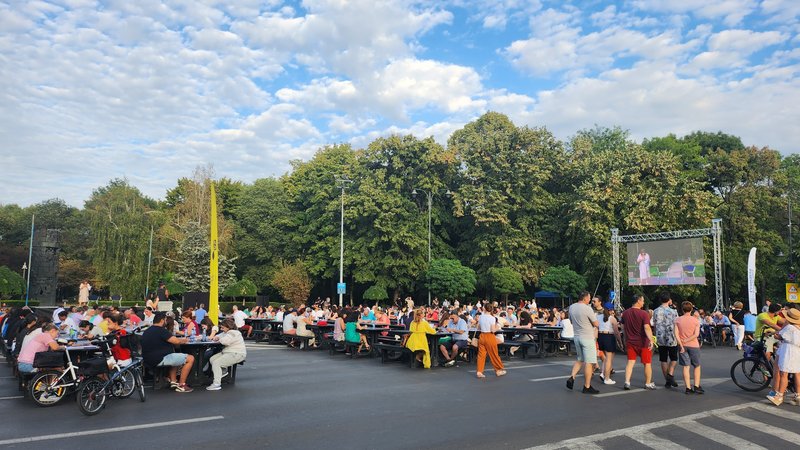
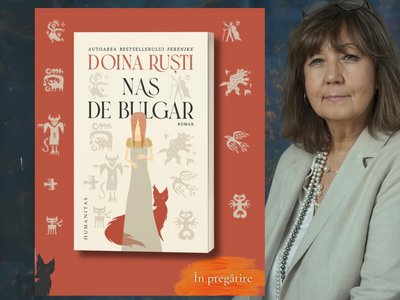
The experience of this dictation became the starting point for a series of encounters in other cities and, more recently, for the performative format of the tour The Five Stories (derived from the novel. Bulgarian Nose.
Other dialogues with Marius Constantinescu:
The moment was picked up and discussed across multiple media appearances:
Municipality of Bucharest - site
Muzeul Literaturii Românedin București
Alexisme (Alexa Stănescu)
Timp Românesc etc.