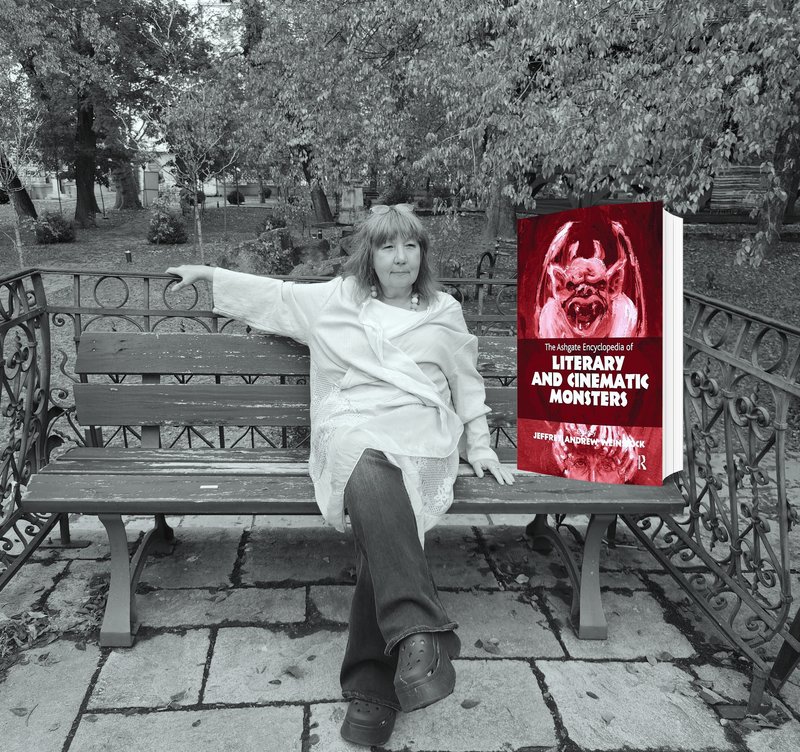
In The Ashgate Encyclopedia of Literary and Cinematic Monsters (Routledge, New York, 2016), edited by Jeffrey Andrew Weinstock, the novel The Ghost in the Mill is analyzed as a form of neo-Gothic, characteristic of late East-European postmodernism. Cited in two places—see page 550 of this major international reference work—the novel is placed within a comparative framework, alongside The Carpenter’s Pencil by Manuel Rivas, highlighting its relevance within a transnational genealogy of narratives featuring symbolic monstrous figures.
In Weinstock’s reading, The Ghost in the Mill stands at the intersection of post-communist memory and the Gothic imagination, revealing a complex narrative architecture marked by baroque accents and an intensified aesthetic effect—defining features of the neo-Gothic mode. Here, monstrosity does not emerge as a supernatural anomaly, but as a structural response to the violence and psychological pressures of communist totalitarianism.
The novel is thus interpreted as a form of East-European neo-Gothic specific to late postmodernism. This classification situates it within an international comparative framework, emphasizing how the Gothic imagination becomes a tool for exploring post-communist memory, trauma, and historical monstrosity.
The ghost is not a singular presence, but a multifaceted one, reflecting the various forms of oppression embedded within everyday normality. There is a single character, generically named Max, whose metamorphoses unfold gradually within ordinary reality. His multiple transformations illustrate how the Gothic is reactivated within a precise historical context, where trauma generates monstrous doubles rather than external terrors.
This critical classification confirms that The Ghost in the Mill belongs to a broader genealogy of modern Gothic, in which East-European literature contributes distinctive forms rooted in history, memory, and narrative complexity.
The Ashgate Encyclopedia of Literary and Cinematic Monsters, edited by Jeffrey Andrew Weinstock and published by Routledge, is a key reference work in cultural and literary studies devoted to the figure of the monster.
The concept of the Neo-Gothic is theorized independently by Dan C. Mihăilescu, followed by Raluca Andreescu and Jeffrey Andrew Weinstock, and is later used as a reading framework by other critics of Doina Ruști’s work — such as Elena Crașovan and Christine d’Anca — especially in analyses of the novels Zogru and The Ghost in the Mill. In these interpretations, the reflexes of communist censorship, secrecy, and the fear of naming things directly are transformed into a form of post-communist fantasy designated as the Neo-Gothic.
Other studies that discuss the Neo-Gothic dimension of the novel The Ghost in the Mill, or identify similar tendencies in other works as emerging from post-communist literature — as a response to censorship and totalitarianism, and as a means of recovering collective memor:
Raluca Andreescu, The Ghost of Communism Past The Birth of Post-Communist Gothic Fiction, Zittaw Press, 2011;
Christene d’Anca – “Mediating a Loss of History…”, Journal of European Studies, Sage, 2018
Dan C. Mihăilescu – Literatura românească în postceaușism. II. Proza, cap. „Realismul apocaliptic și deriziunea”, Polirom, 2006
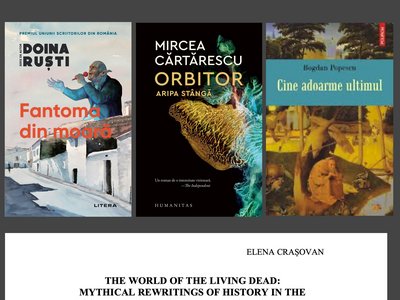
Elena Crașovan – The World of the Living Dead: Mythical Rewritings of Hystory în the Postapocalyptic narratives about Late Communism, Dacoromania Litteraria, 2017
Excerpt from The Ghost in the Mill, published in the journal YouTube Impossible Voice
Updated 2026
Critical reception; Bibliography; Further studies on The Ghost in the Mill