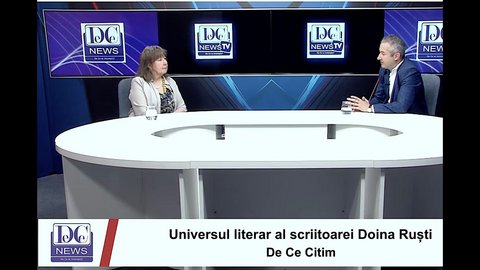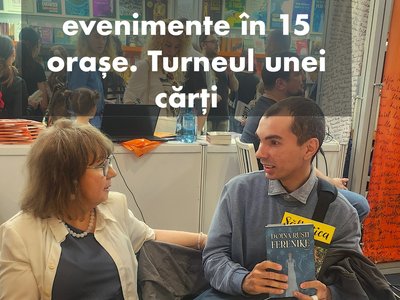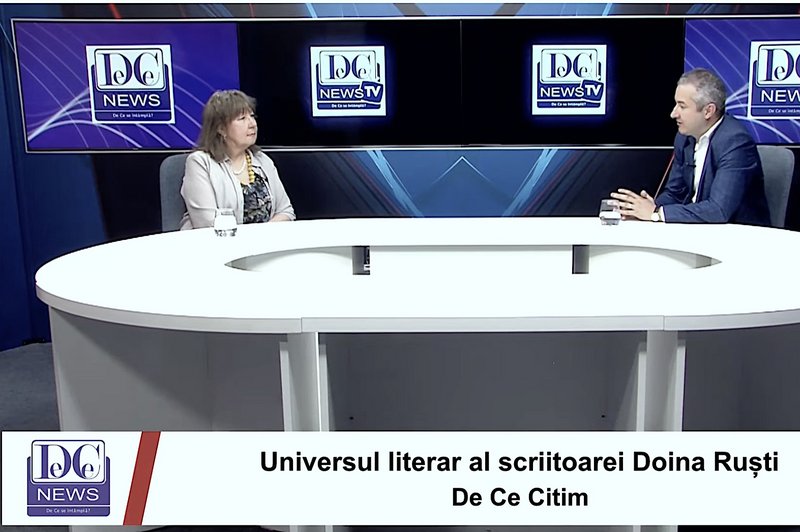
In June 2025, Doina Ruști was Flaviu George Predescu’s guest on De Ce Citim (Why We Read), broadcast by DC News and DC News TV.
The conversation begins with Ferenike and Zavaidoc in the Year of Love, but quickly opens onto broader subjects: the making of a writer, literary models, individual style, epigonism, the relationship between experience and fiction, and, above all, the pleasure of constructing a novel.
For Doina Ruști, writing is not primarily a social act, nor is it a path towards publication, but a game of construction. A novel means conflicts, possible paths, rules, choices and, ultimately, the satisfaction of seeing the game through to the end.
She compares this pleasure to that of a card player, intensely engaged in every stage of the game and, above all, in the exhilaration of its outcome.
For her, the true pleasure lies in the construction itself.
This also explains why she changes her approach from one novel to another. Doina Ruști says that no two of her novels are written in the same register, because every story demands its own tone and its own pattern. Repeating a formula that has already worked would simply mean boredom.
One of the most categorical ideas to emerge from the conversation concerns epigonism.
In Doina Ruști’s view, intellectual formation has no prescribed age. A person may discover literature very early or may find their true path at fifty. What matters is what they do once they get there.
Discovering a great writer late in life does not mean that you should begin writing like them. On the contrary, the essential rule is to create something new:
“To be a writer, you have to move beyond what has already been written.”
You may read Dumas, Balzac, Breban or any other major literary model, but not in order to reproduce their literature. Reworking, however skilfully, a formula that has already been exhausted remains “the work of an epigone.” A writer must be capable of “writing the life of tomorrow”, in a recognisable style that belongs to them alone and cannot be mistaken for anyone else’s.
The same principle governs one’s relationship with literary models. To admire a writer also requires the effort not to resemble them. For Doina Ruști, the real competition is not so much with other writers as with one’s own system of values, with the literature one admires, and with the standards one has set for oneself.
In the part of the interview devoted to Ferenike, Doina Ruști speaks of the novel as the beginning of a larger construction, born from a number of essential things she has learned over the course of her life.
The first is our relationship with life, memory, time and, above all, death. Yet Ferenike was not conceived as a book of mourning or lamentation. On the contrary, the intention was to create an energetic novel, with narrative tension, a climax and a resolution, while beneath the story lies the persistent presence of nothingness.
The title itself receives a symbolic explanation in the interview: Ferenike, “the bearer of victory,” paradoxically becomes the name of that shadowy region within us that draws us towards the idea of disappearance.
Ruști also rejects the notion that a book should have a single “message.” Literature, she argues, should not tell the reader what to think. Emotion comes first; ideas emerge afterwards, and they belong to the reader.
Zavaidoc in the Year of Love grew out of material that had remained outside Ferenike. After finishing the novel, Doina Ruști felt that certain areas of the story and some of its characters still demanded another narrative.
This led to her interest in Mițulica’s adolescence, Mițulica being one of the important characters in Ferenike. From this impulse came Carol, the teenage girl in Zavaidoc in the Year of Love, and around her emerges the Bucharest of 1923, when Zavaidoc was at the height of his fame.
Her research led Doina Ruști to the newspaper Universul, where Zavaidoc’s name appeared constantly in accounts of Bucharest life. Beyond the historical figure, however, the novel becomes a recovery of the interwar world and, above all, a book about love.
The novel’s three confessions create a luminous world, deliberately intended to counterbalance the painful, shadowy territory of Ferenike.
After the world of 1923, the same creative impulse carried her into another historical period. Doina Ruști wanted to see the character of Mițulica against the background of the Stalinist era.
This is how The Wild Girl (Sălbatica) came into being, a novel for young readers about the deportations to the Bărăgan, constructed through the two confessions of teenagers who come from different worlds.
Ruști herself explains the connection between the three books in a simple sentence:
“You cannot write only about yourself; you need context.”
Beyond the discussion of individual books, the De Ce Citim interview outlines a kind of literary credo.
For Doina Ruști, writing means play and construction, but also a constant confrontation with one’s own values. Literary models are necessary, reading is fundamental, and admiration for great writers is part of one’s formation. But at some point, all of these must be surpassed.
A writer does not continue someone else’s literature. A writer does not remake a book they have admired, nor turn their own biography into a belated version of an already existing formula.
They have to move forward.
To write the life of tomorrow.
A writer and presenter of cultural programmes, Flaviu George Predescu has been a contributor to DC News since 2015; De Ce Citim was launched in 2020 by Predescu together with literary critic Daniel Cristea-Enache.