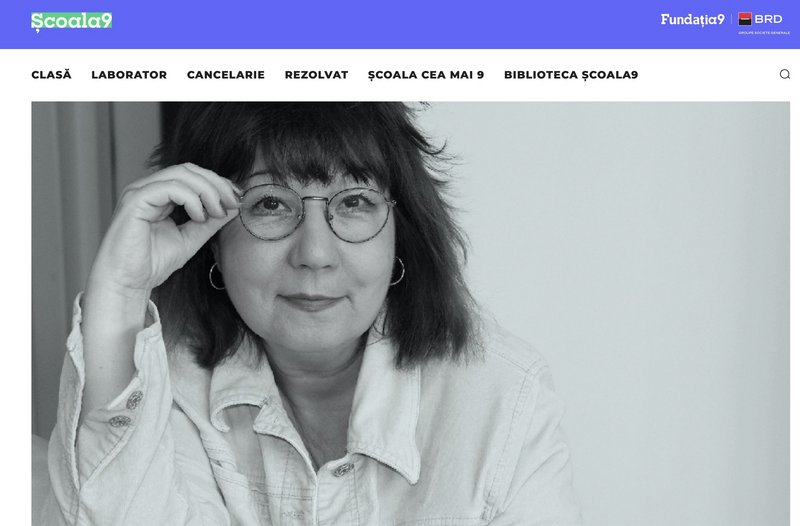
Today I remembered an interview for Școala9, in which I said that “it would be absurd to ask today’s children to keep Ion Creangă on their knees, but I have no doubt they will reach him by other paths.” That does not mean they will not reach the classics, the foundations. It always happens; without this return, there is no history.
Each generation carries its own memories of school. As for me, the school of my childhood does not mean disputes, contests, or curricula, but my white dip pen. The patience of dipping the nib again.
Perhaps school begins exactly here.
The white dip pen, brought from Ogrezeni, seemed providential to me. With it one could write the truth. I did not have to insist much for it to be given to me, especially since, for Cornel, the well-sharpened pencil ranked first. He used it often, calculated, drew rows of numbers. He wrote in an orderly way, and here I must say that handwriting is inherited. The pattern, the way one occupies space, as well as the ability to draw—these are genetically programmed. Mițulica wrote in rounded letters. She had a special, inimitable script, upright, occasionally leaning deliberately to the left. It looked like lace fit for framing. Impossible to overlook. Gică’s calligraphy was classical: letters leaning to the right, large, legible, a teacher’s handwriting. Their children had inherited Gică’s hand; Cornel in particular wrote exactly the same, almost to the point of confusion, except for the letter C of his name, shaped like a crescent with an eye. Muc’s handwriting was hesitant and undisciplined. I inherited hers and struggled for years to impose order on it. My many writing exercises gave me a certain versatility. In exams I automatically entered Gică mode, painting page after page in careful calligraphy. When writing prose, I fell into Muc’s faults, and when I wished to impress, I imitated Mițulica’s letter forms. That lasted until the 1990s, when I attached myself to a PC and used a pen only occasionally. Handwriting still gives me comfort, though one tinged with mildew and decrepitude.
The white dip pen from Ogrezeni belonged to my first literary exercises, to my first story written on lined paper. Even now its memory brings back Ogrezeni—happy, floating, childless people. Sometimes, when I write by hand, I feel the shadow of the white pen drifting beside me, along with the snow of that winter.
With the white dip pen I wrote my first name.
In the winter that became a threshold between myself and the fatal year, all changes are linked to that white pen, to the way I moved it across the page wherever I wished. It was slender and very light, and where my fingers rested it had small ridges that made it comfortable. But even more I loved the nib, longer than others, narrower, without roughness, without scratching the page. I would look out the window at the snow covering the kiosk and the entire garden, and something infinite descended into the nib; sometimes I felt a god of snow guiding my hand. That pen imposed a rhythm, a cadence; I began to elongate my letters, to thin my script.
It was a pen of winter and of stories.
Yet every creative impulse comes with renunciations, with unexpected desires, once hidden beneath fans of flesh.
(Ferenike)
Read also the interview in Școala9