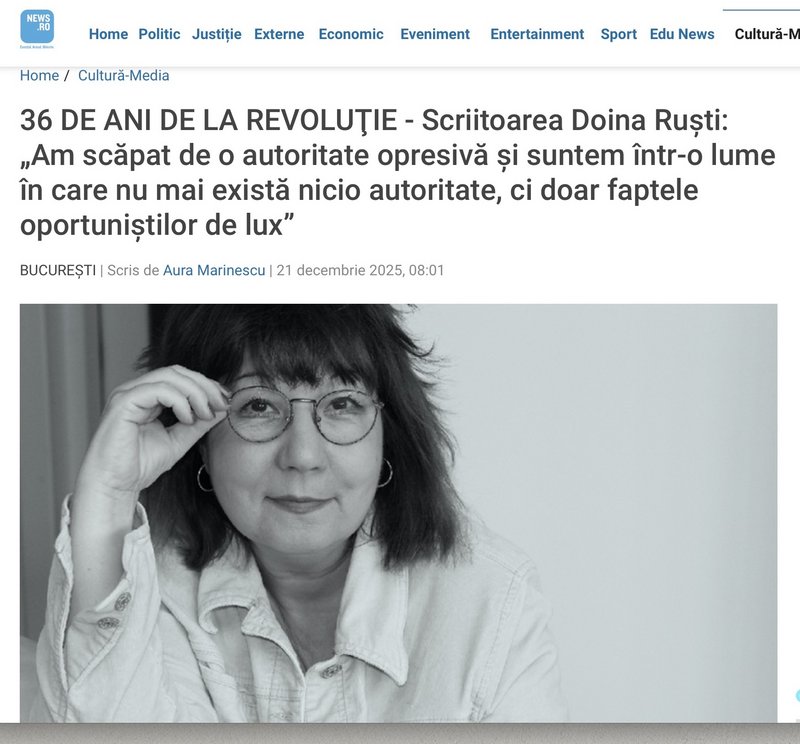
In an extensive interview with the Romanian press agency News.ro, Doina Ruști offers a personal and lucid analysis of everyday life during the last thirty years of communism and the profound transformations that have shaped Romanian society after 1989.
The interview reconstructs the atmosphere of an era marked by total control: mandatory job assignments, rigid work schedules, shared apartments, food rationing, ideological pressure, and restricted access to information. The novelist describes communism as a society in which individual life was fully regulated, while intellectual life unfolded under prohibition and self-censorship.
“For thirty years, I lived with the feeling that the tongue of a monster was constantly licking the back of my neck,” she says, directly referencing her novel The Ghost in the Mill.
In counterpoint, the reflection shifts to the present, where the freedom gained after the Revolution is examined critically: unlimited access to information coexists with manipulation, and the disappearance of ideological authority has been replaced by a “dictatorship of momentary interests.”
The text ultimately proposes a lived comparison between two worlds: one of total control and one of fragile freedom.
Read the full interview:
👉 News.ro
Media pickup:
👉 Știri pe Surse