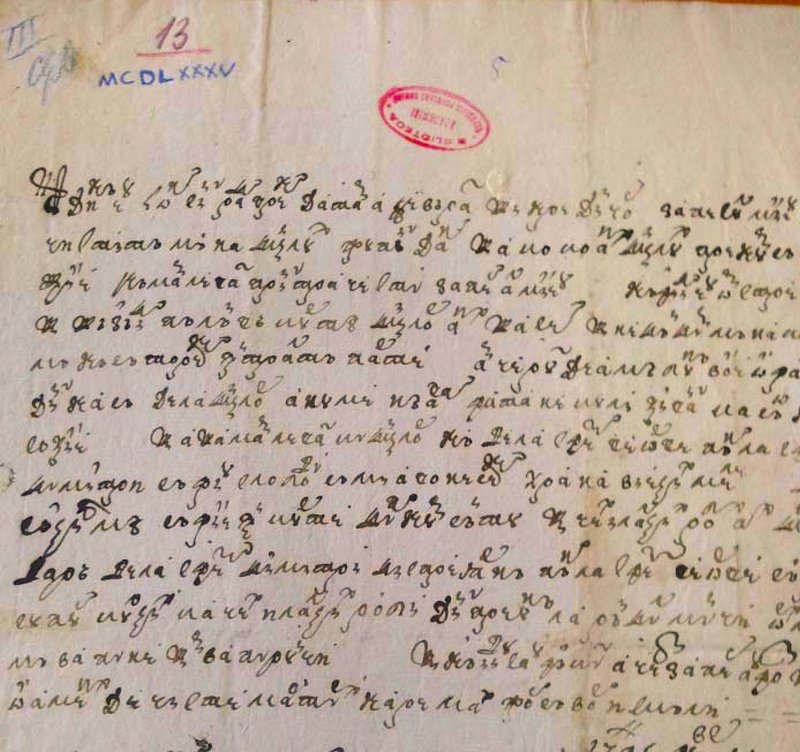
A single-page document dated 10 February 1796 is preserved in the Library of the Romanian Academy. At first glance, it appears to be written in a foreign language. The letters are Cyrillic, the handwriting is difficult to decipher, and Slavonic administrative formulas occur among the Romanian words. Yet the language of the document is Romanian.
This apparent incongruity—a Romance language concealed beneath the Cyrillic alphabet—seems to me one of the most accurate images of the Balkan world. Nothing has a certain origin, a single identity, or a definitive form. Languages overlap; alphabets migrate. To say nothing of people, who change their names and allegiances. Even laws emerge from different traditions, sometimes settling one on top of another.
The document I am referring to seemed to have been forgotten in a drawer. It was 2012. I entered the Library of the Romanian Academy, as usual, without expecting to discover an unusual record. But I came across this page, catalogued as MCDLXXXV/13, with no further information. Its letters are mixed—Slavonic, Ukrainian, and Greek. I had only a vague understanding of what the text was about, so I asked Liana Năstăselu, a specialist in Old Church Slavonic at the Romanian Academy, to transliterate it.
The story moved me from the first reading. Although I had read many other manuscripts concerning slaves, this one was different. I published it, accompanied by a brief introduction, in the American journal Eighteenth-Century Studies, published by Johns Hopkins University Press, under the title “A Greek Who Gave Up His Freedom in the Eighteenth Century: An Unpublished Document” (vol. 47, no. 4, Summer 2014, pp. 429–432). But I could not forget the story.
Not long afterwards, I transformed it into a novel: Manuscrisul fanariot (2015), the first volume of The Phanariot Trilogy.
The signatory of the document is a certain “Ion sin Radu Grecu.” The formula already contains a small map of identities. Ion bears one of the most widespread Romanian given names. He is the son of Radu, a name deeply rooted in the Romanian world, yet he identifies himself as “Greek” and “a foreign man.”
In the eighteenth century, the word Greek could encompass several different identities. It referred both to Greeks proper and to numerous Aromanians, Megleno-Romanians, and other Romanian speakers who had come from south of the Danube. They generally spoke several languages and were integrated into the commercial networks of the Ottoman Empire.
Ion sin Radu had lived for six years near the household of Dan Brașoveanu Doicescu and his wife. There he had met Neaga, the daughter of Neculai, a slave owned by the Doicescu family. Ion was free and Greek. Neaga had been born a slave and could be inherited, sold, or exchanged like any other possession belonging to her master.
In the Romanian Principalities, a law stipulated that a free person who married a slave would also become a slave, together with any children born of the marriage. For Ion, marrying Neaga meant not only descending the social hierarchy but also losing legal ownership of his own person.
Nevertheless, he accepted.
The deed is a contract for the acquisition of a slave—a contract for the sale and purchase of a human being. It states:
“Being a foreign man and having lived near their household for six years, and having found no means to marry elsewhere, of my own free will I asked Their Honours for a girl from their household, named Neaga, the daughter of Neculai the Gypsy, so that I might take her as my wife.”
The phrase “of my own free will” is essential. Ion knows what he is signing. He has not been captured, nor has he been inherited. He accepts being purchased and enters voluntarily into a legal category from which, in principle, he could no longer escape. Moreover, his children would be born slaves.
Surprisingly, however, the contract grants him a measure of freedom. From St George’s Day to St Demetrius’ Day—that is, throughout the warm season—he was allowed to work elsewhere in order to provide for himself. From autumn until spring, he had to return to the Doicescu household and perform his share of the labour, like the other slaves. Neaga remained at the household throughout the year.
The six months during which he was permitted to work on his own account represented the price Ion received in exchange for his freedom. He was not paid in money but was granted the right to live and work elsewhere for half of each year.
In a sense, the document also functioned as a seasonal work permit. For six months of the year, the owners relinquished the services of their newly acquired slave without relinquishing their ownership of him.
We do not know the reason for this concession. Perhaps they valued him for the years he had spent in their service. Perhaps they recognised that he possessed a useful trade. Or perhaps the story of the two lovers had moved them.