Doina Ruști has given numerous interviews, both in writing and on video.
Beginning with her first television appearances in 2004, more than one hundred interviews, conversations, broadcasts, podcasts, and filmed literary events with Doina Ruști have accumulated over the years. Some accompanied the publication of a novel, while others began from broader subjects — literature, memory, communism, Bucharest, the Phanariot world, the fantastic, Balkanism, or the mechanisms of storytelling.
Taken together, however, they form something more than an archive of public appearances: over more than twenty years, they trace a number of ideas about literature, some of which return with remarkable consistency.
*→ *See the complete playlist: over 100 filmed interviews
One of the ideas repeated over the years is that literature does not begin with a thesis, but with the pleasure of play and with emotion.
A story must first create a world the reader is willing to enter. Meanings, ideas, and interpretations come afterwards. For this reason, construction and the ending occupy a central place in Doina Ruști’s conception of prose: a story is not merely a narrative, but also a way of concealing information, with literature-as-folder being one of her recurring ideas.
The Writer’s Life, on the programme Open Stage, DigiTV
On the novel Ferenike (Humanitas, 2025) and its relationship to biography.
Distrust of artificial literature, built only from formulas, reading, and second-hand information, is another subject frequently addressed by the novelist. Prose needs experience, she says. Not in the simplistic sense that a writer must have lived exactly what is being narrated, but must have lived some part of the story. Fiction presupposes the freedom to invent within a territory over which the writer has command. Literature, especially prose, comes from the things that toughen the skin and leave marks. Hence the rejection of writing that may be flawless yet devoid of life: one can learn enormously from books and research archives and documents, but a true story begins only when these things meet personal experience.
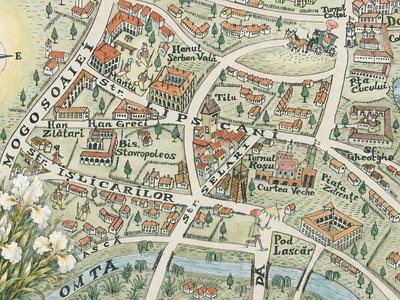
Phanariot Bucharest, the Balkan world, Mediterranean myths, and the archaic foundations of Eastern Europe appear in many of these conversations. But the Phanariots are not the purpose of the story. Rather, they provide a pretext for recovering an old Eastern European world — mobile, mixed, and difficult to reduce to modern borders and identities. The Phanariot age restored a sense of origins for her and, historically, renewed the local imagination through Mediterranean myths and influences.
In the same sense, Balkanism is an inheritance and also comes from her connection with the Danubian world. It is a way of translating often devastating historical realities through fabulation, humour, and frequently through the fantastic.
How I Wrote The Phanariot Manuscript
Podcast: Gelu’s Library
In interviews about communism and her novels dealing with this subject, a consistent position on totalitarianism also emerges. Her own lived experience leads her to say that totalitarianism cannot simply be weighed, analysed, or judged. It was a historical anomaly that can truly be narrated only if one lived inside it and knew its everyday mechanisms: fear, absurdity, and the way these entered ordinary life.
For this reason, communism deserves above all to be told, not judged.
The same perspective explains her distrust of turning Securitate files into absolute truth. Documents are essential to history, but Securitate files cannot be treated as absolute truth. Written and rewritten, these files often falsified a reality that even those who lived through that period may come to doubt.
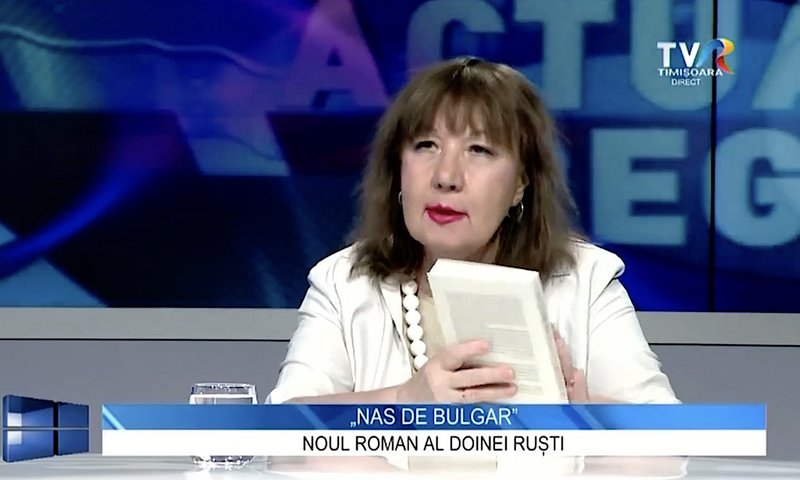
On the publication of the novel The Ghost in the Mill, 2008. TVR, Jurnal.
The violent death of her father appears in only a few of these conversations, not as a biographical explanation of an oeuvre, but as an example of the way literature can alter one’s relationship with lived experience.
A traumatic event can remain sealed within its own violence. Literature, however, opens another possibility: entry into the more difficult territory of lived experience, where memory constructs and experience can be viewed from several angles.
In this sense, literature does not erase trauma. It moves it into a space where it can become story.
My father’s murder could have generated a trauma, but I was lucky to have literature, which took me into the difficult territory of lived experience. I have a horror of artificial writing, without real, lived life. Literature, especially prose, means experience that toughens your skin and leaves marks. You cannot write only from hearsay, only from what you have read.
— Doina Ruști —
Among the names that recur in these interviews are Mircea Eliade and William Faulkner.
At a certain point, Eliade represented the hope of escape from the space of communist terror: the idea that visible reality is not the only possible reality and that the imagination can open an exit where the world seems closed.
Faulkner revealed the infinite possibilities of narration: the freedom of perspective, voices, time, and construction.
In different ways, both contributed to an idea that runs through the entire video archive: literature does not reproduce the world, it reconstructs it.
Among the many critical descriptions of Doina Ruști’s prose, one strikes her as especially flattering, the novelist says. It belongs to Marco Dotti:
“There are two qualities in her writing: depth and the sweetness of storytelling.”
From the earliest television appearances to the most recent interviews, the books have changed, the characters have multiplied, and the subjects have expanded. Yet several convictions have remained almost unchanged:
Literature begins with emotion and must produce emotion;
A story is first of all a game, and for me it is a game of construction;
The ending is the great test of a prose writer. A good ending is prepared from the very first page.
The imagination feeds on the life you have lived;
*→ *See the complete playlist on YouTube
The archive currently includes 119 filmed interviews and conversations and is updated periodically.