The Ghost in the Mill on the International Map of Magical Realism
Ciprian Handru
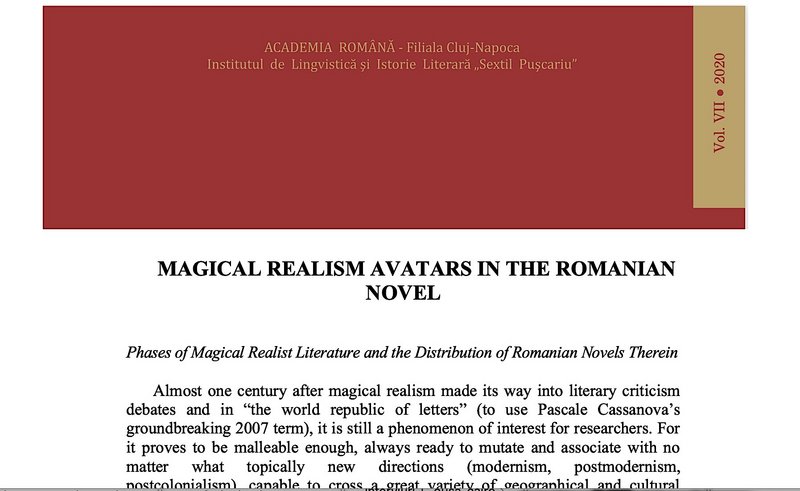
A few days ago, I came across a study by Elena Crașovan in which The Ghost in the Mill by Doina Ruști s discussed from the perspective of magical realism and the place this mode occupies in contemporary Romanian literature. Entitled Magical Realism Avatars in the Romanian Novel, the study was published in 2020 in the academic journal Dacoromania Litteraria and offers an extensive history of Romanian magical realism, placing it in relation to the genre’s international development.
This is not the first time Elena Crașovan has written about The Ghost in the Mill. Three years earlier, in 2017, also in Dacoromania Litteraria, she published the study The World of the Living Dead: Mythical Rewritings of History in the Postapocalyptic Narratives about Late Communism, in which she comparatively analysed Mircea Cărtărescu’s Blinding. The Right Wing, Bogdan Popescu’s Whoever Falls Asleep Last, and The Ghost in the Mill. There, her main interest centred on the mythical rewriting of late communism, traumatic memory, the ghost, and the image of a post-apocalyptic world of the “living dead.”
Now Doina Ruști’s novel The Ghost in the Mill is included in a broad study devoted to the avatars of magical realism in the Romanian novel and to its relationship with world literature. Written by Elena Crașovan, “Magical Realism Avatars in the Romanian Novel” appeared in the academic journal Dacoromania Litteraria, vol. VII, 2020, in an issue devoted to novelistic subgenres as “world genres.” The study can be read here, on the journal’s website, while the full text is available as a PDF. DOI: 10.33993/drl.2020.7.36.55.
Elena Crașovan’s approach starts from the idea that magical realism should not be regarded exclusively as a Latin American formula, but as a literary phenomenon capable of migrating, changing, and taking on specific forms in different cultural spaces. From this perspective, Romanian literature is placed on a broader map, beginning with interwar European formulas, continuing through the impact of the Latin American Boom, and extending into post-communist literature.
In this third phase, Crașovan discusses novels by Mircea Cărtărescu
, Doina Ruști, Bogdan Popescu, Radu Pavel Gheo, and Tudor Ganea. Their common ground lies in the rewriting of historical traumas from the perspective of individual experience, a preference for marginal figures, the interweaving of history and memory, and the use of irony and the grotesque.
In Doina Ruști’s case, the novel chosen is The Ghost in the Mill, published in 2008. The study places it within a group of novels that replace grand official history with the history of small communities and individual experiences, transforming the memory of communism into fictional material. Alongside Mircea Cărtărescu’s Blinding, Bogdan Popescu’s Whoever Falls Asleep Last, Radu Pavel Gheo’s Good Night, Children!, and Tudor Ganea’s The Casemate, The Ghost in the Mill becomes one of the examples through which post-communist Romanian literature enters the international discussion on magical realism.
“Doina Ruști belongs to the representative core of post-communist Romanian magical realism, while The Ghost in the Mill, through both its typology and its literary achievement, may be favourably compared with canonical novels of world magical realism.”
Special attention is given to the ghost, the novel’s central motif. In Elena Crașovan’s reading, the past enters and disrupts the present, while the ghost becomes the expression of a traumatic history invading individual identity. The spectral motif thus acquires a broader function: it makes visible the alienating effects of history while also participating in the exorcism of a violent past burdened by guilt.
Equally important is the novel’s geography. Comoșteni, with the mill at its centre, is included among those spaces that are both real and fabulous, through which the novels of this period construct their own mythologies. From this perspective, the study places it alongside Tântava and Mircea Cărtărescu’s Bucharest, or the Village of the Saints in Bogdan Popescu’s novel.
The study’s scope, however, goes beyond the classification of Romanian novels. Elena Crașovan seeks to integrate them into a genealogy of world literature, and it is here that her assessment becomes particularly significant. The novels of this generation are regarded as exemplary works within the postcolonial and post-communist expansion of magical realism and are related to canonical works such as Salman Rushdie’s Midnight’s Children, Toni Morrison’s Beloved, Ben Okri’s The Famished Road, and Patrick Chamoiseau’s Texaco.
The conclusion of the study makes this comparison even more explicit. Discussing the third phase of Romanian magical realism, Elena Crașovan names Mircea Cărtărescu, Bogdan Popescu, and Doina Ruști and states that their novels “compare favourably” with those of canonical postcolonial writers such as Rushdie, Morrison, and Ben Okri. What is at stake, therefore, is not merely the identification of influences or thematic similarities, but the comparative positioning of contemporary Romanian fiction within an international literary context.
Through this reading, The Ghost in the Mill emerges not only as a novel about Romanian communism, but as part of a broader literature of traumatic memory, in which the fantastic and the real, history and myth, individual experience and collective discourse overlap.
Elena Crașovan’s study thus offers an important perspective on the place of Doina Ruști’s fiction within an international network of contemporary magical realism, in dialogue with Central and Eastern European literature as well as with major postcolonial landmarks.
Elena Crașovan, “Magical Realism Avatars in the Romanian Novel,” Dacoromania Litteraria, VII, 2020, pp. 36–55.
Study page · Full-text PDF · DOI