What will happen to literature in a world where artificial intelligence can produce stories? Will we still need authors?
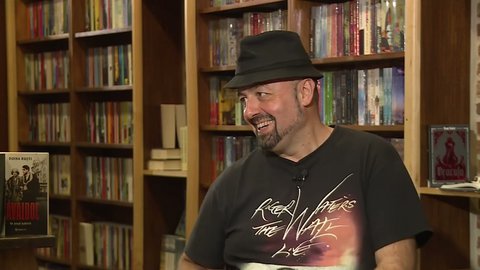
Invited by journalist Vasile Hotea-Fernezan to appear on the television programme Transilvania culturală, Doina Ruști discussed the future of literature and one of her firmly held beliefs: the disappearance of the author, as we know this figure today, is inevitable. But storytelling will continue.
The storyteller imagines worlds, invents situations, and plays. The pleasure of creating fiction does not depend on public recognition or on the status of being an author. From this perspective, the very notion of authorship may become meaningless, but the impulse to tell stories will remain.
A significant part of the conversation focused on the novel Matuf, the Wigmaker (Humanitas Junior, 2026), a story about time travel, identity, and the preservation of memory.
The novel explores an idea that goes beyond the mere preservation of information: memory survives not simply through storage, but through continuous copying and running. It does not remain locked away in an archive; instead, it transforms, develops, and continues to exist in other forms.
Structured on several levels, Matuf combines the fast-paced suspense of a thriller, appealing to readers of all ages, with a deeper layer of meaning aimed particularly at adults.
This second layer begins with the Byzantine philosopher Georgios Gemistos Plethon, whose lost work is metaphorically associated in the novel with Alex's memory. There is, however, one essential difference: Alex's memory does not remain a relic of a vanished world. It develops, transforms, and continues in another form.
Thus, the adventure across different historical periods also becomes a reflection on the survival of consciousness, the nature of memory, and the possibility that identity may transcend the limits of individual existence.
The conversation at TVR Cluj complemented a series of literary events dedicated to Matuf, the Wigmaker.
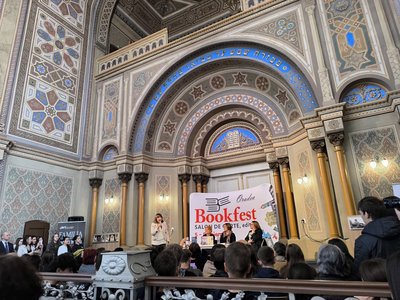
At the Lucian Blaga Central University Library, approximately 200 students from Cluj took part in a discussion about literature, artificial intelligence, and identity.
At the Faculty of Letters of Babeș-Bolyai University, the discussion centred on What Does the Old World Look Like in the Posthuman Era?, as part of the Romanian Old and Premodern Literature Circle.
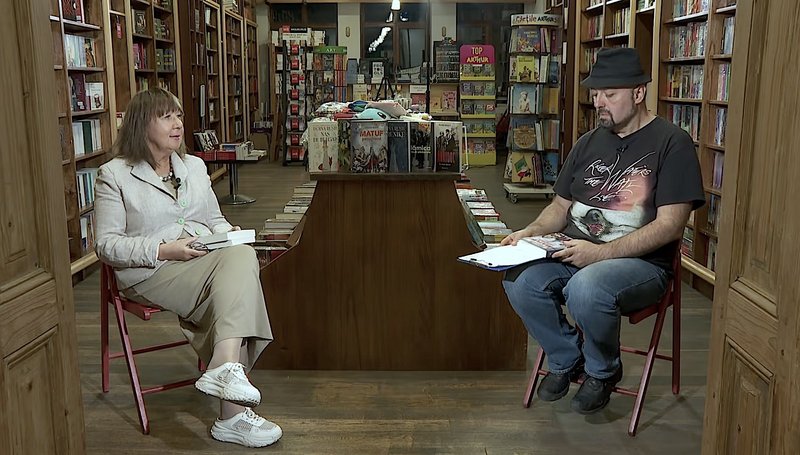
At Book Corner Librarium, the conversation took place in a smaller, more intimate gathering of devoted readers.
One reader expressed a particular wish inspired by Matuf: that a book might one day be written about the intertextuality of Doina Ruști's novels, exploring the characters, motifs, and fictional worlds that communicate across her works.
Such a book could reveal the connections between stories written years apart but belonging to the same imaginative universe.
Watch the full interview:
More about the novel:
Meetings with Readers:
https://doinarusti.ro/stire/2026/matuf-peruchierul-intalniri/index.html
More Interviews with Doina Ruști: