In a document from the period, discussed by several historians, there is a record of the extraordinary adventures of a man from the Băneasa district. It is said that he possessed an irresistible charm—not only for women, but for everyone. The moment you saw him, you felt that your entire life up to that point amounted to nothing at all.
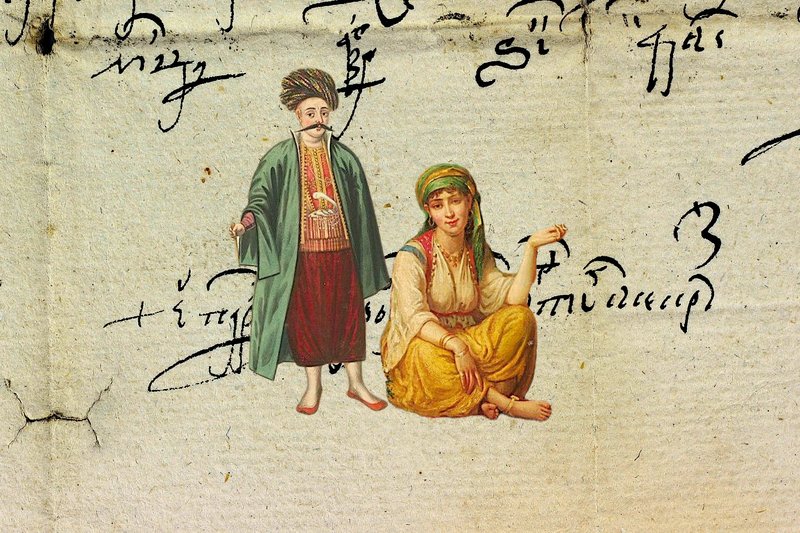
Marinache was of average height and had protruding ears. Ordinarily, such ears might have cast him in an unflattering light, but he had cleverly softened this defect with earrings that drew the eye and made you want a pair instantly. From a thin silver thread hung a pearl the size of a walnut, of a dazzling whiteness, dusted—as if by some invisible hand—with silver powder and narcissus pollen. To complete the impression, he wore a turban that partially covered one ear, made of fine Maltese silk, patterned with white flowers on a sandy background.
Marinache would set out early in the morning and knock at the gates of more aristocratic houses, where he knew a woman lived—one with many dreams, many dissatisfactions, and good thoughts in need of chasing away. He introduced himself as a merchant interested in buying the house, or as an emissary from the Palace collecting donations. He always found something.
A servant would answer immediately—man or woman, it didn’t matter—because in both cases they would be figuratively knocked off their feet, filled with an inexplicable joy.
Marinache would ask for the lady of the house and then wait patiently, knowing full well that no woman would appear before him without first adorning herself lavishly, donning her finest clothes, and applying at least a touch of perfume.
Meanwhile, Marinache waited with one leg crossed over the other, displaying in all their splendor the trousers that had made him famous throughout Bucharest. They deserve a story of their own, for they seemed torn from a tale, fit to wander through a song.
First, there was the fabric, which compelled the gaze. It was velvet, threaded here and there with strands of linen, lending it dignity and preventing it from collapsing into shabby waves. Then there was the color—one that seized the eyes. Even with a gun to my head, I could not fully describe it. It was the color of nights spent in satin sheets, of words you never forget, of eyes pressed to a window, of a pen learning to write, of little devils hidden among eyelashes. It was the color of beginnings. Of promise.
Otherwise, they were ordinary trousers, reaching just below the knee, fastened with a small silver button.
All the encounters followed the same pattern. They talked as long as they talked, and eventually arrived precisely where they had known from the start they would arrive.
The golden rule that had kept Marinache afloat was never to pay more than one visit to any woman—a fact that also speaks well of his memory.
Marinache had visited a great many beds, tested the resilience of countless divans, delighted in the scents of indrușaim, basil, and honeysuckle, and learned how to wait, how to postpone, how to enjoy.
Until one day, when through a door he believed firmly locked burst a man. Marinache panicked, leapt to his feet, and seeing no other escape, jumped out the window—just as naked as he was.
The incident quickly reached every ear and was sung by fiddlers. Someone even wrote it down in the margin of a book.
Once home, Marinache realized something had changed in his life. At first it was only a premonition, but soon he understood that his charm had dissipated, like leaves in autumn. The earrings hung from his ears like millstones, and the turban—no matter which shawl he chose—looked ridiculous. As for the trousers! Without them, his brilliant life had ended. He felt robbed, violated, discarded.
No matter how many attempts he made, how many tailors tried to fashion others, however respectable—everything was in vain. Nothing sat properly on him anymore. His legs seemed crooked, his coat fell badly, and his knees trembled like an old man’s.
Before long, Marinache fell into universal disgrace and utter poverty. The fortune of the trousers had vanished, remaining forever an absolute mystery, like the riddle of the Greek Sphinx.
For the rest of his life, he sincerely believed that God no longer loved him.
In truth, however, his trousers had not been ordinary at all. They did possess a mystery. In their refined weave, between the threads of velvet, there lay trapped a wandering spirit. Among the many spirits of the world, there is one responsible for sympathy—and it was precisely this one that had once fallen prisoner in the warp of a loom. Hungover and weary, it awoke in captivity, unable to escape for a long time.
The fabric became trousers, which passed from Marinache into other hands. But being fabric, they were subject to time like all things. From the trousers, someone made a vest, whose owner inherited the good fortune of being loved. The vest tore, was mended, and eventually became a cap, which ended its days in a fire, thrown into the stove along with other discarded things.
There, the spirit of sympathy awoke and said sleepily: What a foolish dream I had! I dreamt I was a man, with earrings and a turban, and that my name was Marinache. God forbid such a fate!