D.R. – When you write about a real person, people are tempted to ask how much of it is true. But I won’t fall into the sin of accounting for the documents behind the novel Zavaidoc in the Year of Love. Of course, I read the newspapers of that year, and many of the episodes start from indisputable realities: a murder, a kidnapping, the attempt on the king’s life, the inauguration of the Military Circle, and many others are authentic facts. But any reality is reshaped by a person’s pressures and hopes. We call this vision, though it is simply someone’s subjective way of entering a well-known universe. What does the document mean for literature? Not much. I don’t read monographs, especially those little books with famous names on the cover and sentences lifted straight from the internet. For me, literature comes from the pleasure of constructing a state of mind. And here I was interested in the complexity of feelings a person has at the prime of life. There are many people we look at with a touch of pity—people who seem to drag themselves through the world and through life. But every person, no matter how fallen, has had a period (longer or shorter) when they moved mountains. We all have such an age, when we are unique, victorious, brilliant. And in this novel, I wrote about a character at his peak: adored, popular, who longed—as we all do—to reach perfection.
E.C. – Writing about that age really does seem like a theme. As you were speaking, I could already see him appearing in your novel:
D.R. – “I’ll never forget him—he would walk along in a lordly way, on foot, twirling his cane. He wore white gaiters to match his gloves and a short coat, and his hat revealed a gaze lit by serenity. And he was surrounded by four elegant women, giggling, wrapped in furs.”
E.C. – Was that always how you saw him?
D.R. – As a child, when I first heard of Zavaidoc, I imagined a fiddler shouting and singing, a figure from the past and nothing more. Today, however, I know he was a complex artist with multiple talents. If we look through the newspapers of the time, we quickly understand that I did not choose the year 1923 by chance. It was the optimal moment for an artist who could perform any genre—from operetta to folk or jazz. He collected music from all regions of the country. He opened a new stage in urban music. He made a spectacle out of everything. He wanted to write. He did write. His writing was impetuous, “winged.” People often say there are those who scatter themselves. Some do so pointlessly and nothing remains of them, while others scatter like summer rain—and wherever they pass, even if it seems they have wasted time, the earth blossoms. Zavaidoc belonged to this second category, one very familiar to me, very much to my liking. He lived intensely, to the point of exhaustion. But I wasn’t interested in him as a typology.
E.C. – Then how?
D.R. – I was interested above all in his everyday life, his most human side. We see him in a photograph wearing a silk tie, looking in semi-profile—probably posed by the photographer—but from that image other attitudes unfold; it’s impossible not to imagine him tying the little scarf, studying it in a shop window, receiving it as a gift. He appreciated fashion, he cared about his appearance, like anyone born poor, for whom money came slowly, through hard work. And if you go deeper into the facts, you cannot fail to see his independence, his aspirations. But Zavaidoc in the Year of Loveis not a character-driven novel.
E.C. – It has often been said that your strength lies in composition…
D.R. – I opted for three narrators, though Carol is the voice that holds the fabric together. From her perspective, the action appears in details expanded by age, education, and her family environment. Through her, I chose a character I consider illustrative not only of 1923, but of the period as a whole. Any narrator is a shy participant who observes and, as they grow attached to events, develops desires that color the story more than the characters’ actions themselves. Therefore, the narrator gives not only the tone of the story, but also the subtle direction of its message, its emotional register, and so on.
E.C. – But there are two more narrators—what role do they play?
D.R. – The novel is built on the idea that every story is unique. That is why I did not construct a puzzle this time, I did not complete the story through technical interweavings. There are essentially three stories, each leading to a different part of the epic, with a different understanding, different interests. It is true, the dominant figure remains Zavaidoc. But he is not the main character, because every narrator speaks first of all about themselves, places themselves at the center, and everything revolves around them. Matilda, Carol, and Ică are narrators aware of their role, and they tell those events that have decisively shaped them.
E.C. – I remember you say this explicitly in the novel:
D.R. – “Every story belongs to the one who tells it to the end. Others read it and forget it. My story is not Matilda’s. It would be foolish to overlap them, to weave them together.”
E.C. – What I liked is that each story brings new events, clarifying questions that arise when reading the first part. How did you achieve that?
D.R. – I replaced the classical “moments,” but kept the escalation of conflict. Each narrator is part of the epic discourse. But what I enjoyed most was writing Matilda’s section.
E.C. – It also has a beginning typical of a confessional novel:
And, last but not least, I was interested in something else: among the long line of characters traumatized by the experience of war, Zavaidoc promised an openness to change—he was inventive, histrionic, with an epic imagination (very dear to me), passionate, in other words, latino.
E.C. – Let’s return to authenticity and its paths: if the document is not important for literature, then what gives authenticity to a novel, especially one based on a real person, like yours?
D.R. – In my case, authenticity rests on two things: the narrator’s discourse and the construction of the character in relation to other characters. I believe that if these two work, the rest becomes simple. But to enter an epic tone, you need a kind of love affair with the character. That is why people often say you can tell immediately when you don’t love your characters. In this case, my connection to the story came through Matilda. From her, other characters began to take shape, and the atmosphere emerged. But to avoid being too categorical, I must say that information also played its part.
E.C. – For instance, the death of Doctor Carniol—is it based on a real case?
D.R. – Yes. It was a case reported in almost all the newspapers of 1923, researched and studied in journalism faculties, and so on. What strikes you are the enigmatic details of the event, but especially the type of sensationalism it offers. It is an incident that stimulates the imagination of atmosphere, shaping the mental fabric upon which each character develops.
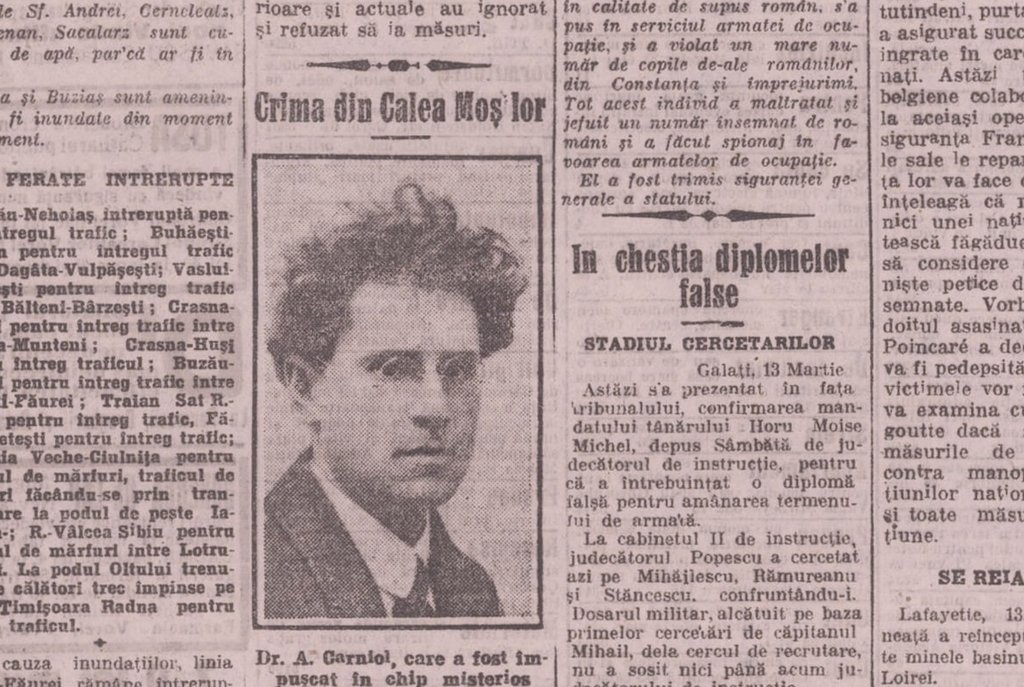
Excerpt from the newspaper Universul / 1923, about the assassination of Dr. Carniol
E.C. – What do you expect from this novel?
D.R. – That it will be read with pleasure, and that the reader will discover, along the way, the love note I have hidden between the lines.
E.C. – Are you working on something else? Or did Zavaidoc in the Year of Love exhaust you?
D.R. – I’m waiting for Platanos to appear, a novel that continues the story of the short piece with the same title—a text studied (with enthusiasm) in schools. At the suggestion of students across the country, I wrote a novel that continues its action. At the same time, I’m also working on a more special novel: The Wild One. But we would go on too long if I told you about all my projects.
E.C. – After four years of silence, I imagine you have a lot to say!
D.R. – Of course—I have a yellow bird on my shoulder.
Read the full interview in LaPunkt.ro.