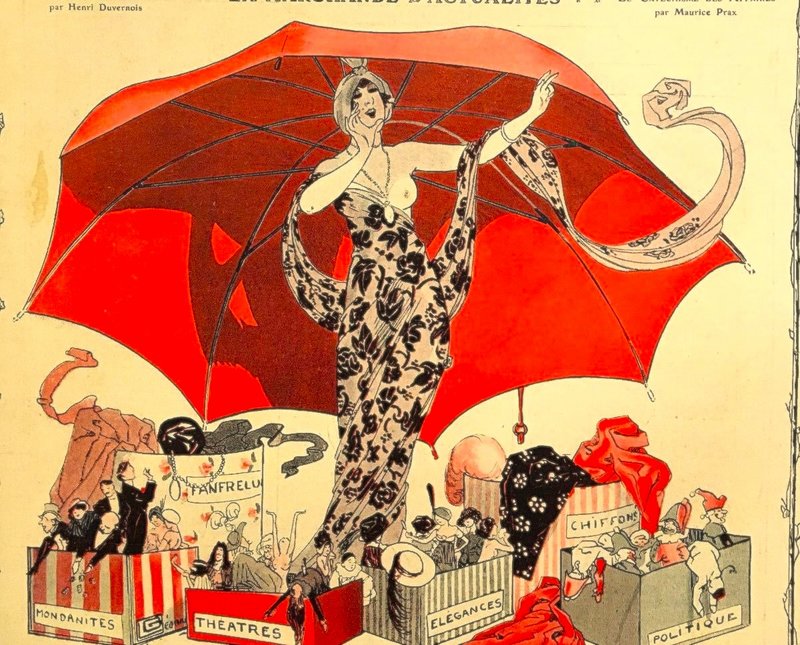
She had lived for many years on Șelari Street, in the basement of a building that housed, upstairs, an umbrella factory. Sometimes she worked as an extra in the theatre, other times she posed for painters, but most often she could be seen on the pavements of Șelari or on the nearby streets, holding a red umbrella and advertising the umbrella factory. She didn’t earn much, but she had the chance to display her dresses, show off her figure, and twirl umbrellas in all sorts of ways, making you look at her—and remember her. She was elegant. She had charm.
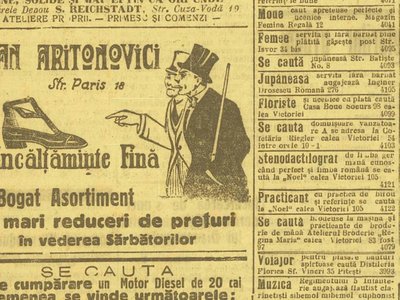
Her luck was that the umbrella factory began advertising in Universul. They presented their range and listed the address, and after a while they also added her photograph: holding an imperial umbrella, suitable both for rain and for the height of summer.
One day in 1928, a bizarre scandal broke out, changing several lives. It began with heated discussions about sound cinema. An article spoke of the harmfulness of films with voices, reporting that actress Pola Negri herself was appalled. The advent of talking pictures, it was argued, might turn everything into theatre and compromise cinema altogether.
The dispute spilled into streets and cafés and might have faded away if someone—anonymous to this day—had not noticed the advertisement next to the article, promoting umbrellas made on Șelari Street. How was it possible, this person asked, that alongside serious matters, in the same newspaper that published photographs of queens, there should appear a farfuză?!
Several eyes clung to the page, a few lips murmured, and the word caught on, quickly turning into a buzzing fly that would not leave you alone.
Indeed, the girl with the umbrella, leaning slightly forward, had something irritating about her. She carried a breath of summer, a light rain of pebbles ready to slip into your shoes. She wore a mischievous smile. She was provocative and clearly had little to do with umbrellas from Șelari. She was low-cut, one strap of her dress slipping carelessly off her shoulder. One could not call her immoral, but she made you think of clandestine meetings and suggestive words. She was not vulgar—just coquettish. She even hinted at a certain elegance, yet she remained, to anyone reading the newspaper, a farfuză.
You would not be ashamed to be seen with her in a bar near the umbrella factory, but you would not introduce her to your relatives. She could not even be called frivolous—only farfuză: a coquette with indecent potential, making you imagine questionable deeds.
And from there the storm began. Male voices whispered the word with pleasure—at the cinema, on the boulevard, shaking cigarette ash into ashtrays while sipping spritzers, waiting for trains, along ministerial corridors, at the racetrack, or in their lovers’ beds—until wherever you went, the word farfuză crept into your ear.
For weeks she was talked about. Even after the advertisement was replaced, discussions continued, and the girl—who had barely survived from one job to another—was transformed overnight into Miss Farfuza.
She could no longer walk the streets. She could no longer find work. Her life was ruined—not because of a photograph, but because of a word. A powerful word, sharp and ambitious. Once harmless, describing someone pretentious, slightly ridiculous, superficial and affected, destined for a life of little depth, it gradually degenerated, becoming in our time almost synonymous with prostitute. An injustice done to a word that had travelled the Balkans in the pocket of baggy trousers, softened by gallant society, and later drained dry by thin, misogynistic lips—by people lacking compassion and imagination.
Farfuza dared not speak. She left Bucharest and its pleasures. For two years she lived the lethargy of defeat in a provincial backwater, until one day, out of the blue, she boarded a train, telling anyone willing to listen about the joy of twirling an umbrella.
She walked the streets happily—no one recognised her. No one stopped her. No one whistled.
At last she reached Șelari. In the building where she had once lived, the ground floor now housed a shop with a window crammed with umbrellas and hats, raincoats and waterproof shawls. At the centre stood a mannequin, its bust exaggerated by absurdly lifted breasts, so much so that you might think the wind had caught them and was about to carry them away down the surrounding streets.
On the sign was written La Farfuza, and passers-by read it with satisfaction and the distant memory of a day when the word had conquered the city.
The former Farfuza leaned against the shop window and sank down onto the pavement. All her hopes were gone: she would never again twirl an umbrella on Șelari Street. Even the bad name had been taken. People passed her by indifferently. Eventually someone tossed her a coin; later, someone else gave her a piece of bread. She could not move. She had no plan, no connection, no hand ready to fall on her shoulder.
In time she accepted life in the shadow of Farfuza-with-mannequin-and-window, holding out her hand for a little attention. She slept in basements, crawled through the gardens behind the shop. Her entire life drained away on Șelari Street—which, I believe, entitles us to consider it a place worth visiting, entirely consecrated to a single word. We might even rename it Farfuza Street.