You have to be extremely optimistic to launch a print publication these days. And if that publication is a cultural magazine, you need something more. (Let’s skip the grand words.) Doina Ruști goes through the pandemic with her optimism intact and with that miraculous something still working. I sincerely hope she succeeds.
A new cultural magazine, and in print? Aren’t you being too optimistic?
I was born optimistic. When I came into the world it had been raining for weeks, there were floods everywhere, and people were waiting for the end of the world, as usual. My mother didn’t even make it to the maternity ward, and I was born at home, in aristocratic fashion, taking the best part of that disaster.
And now my native optimism has spread to the magazine. In times like these, a publication is truly necessary—one with writers, with letters that vibrate. You open the magazine and the letters begin to fly out like smoke, entering your brain, flowing into your blood. Don’t you miss that?
I should also tell you that OPTm (Eight Reasons) started as a game and has now reached issue seventy: https://optmotive.ro/. It is published by the Association of Fiction Creators—writers, actors, directors, musicians, painters, and others—a guild, as you know, that needs words printed on light paper. Most of the contributors are literature professors who read cultural magazines professionally.
And there is also a whole life around it, a complex community made up of people capable of becoming a group with its own identity. Cațavencii, for example. The OPTmists, in our case.
Do you read the magazines of the Writers’ Union?
No.
What about Observator Cultural?
Very rarely. Instead, I read La Lettura, the supplement of Corriere della Sera. When you hold that magazine in your hands you expect a story to begin, and whenever I think about cultural publications, that one comes first to mind.
It is one of the longest-running and most widely read magazines. I believe a magazine gains real value only when it is not tied to a single name but to the story it promises. When one person runs a publication for too long, its space becomes routine and the issues begin to look like photocopies.
Did you hear what happened to Ruxandra Cesereanu at Steaua, from the honorable leadership of the Writers’ Union?
I wouldn’t call it a misfortune. I would call it a liberation.
Otherwise, how are you doing as a writer, as a private individual?
My life doesn’t look bad at all. Continuing the optimistic tone from the beginning of the interview, I could say that every writer has a reserve life, inside which other lives grow.
Among the memorable events of the past period I would mention a rather fantastic encounter with the Bucharest of the 1990s. Do you remember what it was like? I had forgotten many things until last summer, in the middle of the pandemic, when I received a phone call.
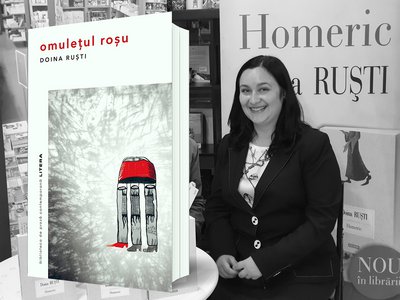
An editor from Rome called me to say he wanted to republish, at his own expense, my debut novel—a forgotten book that I had left far behind. The Little Red Man, published in 2004, was the novel that opened the door of literature for me.
Since it was a reissue, I reread it, initially more for Roberto Merlo, who wanted to revise the translation he had made years ago. Which is rare, because I don’t like rereading my books.
But as I moved forward in the story, I stopped paying attention to the writing and possible narrative flaws and let myself drift back to the late 1990s and early 2000s, when we used to meet in the Mirror Hall.
You were writing weekly for România literară at the time and seemed very optimistic, while I was only a reader with dreams. The internet had just appeared and its world still seemed mysterious to us. We believed in hyperliterature, in stories disseminated along epic paths, but also in the subliminal power of a virus—I mean the ones from the virtual world, not COVID.
Since you brought it up, do you think COVID still has something else in store for us?
We are only at the beginning of the new viral era. The attack, the pandemic expansion, this whole history is not merely a period of illness but an existential model.
I would rather not repeat what I already wrote in my recent novel Occult Beds, but I would extend the idea: once disorder is installed, reality gains so many faces that each person sees History differently.
The virus that invades the world in the novel comes from the impetuosity of a man capable of mobilizing the desires of other people just as restless as himself. In the novel, a man wants everything, and his stubbornness continues beyond life, into the grove of wild carob trees.
But even paradise is not enough for him. He cannot stop; he has no taste for mystical idleness. He wants to be the plague that devours everything.
And in moments of crisis, society either stagnates or transforms radically. We are now under the rule of the fugitive from the grove of carob trees.
Have you been vaccinated or are you still waiting?
That’s a rather personal question.
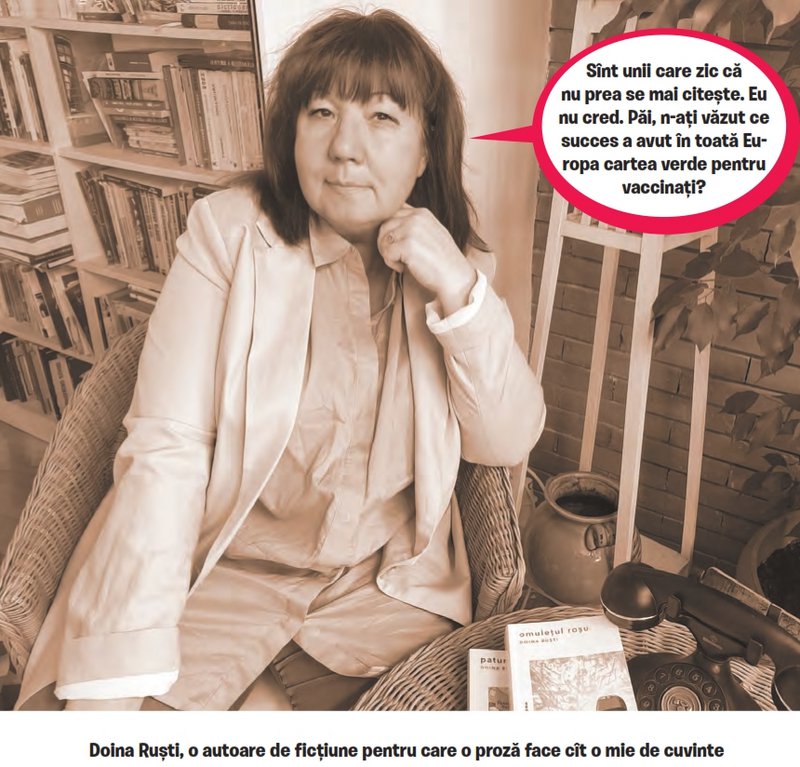
Some complain about the introduction of the green certificate for vaccinated people, saying it discriminates against them.
There have always been restrictions, marginalizations, groups. Things continue along the same line because people are different: there will always be some with a green certificate in their pocket and others who oppose everything.
Has the pandemic changed you in any way?
Certainly. It broadened my horizons. First of all, I travelled more—even if in slippers, in front of my laptop.
I had events all over the world, and more than that, I could enter people’s homes. At a normal book launch you would see a bookstore or an amphitheatre full of people and feel frustrated because you barely managed to speak to anyone.
This year there were meetings attended by hundreds of people. Litera Publishing has a very well-organized system, and online meetings bring a lot of people together.
You can enlarge the frame, study the guests, glimpse part of their domestic life. A wardrobe, a mirror like the shadow of a dragon, a shelf of books give you an idea about your readers.
One memorable meeting was with the League of Students in Italy, but also with His Excellency Alfredo Durante Mangoni, the Italian Ambassador to Romania. Although I was participating in an event that was mentally taking place at the Accademia di Romania in Rome, I was also in the ambassador’s house.
There were many such strange meetings that turned my laptop screen into a labyrinth. Suddenly the world expanded and I was able to compare different spaces that were experiencing the same situation.
Does therapy through writing help?
I don’t know. For me writing does not have that function. I am a builder and I adore the game.
While I was writing Occult Beds, I was there, in the grove of carob trees, part of that ridiculous character, yet at the same time theoretically anchored in my vision of writing and of the new type of reader who plays the central role in the novel.
What was therapeutic for me, however, was reading the novel aloud. I recorded an audiobook—the first one, in fact.
Litera Publishing has large recording studios, and I had to go there five times to record the entire novel. Those sessions became an important event during that period.
First there was the atmosphere, animated by actors, piles of books, background music. Then there was the experience of reading itself, which placed me in what I might call a “critical comfort”—if you don’t find that expression oxymoronic.
By the end of the recording I felt as if I had returned from a vacation. That is a story worth telling separately.