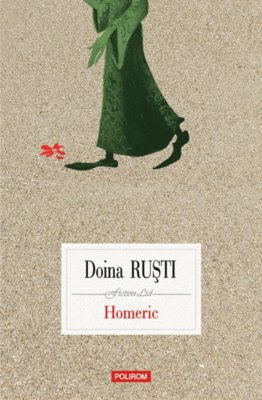
A debauch of the fabulous, in a book of damned passions and deadly charms.
Paul Cernat
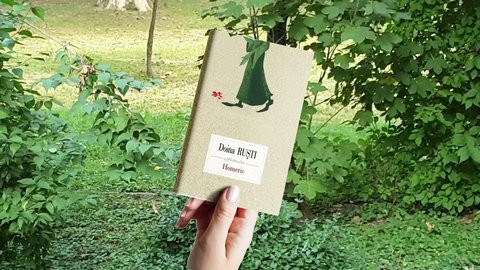
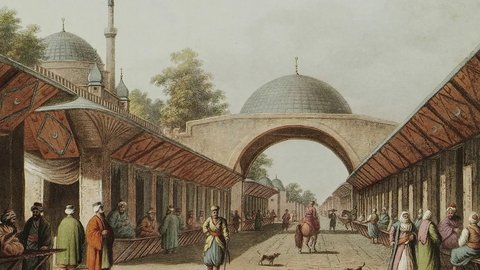
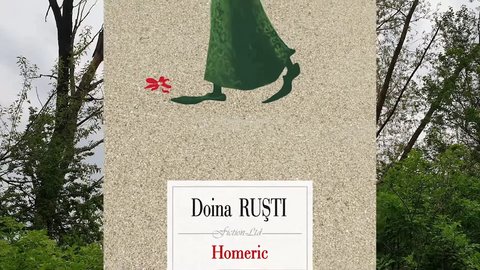
Homeric is set in late-18th-century Bucharest — a Balkan city of fragrances, merchants and superstition, where love, magic and death intertwine.
At its core lies the forbidden love story between Despina, raised in a wealthy household under the watchful eye of a ghostly guardian, and Pantelimon, a talented but married painter. Each day, Pantelimon paints portraits for hire on the wall of a butcher’s shop, and people fight to appear there — even if only for a single day. He is the city’s star, adored and envied in equal measure.
Behind this love affair, strange things begin to happen: people vanish, houses appear haunted, and the Cotroceni Forest becomes the most terrifying place in Bucharest, said to be inhabited by a towering phantom. Some claim to have seen it. The entire city descends into a state of collective hysteria, fed by rumours and fear.
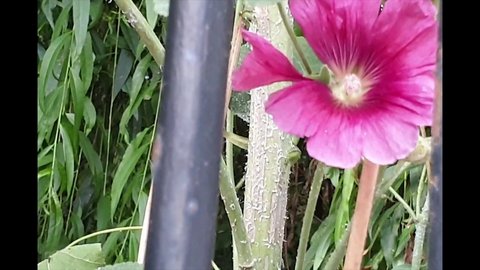
In parallel, Mărmănjica, a young botanist, finds a pressed flower hidden inside an old copy of The Iliad — the so-called Devil’s-Blood Flower, believed to possess magical powers. From that moment on, she begins to experience visions and uncovers many of the city’s secrets. By accident, she becomes a witness to the passion between Despina and Pantelimon and warns Despina to leave the painter, foretelling a terrible fate for them both.
Frightened by this prophecy, Despina announces her marriage to another man. On the wedding day, Pantelimon appears at the church, desperate to stop her. In the crowd stands Năltărogul, hidden beneath his cloak that renders him almost invisible. In a moment of distraction, he touches the two lovers, and his fatal touch turns them to dust before the eyes of the stunned guests. Panic spreads, and the crowd, believing in a curse, rushes to set fire to the Cotroceni Forest.
Only after this event does the narrator — the voice who has told the story with an uncanny sense of involvement — reveal his true identity. He is Năltărogul, the last descendant of an ancient race of giants bound to the Devil’s-Blood Flower. Their curse is that any human touch turns living beings to dust. Having lived for centuries, Năltărogul has witnessed all the stories of Bucharest, from the archaic age of his tribe to the present day.
In the novel’s closing pages, he walks through the modern city, near the Gorgan, a mysterious mound said to conceal the tombs of ancient giants.
Homeric is a polyphonic, cross-genre novel woven from many stories — of miraculous elixirs, secret loves, identical dwarfs in the forest, a priest who leaves his fortune to a cat, and a coffee-seller who turns out to be Despina’s father. Journeys to Pavia, Istanbul and Vienna, glimpses of private lives and folktale episodes — including the myth of the magical flower — lend texture and density to this world.
Beyond its magic and strangeness, the novel explores human fragility and the fate of excluded, peripheral beings — shadows that populate the collective memory.
The suspense is sustained by the narrator, who, although present in every event, reveals his identity only at the very end. Bit by bit, he speaks of himself, prompting the reader to question constantly who he is and what role he truly plays in the story.
The most striking quality of Doina Ruști’s writing, visible across all her books, is the imaginative verve from which her stories are woven—the inexhaustible energy that gives birth to characters and narrative threads. Although shaped within the conventions of the historical novel, Ruști’s prose uses historical hypotheses as pretexts for exploring fantastic scenarios, blending fiction and metafiction into an alloy of magical realism that brings her close to the great South American masters, with whose work numerous correspondences may be drawn. The fabulous stories in Zogru, The Book of Perilous Dishes, The Ghost in the Mill, or The Phanariot Manuscript are, almost without exception, also stories about the act of storytelling itself—subtle metanarratives on the nature of fiction, its status, and its relationship with reality. More