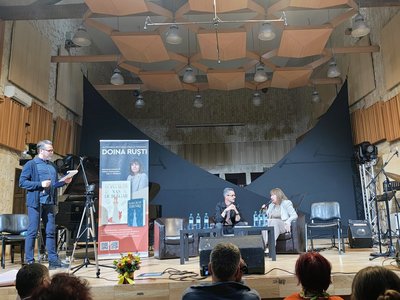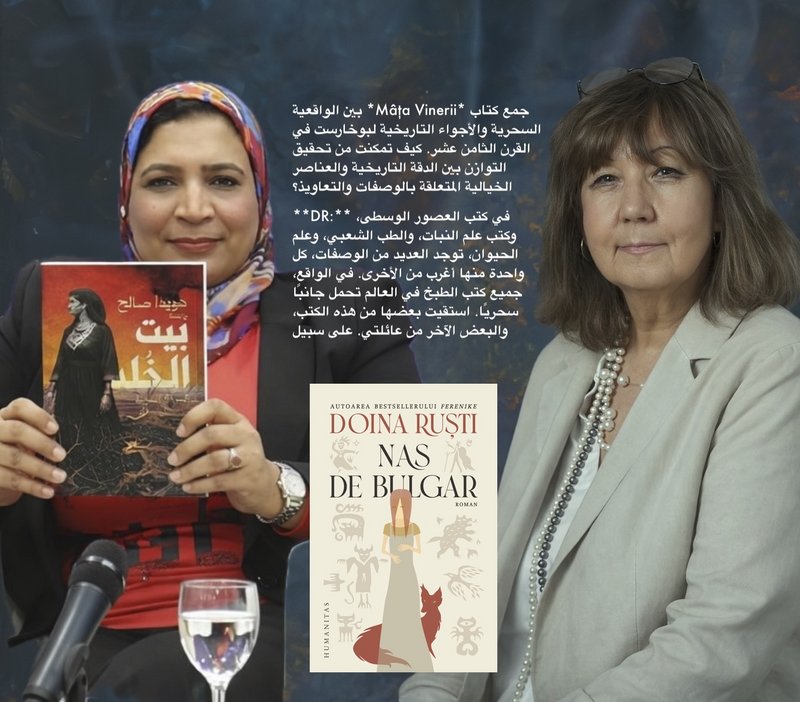
The excerpts below are taken from the interview published in the magazine Misr El-Mahrousa, Cairo.
HS: The Book of Perilous Dishes blends magical realism with the historical atmosphere of 18th-century Bucharest. How did you balance historical accuracy with fantasy elements?
DR: In medieval manuals of botany, folk medicine, and zoology, there are countless recipes—each more unusual than the last. In fact, all recipe books have a magical dimension. Some I took from such texts, others from family tradition. For instance, the remedy for melancholy comes from Avicenna, while the chicory bread follows my grandmother’s recipe.
Q: Why did you choose the kitchen as the central space of conflict?
A: I chose the kitchen almost by chance. I found a document from around 1780 about the abduction of a very talented cook. It impressed me, and I wanted to write about it. Gradually, I entered the fabulous mythology of the kitchen.
Q: Your prose has strong visual density.
A: It works the other way around: I have a very strong visual memory, which is why every story unfolds for me in a cinematic way.
Q: How do you see the translation of your work into other languages?
A: I don’t worry about translation—it largely depends on luck. There are exceptional translators who enhance a work, and I’ve been fortunate. A translation is another work altogether; it belongs to the translator, while I remain only its ancestor.
Q: Has Romanian literature overcome its cultural isolation?
A: No. Contemporary literature operates within a vast system of promotion and commercialization, which inevitably leads to translation and circulation. A work without financial support dies almost immediately.
Q: How does your academic background influence your writing?
A: I have always been drawn to myths and their endless imagery. I have written two dictionaries of symbols, and while teaching at the Faculty of Film, I made films inspired by Romanian symbolism.
Q: Can Pâtca be seen as a search for identity?
A: Pâtca is an orphan, so she naturally seeks her roots. She is also a minor, exposed to danger, and a woman in the 18th century, when women’s conditions were far worse than today. Above all, she belongs to my gallery of female characters: independent and sometimes anarchic.
Q: Your female characters often possess hidden powers.
A: My female characters are stubborn, independent, and combative, often with hidden strength. I believe femininity holds the keys to seduction not as a natural gift, but through reason. My characters are cerebral; even young girls display maturity. What we call feminine intuition stems from rational deduction.
Q: Why are you drawn to the 18th century?
A: For Romanians, it marks the beginning of modernity—a period moving toward emancipation and Westernization.
Q: There is a tension between pleasure and danger in your work.
A: I am not in a position to answer that. For me, narrative play comes first—I enjoy constructing a story.
Q: What is your current project?
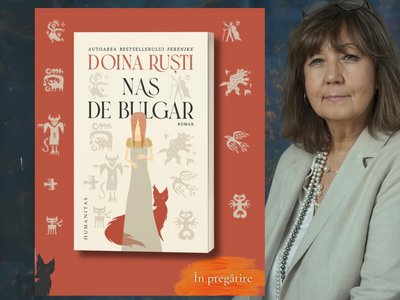
A: My novel Nas de bulgar has just been published, a continuation of Ferenike, a story about love and identity. I am now preparing for a national tour.
Selected excerpts from interviews *here.*