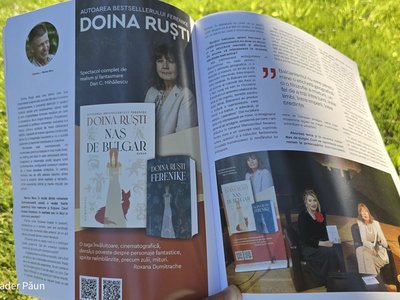
Doina Ruști was invited by HotNews for an in-depth conversation about My Bulgarian Nose, identity, communism, freedom, and the future of literature. After the interview was published, the writer left a few personal reflections here: every conversation, she says, opens doors into personal memory.
I enjoy talking to people. I especially love unplanned conversations, when the person across from me asks something I had never considered before. Sometimes you begin with an idea or a book and, almost without realizing it, arrive at your own obsessions and at events long past. Every conversation makes you dig beneath the surface.
That is what happened a few days ago at HotNews, when I met Ana Tepșanu. We began with My Bulgarian Nose and the idea that “to love is to discover who you are,” and I remembered the “fortress” I had built around myself—a fortress many of you will recognize—and those distant years when I was afraid of losing, of exposing myself, although everything in life depends on the happiness of stepping outside, revealing yourself, and being noticed.
From there, it was only a small step to my roots south of the Danube and to the Balkan world. I cannot look in the mirror without seeing all my ancestors mingling there, not without losses, crossing the Danube hundreds of times.
That is how I came to speak about the eleven stories within the novel, about the realm of the fantastic, and about the deceptive character who guards the crossroads of my fiction: an apathetic, indecisive, and often enchanted creature. I no longer even feel like calling this creature Balkan, but rather Danubian.
The windows let the July sky enter me and, inexplicably, brought back memories of the past, of the sinister Ceaușescu era—not merely as a time of cold and shortages, but as a world in which “your life did not entirely belong to you,” and every encounter with another person could change your attitude.
We spoke about freedom.
Inevitably, we arrived at Ferenike and at the woman’s body, transformed by the dictatorship into the property of the state.
But it was also a conversation about journeys and future projects. I seized the moment and spoke about my encounter with Matuf, a wigmaker from an old Phanariot world, during the reign of Mavrogheni.
And that is how I came to announce my new novel: an adventure, a thriller written in a fantastic-speculative mode, and, of course, a crossover novel, about which I will let you read more in HotNews.
Matuf Peruchierul is, above all, a novel about AI.
And at the end, as often happens, we returned to love and to the present. Perhaps, before making grand declarations, we should begin with a more modest and more difficult exercise: to temper our hatred.
The full interview is available in HotNews.