The novel Fantoma din moară entered a new stage of reading and interpretation with its translation into Hungarian. The Hungarian edition, A malom kísértete (Orpheusz Publishing House, Budapest), translated by Szenkovics Enikő, offers not merely a passage from one language to another, but a cultural re-reading of a work of fiction centered on communism, memory, and the mechanisms of collective fear.
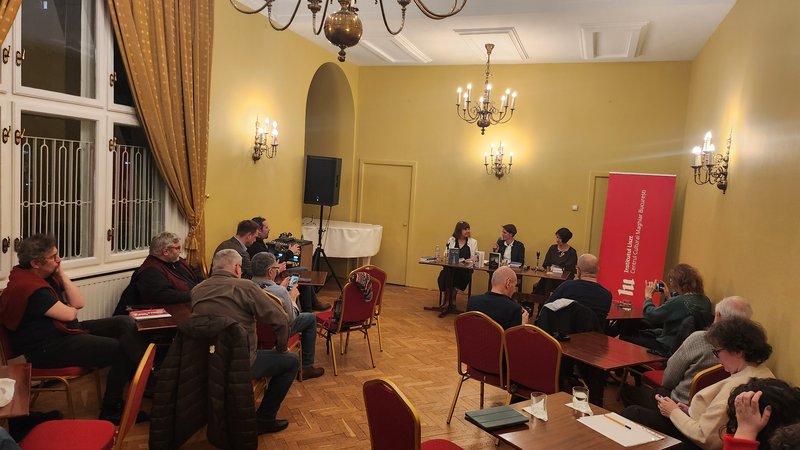
The translation was presented in Bucharest during the mini-festival Corzi literare, a project dedicated to Romanian–Hungarian dialogue through literature and translation, organized by the Institutul Liszt – Centrul Cultural Maghiar București and the Institutul Cultural Român.
In this context, translation was not treated as a secondary, technical gesture, but as a literary event in its own right, in which author and translator engaged in a dialogue about meaning, memory, and the shift of perspective brought about by a change of language.
Invited writers included Karácsonyi Zsolt, Doina Ruști, Mircea Cărtărescu, Sántha Attila, and Szöllősi Mátyás.
The Ghost in the Mill is a novel built on the tension between communist reality and its invisible mechanisms: fear, denunciation, repressed sexuality, and the distortion of human relationships. Its translation into Hungarian relocates this world into a cultural space shaped by different forms of totalitarianism and historical trauma, yet governed by similar mechanisms of control and erosion of intimacy.
In this sense, translation functions as an interpretation. It does not merely reproduce a text, but situates it within a different horizon of expectations. In Szenkovics Enikő’s translation, certain emphases shift, some tensions become more visible, while others acquire a different density. The novel does not “lose itself” in translation; it transforms — a sign of its literary resilience.
An essential element of this process was the dialogue between author and translator, which made visible the otherwise invisible labor of translation. The translator is not a neutral intermediary, but a cultural mediator, tasked with finding not only lexical, but also historical, mental, and affective equivalents.
In the case of The Ghost in the Mill, this dialogue addressed not only linguistic solutions, but also the ways in which Romanian communism can be read through a different collective memory. Translation thus becomes a form of implicit criticism — an active reading of the text.
The Hungarian edition is part of the novel’s broader trajectory, which since its publication has been regarded as one of the most powerful Romanian works of fiction about communism. Its circulation in another language confirms that this theme does not belong to a single national space, but to a shared East-Central European history, with all its variations.
Translation does not merely provide visibility or cultural export. It is a test of endurance. A translated book is a book reread, challenged anew, and exposed to a different sensibility. In this sense, The Ghost in the Mill continues to exist not through immediacy, but through duration.