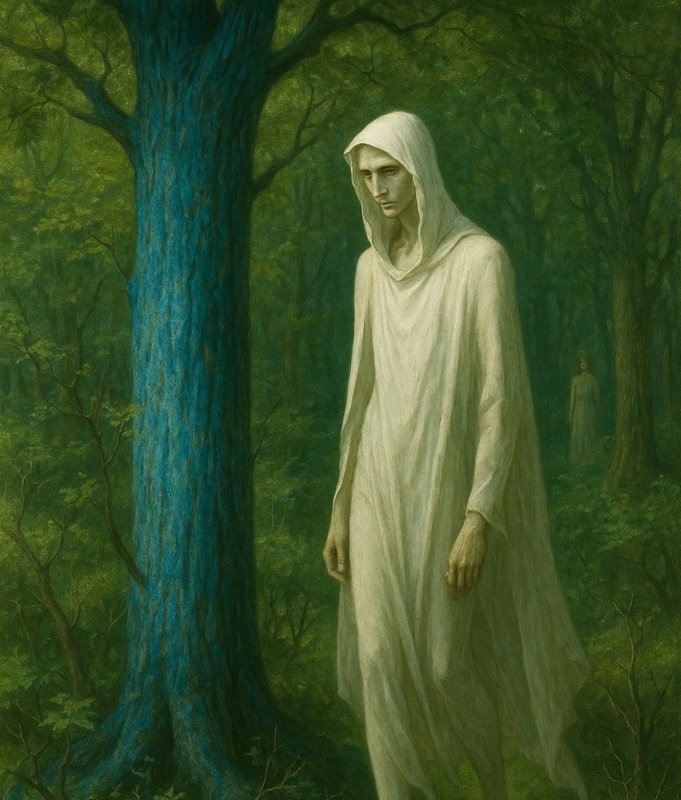
The city swarmed with mysteries, and among them, the most pressing questions were about those who had vanished without a trace.
In the dreams of the Gorgani mahalale, all evil lay in the forest at Cotroceni—a place many had never entered, though they saw it from afar, like a weave of thorns, inhabited by dwarfish creatures with poisoned claws. They came out mostly at night, spreading through the streets—tiny, relentless, perfidious beings, no taller than a handspan, ready to sink their teeth into the lower leg of a man.
These monsters were driven by a single desire: to destroy Gorgani, the whole web of mahalale, believing themselves the rightful masters of the waters of the Dâmbovița, bound, in a way, to reclaim their land. In the rest of Bucharest they were less feared, rarely spoken of, though for everyone the forest remained a diabolical place.
Many had heard of the unseen one, had felt his presence, his breath. Others—fewer—spoke of a hulking creature said to live beneath a mound, called since old times Gorgan. The thought took hold, and at night Mărmănjica would wake in terror and run to the window, fearing the ghost’s breath might burst forth in waves.
Năltărogu, whom she had seen so clearly, was becoming something else—a threat, a monster feeding on the people of Gorgani.
Like so many others, she began to imagine the fabulous kitchen hidden beneath Gorgan: a great hearth where Năltărogu cooked ciulama of people.
When she opened the windows toward the market, the smell of stew would often drift in—a scent that, in the evening, when the linden trees stood perfectly still, floated above the houses, slipped into gardens, and spread across the Dâmbovița, all the way to the mud of the ponds. Above Gorgani Square, vaporous hats would sometimes gather—the souls of those boiling in the cauldrons of the man-eating specter.
At other times came the sly smell of frying, softened with hop leaves scalded in wine, or the thin smoke of cornmeal cakes. At noon, one could feel the steam of compote, ready to be dripped into salads. But it was the honey-soaked roasts that ruled the neighborhood—slow-cooked, but also grilled, smeared with garlic.
Boiled turnips and vine leaves sent their sorrow into the streets, and sometimes one could hear the bubbling.
Deep within Gorgan, the hearth roared, and Năltărogu, turning pancakes, whistled softly.
Mărmănjica remembered him in the marsh—a floating head. She dreamed of his wide eyes, as if they compelled you to forget all thoughts of ogres and ghosts.
Why hadn’t he eaten her?
Perhaps he had his preferences. Perhaps he was particular—and, of course, he had plenty to choose from.
You don’t make stew out of blackbirds and thrushes.