Editorial Note
The short story “Crime and Poetry” was published in 2022 in Amorous Oddities from Phanariot Bucharest, issued by Litera Publishing House. The video version featured on this page was also made that year.
The historical events evoked in the story are based on period documents. The interpretation of the conflict between Alecu Văcărescu and his family—including the hypothesis that a homosexual love lay behind his being disowned—represents the original literary perspective of the novelist Doina Ruști.
The text and its literary interpretation are republished here to establish the source and chronology of this perspective.
One day in September 1835, Ban Teodor Văcărescu went out for a walk. This ban, nicknamed Furtună—Storm—on account of his choleric temper, was extremely rich and extremely stingy. Still, he had no liking for gifts, bribes, or blackmail. There was even a story going round about his loathing of money made by dishonest means. A man once tried to bribe him, and Furtună struck him across the mouth with the purse of coins. He was a bit of a crackpot, they said, but he meant well and had his heart in the right place. His friends called him Teodorachi. Yet the name Furtunăshows him turning everything upside down.
That autumn afternoon he met Chladek, a young blue-eyed painter, Czech by birth, who spoke Serbian and perhaps knew some Romanian too—or learned it later, at any rate. The meeting meant a great deal to Ban Furtună. Perhaps it reminded him of his youth. This Anton inspired confidence, and Teodorachi began to talk. He had a medallion bearing the painted likeness of his cousin, long dead. For some reason nobody knows, Furtună wanted a portrait. He asked Chladek to correct the likeness, to add to the eyes the passion preserved only in his memories.
Evening fell unnoticed. A man made of milky mist entered through the window, and Ban Furtună, fearsome as he was, burst into tears.
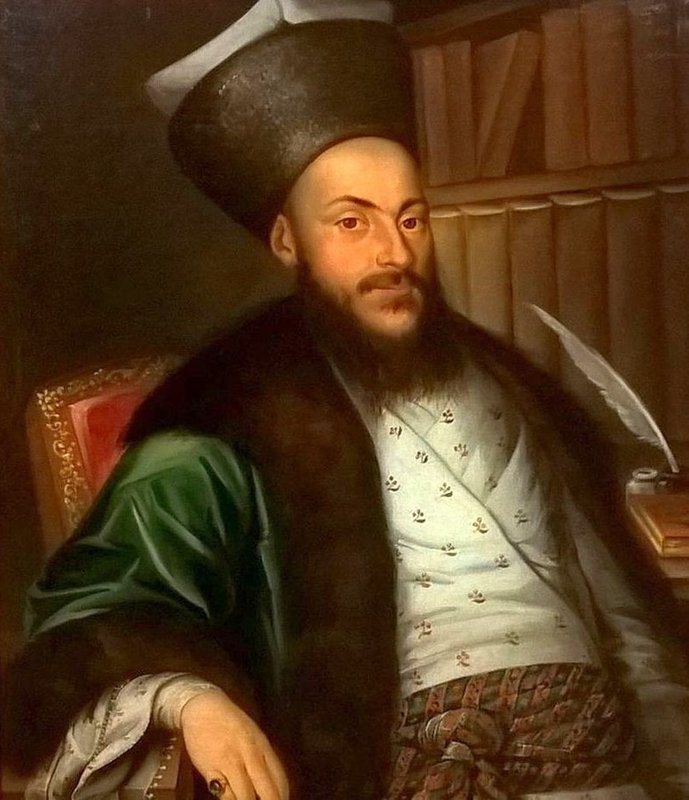
The painter Anton Chladek carried this episode in his heart, and the portrait of Alecu Văcărescu was born from the fragrance of that evening.
Alecu died young, at the end of the eighteenth century. He was a poet and the son of a poet, for his father was Ienăchiță Văcărescu.
Alecu’s life was short and extraordinarily turbulent. His mother died when he was young, and Ienăchiță married twice more, first Elena and then Ecaterina Caragea, an authoritarian woman. When the family was exiled to Nicopolis, Alecu spent his adolescence as a fugitive, first in Bulgaria and then on the island of Rhodes.
By the age of twenty-one he was already married to Elena Dudescu, who was fifteen. In record time, he became the father of three children.
But this is not how he stayed in Teodorachi Furtună’s memory—not as a pater familias. Alecu was one of the leading figures of Bucharest’s high-living set, forever moving from one revel to the next. The musicians sang his verses, and his inimitable voice influenced many people. His poems speak of a certain Luxandra, of Elenco. But the names are more like labels on costly perfumes. Nothing definite is known about his love affairs. A few lines remained in Furtună’s mind, and he recited them to Chladek in the dim light of a September evening: “Nor death, nor grief, nor torment, nor fear, nor shame / Shall ever tear me, in this life, from thee.”
An old mouth whispers and trembles, drawing out its memories, while the portrait is already taking shape in Anton Chladek’s mind. Looking at it today, I can almost hear the words of Teodorachi, for whom his cousin Alecu Văcărescu remained unforgettable.
A poet, hypersensitive, impetuous, timid and choleric all at once, Alecu must have irritated a great many people. There is something effeminate about him. He has distinction, elegance. He wears a whitish anteriu, in an age when boyars chose livelier colours, matched to an ișlic whose crown of white silk has been smoothed with a feather. He wore just one ring, on his little finger. His beard is carefully arranged, trimmed to the millimetre. All of this shows me a sensitive man, attentive to his appearance.
The story goes that Alecu led a dissolute life and scandalised his family. His father, the great poet and scholar Ienăchiță Văcărescu, was so fiercely opposed to him that he had disinherited him. Yet Furtună also insists on a portrait of his uncle. Perhaps, deep down, he agrees with him. Even so, his bond with Alecu comes first: Alecu is the one he talks about.
They had grown up together and met often, especially at the house of Furtună’s grandmother Venețiana, a Rosetti woman who was, in fact, his step-grandmother. Both Furtună and Alecu frequently visited Venețiana’s house, not far from Ienăchiță’s—a large house with divans and doors covered by curtains falling in folds. Alecu was elegant and charming; he knew how to recite and how to recount what was happening in the town’s fashionable circles. Words came easily to him; he knew how to electrify a drawing room full of guests. He was certainly a model for Furtună. Six years separated them. Perhaps for that very reason, their relationship became close only after Furtună had turned twenty—possibly in the year of the murder.
At the time, Furtună was twenty-three and spent long periods at Jilavele, where Venețiana owned an estate. Many of the younger Văcărescus from that sprawling family spent their weekends there.
And it was at Jilavele that the murder took place, one October morning in 1798. Venețiana was found dead, poisoned by three hired killers who specialised in poisons.
Snow fell, November began, and the poisoners languished in a dungeon. No one knows whether they confessed; no documents attest that they were ever questioned.
Nevertheless, suspicion fell upon Alecu Văcărescu. The motive now seems more than improbable, not to say strange. Alecu was accused of being in love with his cousin Maria—a scandalous but unproven claim—and of having disposed of his aunt in order to rid himself of her and the obstacles she had placed in his way.
The only accuser was Scarlat Câmpineanu, Prince Moruzi’s right-hand man.
For other kinds of murder, the punishment was hanging. Poisoning, however, was considered a treacherous crime: the culprit was stabbed outside the city, with no public present, and the body thrown onto the rubbish heap. I’m exaggerating—but not by much.
As he recalled the events on that autumn evening, while Chladek was already sketching the portrait in his mind, while darkness slipped treacherously into the drawing room and a smoky silhouette came to life in the distant corners, near the ceiling and beneath the heavy curtains—on that evening of weakness, Ban Furtună was putting in order the dreadful events he had not thought about for a very long time.
By the spring of 1797, the conflict between Alecu Văcărescu and his father had worsened. His stepmother considered him a danger to her own son, Alecu’s half-brother. This was Nicolae Văcărescu, himself a poet and the same age as Furtună. Alecu set him a bad example, and so Ienăchiță forbade his elder son ever to set foot in the house again and disinherited him. More than that: he forbade him to divorce. You may wonder how much power a parent’s word carried in such a matter. In boyar families, a son who disobeyed his father became a pariah: he was excluded from the game, marginalised, struck from consideration. It was not the betrayal of a son, but the betrayal of a caste.
Alecu had three children with his Dudescu wife and was nearing thirty. Their fortune was considerable, but divorce would have left him rather poor. He seems to have been willing to face that risk; he would have left and gone out into the world had it not been for his father’s prohibition. A social rupture with Ienăchiță would have closed every door to him.
The summer of 1797 was memorable. Ienăchiță died unexpectedly and suspiciously, apparently poisoned. Those around him blamed the Princely Palace and Moruzi. Who spread the rumour? No one knows. Someone whose words carried weight and knew how to burrow deep into people’s minds, creating connections, suggestions, little serpents that could not be stopped.
A summer day, sorrow over the city. Ienăchiță is buried with great ceremony, and Moruzi is the first to record in the official document that he died poisoned. In a closed carriage behind the funeral procession sits Alecu Văcărescu, the disinherited son, together with his family; some distance behind comes Furtună’s carriage, carrying a young, unmarried boyar. It is July, and Bucharest smells of ripe cherry plums.
Soon after Ienăchiță’s death, Alecu takes a momentous step: he stakes everything on a single throw and asks for a divorce, placing freedom above all else.
Men rarely divorced merely because they were in love outside marriage—especially a man like him, who was almost always entangled in one love affair or another. Nor did women from boyar families divorce when their husbands were merely philanderers. Great interests were at stake, preserving the caste.
In Alecu’s case, there must have been something more, perhaps something intolerable, unspeakable. Something connected to the events that followed and perhaps even to the murder of which he was accused. Only one man seems to have known the whole truth: Prince Alexandru Moruzi.
Always riding high, with a powerful father, well-placed relatives, and a wife so beautiful that the mere sight of her took your breath away, Moruzi was a memorable Phanariot prince. As his many portraits show, he was a sober fellow. He wore sensible clothes with a good-quality collar, the sort that withstands hard wear and still makes an impression whatever the changes in fashion. We also know from his numerous decrees that he detested luxury, so much so that from time to time he ordered the boyars to put an end to their extravagance and show greater modesty and restraint in their choice of clothes and carriages.
This Moruzi was a Freemason, a learned man and an excellent administrator. I would even venture to call him an avid reader, judging by the many letters from townspeople to which he replied with genuine involvement, attentive to their dramas and sometimes moved to tears by their complaints and petitions.
Strangely, he felt an utter antipathy towards the poet Alecu Văcărescu. On the surface, he could not stand him. It is said that he went so far as to pay Scarlat Câmpineanu to accuse Alecu of murdering his aunt Venețiana.
Some have speculated that Moruzi was in conflict with the Văcărescus because of a love affair between his beautiful wife and Ienăchiță, Alecu’s father, who was persecuted, condemned, and ultimately killed. But remember that Moruzi was the first to speak of Ienăchiță’s murder. Besides, Ienăchiță was his trusted man and was kept in office. Others even speak of a daughter of Moruzi whom the poet had corrupted with his poems.
I’d almost say, jokingly, that while Alecu Moruzi was a reader, Alecu Văcărescu was a poet. In a way, the quarrel between them had aesthetic roots.
Ienăchiță dies poisoned in the summer of 1797, and a year later Venețiana is poisoned. Immediately after her death, Alecu is arrested and treated like a criminal. He appears lost. In Furtună’s mind there still linger his desperate eyes and disordered clothes from that ill-fated hour when he was forced into a cart.
Although there are no other witnesses, the family does not stand by him—an incomprehensible thing. But luck is on his side: Moruzi is summoned to Istanbul, and Hangerli takes the throne in his place and immediately closes the case. Not for long. A year and a few months later, Moruzi gets the throne of Wallachia back, and the first thing he does is throw Alecu into prison, accused of the same murder by the same Scarlat—clearly hand in glove with Alexandru Moruzi. A few words about him: Scarlat, esteemed by the Austrians, a fighter and military commander with a clearly anti-Ottoman outlook, seems to have inspired confidence by being frank and firm. Moruzi valued him, or perhaps they were simply cut from the same cloth—puritanical and macho, born to command. In any case, this Scarlat was Alecu Văcărescu’s only accuser.
Scarlat’s story is flimsy. If Alecu had fallen in love with his cousin, there were many ways in which the families could have intervened: marriage, a convent, travel, or exile.
I do not believe it would have led to murder, even if there had been a relationship between the poet and his cousin.
A great many people had a hand in this story. It was not just a suspicion of murder, but a conspiracy, something far more serious that many people wanted hidden.
From the discovery of the body to Scarlat’s complaint, everything was kept secret. The police records explicitly state that no one was to enter, that no one was to see Venețiana’s body, that the rumours were not to spread, and so on.
Equally incomprehensible is the fact that the Văcărescu family did not come to Alecu’s aid. Something grave, an irreconcilable conflict, stood between them and the poet. And it was all connected to freedom. Let us remember that immediately after his father’s death, Alecu divorced, accepting all the attendant risks. He was left poor and inherited nothing from the great Ienăchiță. Because he was a reveller and a spendthrift? That would have been too little. No boyar disinherited his son merely for that.
Among the details, I would also note that both Ienăchiță and Venețiana died of poisoning, without the killer ever being clearly identified.
He does not confess to the murder. In defending himself, he says, among other things, that the victim had been very close to him—like a mother. He had spent many hours in her house, among her children and grandchildren, one of whom was Teodorachi Furtună.
Alecu arrived in his carriage, enlivening first the street and then the house. He was charming and elegant and recited poems in Greek. Every visit he made was memorable. In summer he visited her estate at Jilavele, where all her grandchildren—the children of her three sons—would gather. Teodorachi was the same age as Nicolae, Alecu’s half-brother, and six years younger than Alecu. Elegant, his mind full of dreams and love poems, Alecu was a model for them.
In the petition in which he asks to be exonerated, Alecu maintains that he had not set foot there for about a year. To him, Venețiana was already dead—that is, they had quarrelled beyond repair. There had been a scandal; Alecu had shouted and left, slamming the gate behind him. Teodorachi and Nicolae remained behind, shaken by the scene and ready to walk through fire for Alecu.
More than by the charge itself, he is angered by the man who made it. He does not merely want to clear his name; he wants Scarlat dead, and explicitly asks Hangerli for this: “Condemn, Your Highness, this chimera in human form, this living image of wickedness… this putrid abortion of nature…”
Passion, sensitivity, and talent. What emerges above all from his words is the fury of a man who has suffered an injustice. He states unequivocally that Scarlat framed him for the murder and invented the story. He insists that the three poisoners suspected of the crime be questioned. Their testimony would not have carried much weight in any case, since all three were slaves. Yet we know nothing of their statements, or even how they came to be caught.
While Alecu writes his petition to Hangerli, Teodorachi Furtună is preparing to enter the Divan, a dignity reserved for the great boyars. This suggests that financial transactions had taken place between him and Hangerli. Hangerli bought four of the Văcărescus’ estates. Perhaps Alecu’s release also came from this.
The rest of the family abandoned him, every last one of them. And this had been happening since childhood, if his mother’s death is also counted as an abandonment. Ienăchiță hurried to marry him off and was generous enough—he gave him estates just to see him married. The Dudești family was very rich too, yet Elencu, Alecu’s wife, was still a child, only fifteen. A serious conflict between her and Alecu is out of the question. We see her in old age in a portrait, soured and gloomy. For her too, the marriage and then the rupture must have been dramatic enough.
Alecu’s stepmother, Princess Caragea, was, I believe, a difficult woman, proud of her princely descent, which is why she was called Domnița, the Princess. In the long lawsuit Alecu brought against her after his father’s death, one sees how abjectly the judges bowed before the Princess, who gave her stepson nothing. The suit was long and ruinous, and Alecu wrote his own arguments in a clear, elegant style.
Meanwhile, again through Hangerli’s favour, he received the office of clucer. He supervised the collection of taxes for the Palace. He would climb into a carriage and travel through several southern counties in the dry frost of November.
The divorce proceedings, too, were long and ugly.
Nobody wanted him; nobody had a kind thought for him. All the Văcărescus seem to have come away the worse from meeting this impetuous, sensitive and rebellious pre-Romantic poet.
Even after his death, Alecu remained a kind of secret relative. His son Iancu, also a poet and in many respects his father’s spiritual heir, discreetly brought his remains to the family cemetery. His name was whispered by all the Văcărescus who lived after him and had never known him.
After Moruzi’s second accession to the throne, Alecu is arrested again on the same murder charge and sent to a prison in Tulcea—in reality, a guarded enclosure. He sleeps outside in the rain, on a reed mat, with only the clothes on his back. He has no money and barely manages to write a few letters—none of them to his family. From these we learn something of his detention, or rather his extermination. Tulcea was under Ottoman jurisdiction, and sending him there was excessive indeed. Yet no one seems scandalised by it. In his last letter, he complains that the guard will soon take away his inkwell.
He endures humiliation and torment from summer until autumn, when he dies, in November 1799. He was only thirty. In the last moment of his life, as the damp from the mat seeps into his bones and winter vapours gather above the Danube, he sees the face of Scarlat Câmpineanu before him, in the guise of an avenging angel.
The only man who might have known the whole truth was Moruzi, and he let nothing come to light—especially as he had little time. In 1816 he fell from favour, was arrested, and sold to the galleys. Before he died, pulling at the oars with no hope of rescue, the figure of the chimerical Scarlat appeared to him, reminding him of the real reason Venețiana had died—a secret he carried with him into the next world.
Of all those who knew the poet, only Teodorachi Furtună (1774–1853) seems never to have forgotten him. Many years after Alecu’s death, when Furtună was past sixty, he met the painter Anton Chladek and, after an evening of memories, commissioned from him the portrait, one of the most expressive of the period. He did not want a portrait of his grandmother Venețiana, nor portraits of his sisters or children, but a portrait of Alecu and another of Alecu’s father. Perhaps he loved poetry and wanted his descendants to know that two poets had existed in the family. Perhaps.
The portrait of Teodorachi is also worth studying, for the weight of old memories can still be seen on his face. Shapes of mist can be discerned behind him. Looking at him, it is impossible not to notice several details: he is dressed in the clothes of his youth, in a light-coloured anteriu, with his beard trimmed hair by hair, like Alecu’s. And on his little finger he wears a ring, exactly as Alecu did.
His life, choleric by nature, passed in great loneliness, as Ion Ghica relates. He was sullen, but he had weaknesses, and avarice ranked first among them. Greed compensated for an irreparable absence. When the great Ban Furtună died, his cellar was discovered to be crammed with gold coins, but no one ever went down there because a ghost patrolled it at night, a slender silhouette that sometimes recited verses in Greek.
Of everything he had lived through, only the two poets remained in his mind, father and son, caught in a secret conflict from which poison was not absent.
Two people died, both wielding complete authority—Alecu’s father and Teodorachi Furtună’s grandmother—both poisoned. Two barriers, beyond which freedom stretched. So they believed; so they hoped.
As for Moruzi, he was merely a man who believed it his duty to restore order and put an end to every excess. And Scarlat was his trusted man, the one who whispered into his ear the city’s most closely guarded secrets and strangest happenings.
The last thing I know about Ban Furtună comes from the writer Ion Ghica. Ghica had an overdue debt carrying a large commission and visited Ban Furtună to settle the matter. The occasion allowed him to draw a Balzacian portrait of the ban, describing him as a dark, miserly moneylender. He was dressed in a green anteriu, over which he wore a brick-red woollen coat. Furtună kept him there for six hours, humiliated him and put him through the wringer, without Ghica knowing that the reason lay not in misanthropy but in a painful past. Scarlat Câmpineanu—the abortion of nature, Alecu’s accuser—was Ion Ghica’s grandfather.
(Doina Ruști, “Crime and Poetry,” in Amorous Oddities from Phanariot Bucharest, Litera, 2022)
© Doina Ruști, 2022. All rights reserved.
This text may not be reproduced, adapted, dramatised, or used in audio or video materials without acknowledgment of the source and the permission of the copyright holder.