Over the years, Agerpres, Romania’s national press agency, has published a consistent series of articles documenting the literary activity and public presence of Doina Ruști, one of the most important contemporary Romanian novelists.
These materials do not function as isolated mentions, but rather as a coherent archive reflecting a long-term cultural trajectory. Through cultural reports, official communications, book fair coverage, and in-depth features, Agerpres has repeatedly highlighted Doina Ruști’s role as a novelist, university professor, and an essential factor in Romanian cultural life.
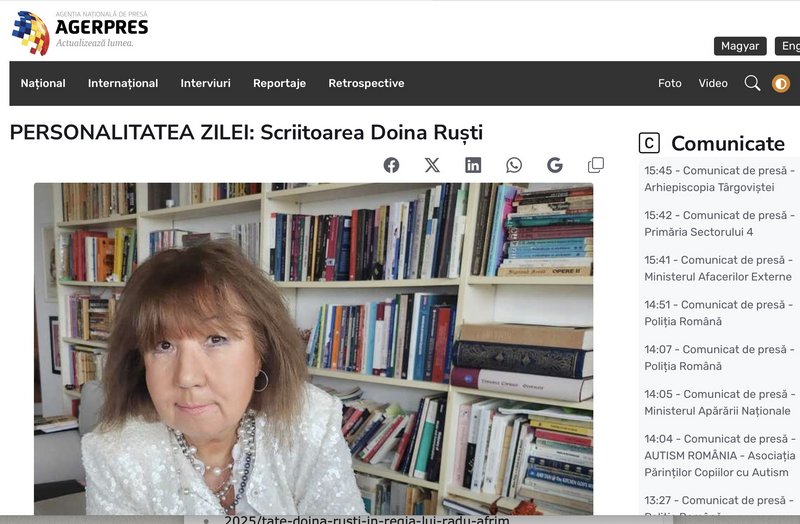
A central reference point is the article Personality of the Day: Writer Doina Ruști, which places her work in a broader literary and historical context, emphasizing the depth and continuity of a career built around fiction, memory, and cultural identity. This feature situates her among authors whose work has shaped contemporary Romanian prose and whose novels are studied, translated, and discussed internationally.
Beyond this landmark profile, Agerpres has included Doina Ruști in extensive coverage of major cultural events: international book fairs such as Leipzig, Belgrade, and Bookfest; national programs dedicated to literature and reading; and institutional initiatives involving museums, theatres, publishing associations, and cultural organizations. These appearances confirm her sustained visibility within both the Romanian and European cultural landscape.
Several Agerpres articles also document her presence at emblematic events like Gaudeamus and Bookfest, widely regarded as barometers of reading culture in Romania. In these contexts, Doina Ruști’s work is presented alongside that of leading Romanian writers, reinforcing her position within a canon shaped by literary quality and public relevance.
The accumulation of these references outlines a portrait defined not by momentary publicity, but by durability and influence. Through its long-term editorial attention, Agerpres records Doina Ruști’s contribution to Romanian literature as part of a living cultural history—one that connects fiction with social memory, intellectual debate, and artistic innovation.
Taken together, these articles form a solid documentary framework that confirms Doina Ruști’s status as a major novelist and a lasting presence in the contemporary cultural conversation, both nationally and internationally.