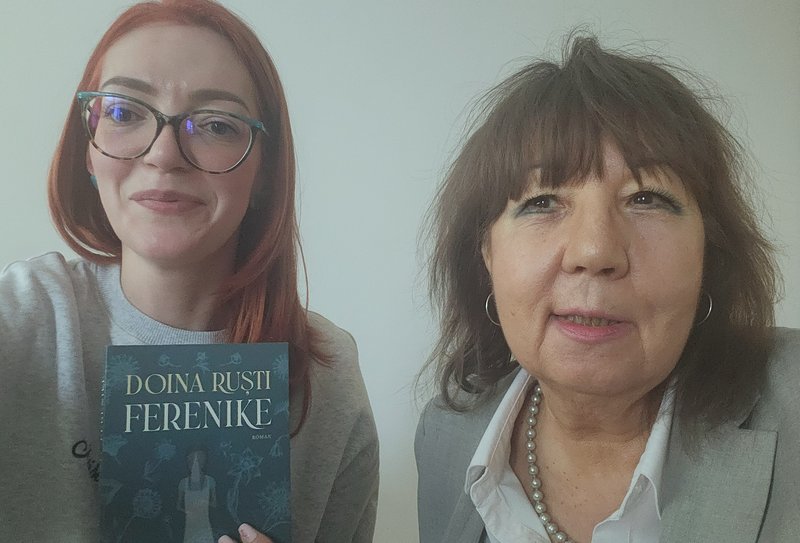
Today I came across a confession that still follows me—one I shared not long ago with Ioana Zenaida Rotariu. She asked me something about writing and fiction, and I answered.
The interview explores essential themes of the novel Ferenike: memory, the relationship between reality and fiction, and the way personal experience is transformed into narrative construction.
Zenaida Rotariu: “I hated her for her brutal honesty [Muc], yet I adored Cornel, who lied to me in an artistic way.” Who are Muc and Cornel? Do you still see them today as the five-year-old girl once saw them?
Doina Ruști: Muc and Cornel are my parents, who died young, before they had the chance to mature, and I will always see them at the age they have in the novel—the only age I ever knew them. They do not appear through the eyes of the child, but through the perspective of the mature narrator. My ages are in constant connection, just like the forms of a word that passes through metamorphoses. For example, whenever I say avatar, I think of all the plural forms I have used throughout my life. In my youth, I used the Eminescian plural avatarii, which circulated in cultured circles. It was worn out in the 1980s, when the dictionary form avatare took hold. And after ’85, when there was a push to preserve suffixes inherited from Latin, it aligned with other “made-up” neuters, becoming avataruri.
All these forms indicate an experience in evolution and a social history. Whenever I say avataruri, the other forms come to mind—the prose of Eminescu, my earlier selves, even certain garments—three nominal forms, effervescent, ready to dissolve, passed from mouth to mouth, three plural forms, exactly as they should be, in a complex and historical metamorphosis.
The same goes for my ages: though connected, each carries a singular charge. Therefore, I return to Muc and Cornel from my present perspective, in order to connect them with my other ages, including childhood.
Cornel is the main character, while Muc functions here more as a reflective figure, and nothing more. And this is natural, because Ferenike recounts my first life experience, forever tied to my father and to the central story of the novel. I avoided the classical approach, with the paternal figure in the foreground, opting instead for a character who belongs to my imaginative universe as a writer. In the reality of my childhood, Cornel was a young man, in the process of adapting socially. Immature and a poet, it was through him that I was fortunate enough to learn the paths of adventure. In the novel Ferenike, he becomes the central figure of my adventure—an adventure taken seriously, viewed from the present perspective as the natural path of fiction.
Not for a moment did I step into the child’s skin; I did not adopt naivety as a narrative mode. Symbolically, Cornel represents the fabulous side of the imagination, because, in the world of artistic “fabrications,” there exists a reparative imagination, which turns a character into a hero (positive or negative), and an imagination of long-distance messages.
Both arise from the deceptive abilities of the human being, which is why I insist here on the fabulatory side of my character. Cornel is the lying-artist, the one who, at a certain moment, opens the door to fiction for me. I did not pursue family ties; the father–daughter relationship did not interest me.
In the novel Ferenike, I am the main character.
Confessional fiction does not particularly appeal to me: I am referring to those self-revealing novels in which the author ostentatiously returns to childhood, to the discourse and tone of that time, mimicking naivety, ignorance, even purity—in a rather ridiculous way, I would say. You may recall the long series of novels in which the narrator recounts formative readings, pretending not to understand their value, or, even more implausibly, narrates communism without having directly experienced it. I have avoided falling into this realm of cliché.
I have also steered clear of the classical paths of the introspective novel, in the Proustian sense. I am not convinced by writers who analyze their past actions as if dissatisfied, yet in fact choose to foreground episodes that implicitly glorify their own being. There is, of course, the opposite tendency as well: to bring forward all the detestable events—horrors or vices—while expecting consolatory applause.
So what did I attempt to do in Ferenike? I preserved the structure of the novel—namely, the narrative thread (conflict and resolution)—while attempting a form of narrative doubling. The narrator is myself—the writer, the author of novels I explicitly mention, with a verifiable biography, much like in memoir. Yet the universe of the novel undergoes the inherent metamorphoses of fiction. There is a narrator, and there is a character followed through moments of development, a projection that is more or less subjective.
The relationship between narrator and character, as two versions of myself, remains fundamentally novelistic.
The central idea of the book is that all actions have consequences. Thus, the main character, who bears my name, acquires multiple other names throughout the novel, because each episode resonates historically. I recount, for instance, the story of Paula, a girl who occupied my thoughts as a child. This person, in fact real—as are all the characters in the book—was a student at a vocational school. From her story grows the biography of the narrator-character, shaped by the transformations of the Romanian educational system, which in the 1960s promoted vocational training, and toward the end of the dictatorship advocated the generalization of high school education. Both stages leave their mark on the narrator-character, who evolves from a detached observer of a society in the process of urbanization into an active participant in a world of formal education.
Each episode of the book is constructed on a narrative of perspective, moving from the space of the family toward that of our present. This was my intention as early as when I was writing The Ghost in the Mill, but I have only now managed to put it fully into practice.
Ferenike is an autobiographical novel in which the family is only part of the framework. The novel Ferenike is structured in three parts: I. Main Streets, II. Houses and People, and III. Ferenike. What emerges is an existential map, starting from the family and extending toward the most obscure zones of the subconscious, where the demon Ferenike takes shape.
The full interview can be read on the LIBRIS platform, where the complete version of this dialogue is published.