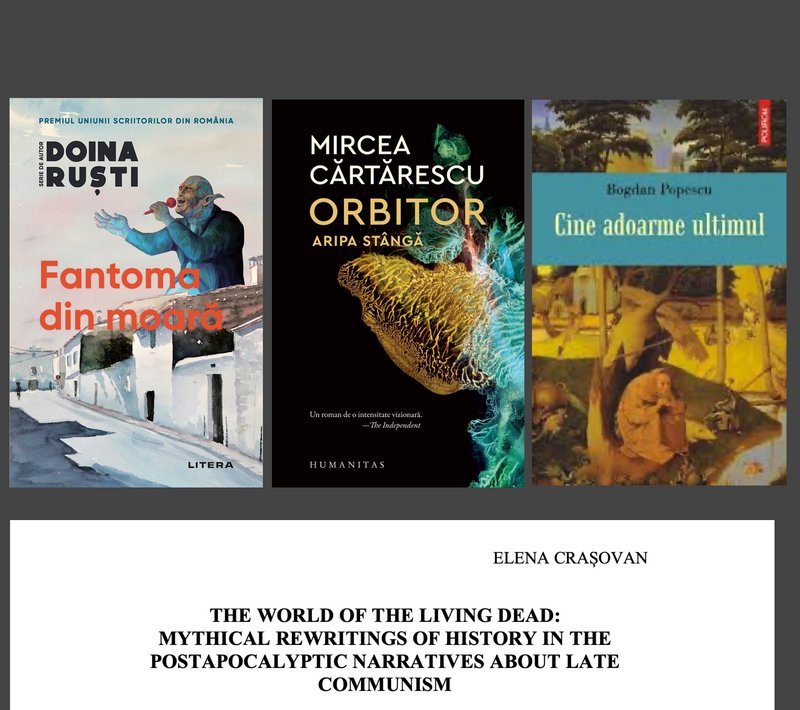
In a study published in Dacoromania litteraria in 2017, Elena Crașovan, professor at the Faculty of Letters of the West University of Timișoara and literary critic, offers a comparative reading of three novels about late communism: Blinding. The Right Wing by Mircea Cărtărescu, The Last One to Fall Asleep by Bogdan Popescu, and The Ghost in the Mill by Doina Ruști.
The study starts from the idea that these novels do not merely “tell” the story of communism, but mythically rewrite it, opening a symbolic perspective on history, one dominated by apocalypse, ghosts, contamination, and collective memory. In this interpretation, magical realism does not function as an ornament, but as a way of understanding a historical trauma that cannot be reduced to a simple realist account. In this context, The Ghost in the Mill occupies an essential place: it is the novel in which the ghost becomes the figure of a past that can no longer be buried.
For Elena Crașovan, the world of The Ghost in the Mill is built as a double space. On the one hand, Comoșteni preserves the image of a childhood village, with its rituals, superstitions, small events, and local mythologies. On the other hand, the same place becomes the scene of a violent history, distorted by totalitarianism. The village is not merely a setting, but a living, vulnerable organism, crossed by fear, silence, and obscure forces.
The mill, situated at the center of this world, appears as an ambivalent symbol. It is the “heart of the village”, a place of work, food, and the circulation of life, but also a mechanism of devouring. The destruction of the mill in the 1980s is not read as a liberation, but as a false end of the world. Once pulverized, the past does not disappear; it spreads into people. Trauma no longer has a precise location, it can no longer be isolated, but infiltrates bodies, gestures, and the community’s way of living.
One of Elena Crașovan’s most important observations concerns the way in which the novel transforms the ghost. We are not dealing with a classical apparition, tied to a haunted place, but with an invasive presence that enters the body and the mind. The ghost does not remain outside people; it gets inside them, disturbing their intimacy and altering their existence.
For the characters in The Ghost in the Mill, the encounter with the ghost is experienced as aggression, as a violation of intimacy, but also as a strange form of dependence, trance, or sickly love. Victims and executioners, poor peasants and servants of the regime, all come to share the same condition: they are possessed bodies, lives lived “together with someone else.” This is the starting point for Crașovan’s reading of the “world of the living dead”, a world in which people continue to walk, work, and repeat everyday gestures, but have lost control over their own destiny.
The study also discusses the idea of “reverse nostalgia”, a concept borrowed from Svetlana Boym. This is not a longing for an idealized past, but the dream of a redemptive future, in which someone, someday, will repair everything. In this key, the novels under discussion speak of communities trapped in an endless transition, of characters who no longer believe they can change anything, and of history felt as an impersonal force, coming from outside, passing over people and crushing them.
In The Ghost in the Mill, this idea takes shape in the image of the inhabitants of Comoșteni, who no longer perceive themselves as subjects of their own lives, but as extras inserted into a story written by someone else. They live under the pressure of a history imposed upon them, one they can neither fully understand nor truly bring to an end.
Elena Crașovan insists that the magical realism of The Ghost in the Mill is not a form of escapism. On the contrary, it becomes a way of representing what cannot be said directly, what remains too painful, too obscene, or too deeply buried in the history of communism. The ghost, the mill, the contaminated village, and the possessed bodies become literary forms through which the “unnamable” past is recovered and transformed into image, atmosphere, and local myth.
At the same time, the study underlines a paradox. Although these novels seem to offer an apocalyptic view of history, what they reveal is rather the impossibility of truly settling accounts with the past. The apocalypse clarifies nothing, the ghosts do not leave, and post-communist communities remain caught in a suspended time, between trauma and the expectation of a salvation that keeps being deferred.
The importance of this reading lies in the fact that Elena Crașovan places The Ghost in the Mill in a major dialogue with two other representative novels about late communism and highlights the metaphorical force of the ghost as a figure of history entering people. In her interpretation, magical realism does not conceal reality, but makes it more visible, precisely because it transforms it into myth, image, and bodily experience.
For today’s readers, the study offers a fertile key to understanding the novel: The Ghost in the Mill is not only the story of a haunted village, but also the story of a society trying to go on living with its own ghosts, created by communist history and implanted in people’s lives.