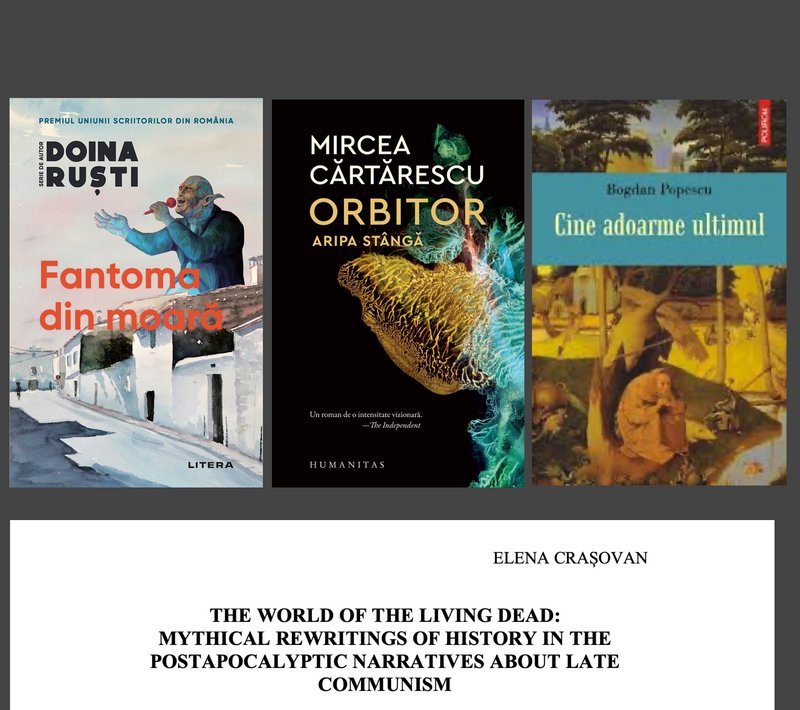
In a study published in Dacoromania litteraria (2017), Elena Crașovan, professor at the Faculty of Letters of the West University of Timișoara and literary critic, proposes a comparative reading of three novels about late communism:
Orbitor. Aripa dreaptă by Mircea Cărtărescu,
Cine adoarme ultimul by Bogdan Popescu,
Fantoma din moară by Doina Ruști.
The study starts from the idea that these novels do not merely “tell the story” of communism; rather, they mythically rewrite history, opening a symbolic perspective dominated by apocalypse and ghosts, within the tradition of magical realism, as a way of speaking about collective memory. In this context, Fantoma din moară occupies a central place, as the novel in which the ghost becomes the metaphor of a past that can no longer be buried.
For Crașovan, the world of Fantoma din moară is a double space: on the one hand, the village of Comoșteni is the place of childhood, with its rituals, superstitions, and small local mythologies; on the other hand, the same place becomes the stage of a violent history, distorted by totalitarianism.
The mill, “the heart of the village,” appears as an ambivalent symbol: it is both a source of life and a mechanism of devouring. The destruction of the mill in the 1980s is not interpreted as a liberation, but rather as a “false end of the world”: the past is not buried but pulverized and scattered among people, who remain forever bearers of trauma.
Elena Crașovan’s most important observation concerns the way the novel transforms the ghost. It refers to the idea that we are not dealing with a classical apparition haunting spaces, but with an invasive agent that enters the body and the mind.
For the characters in Fantoma din moară, the encounter with the ghost is experienced as:
physical aggression,
violation of intimacy,
but also as a form of sick love, dependency, or trance.
Victims and executioners, poor peasants and agents of the regime share the same condition: possessed bodies, lives lived “together with someone else.” This leads Crașovan to speak about the “world of the living dead”: people who continue to walk, work, and repeat gestures, but who have surrendered control over their own destiny.
Another important aspect of the study is “inverse nostalgia” (a concept borrowed from Svetlana Boym): not the longing for an idealized past, but the dream of a salvific future in which someone, someday, will repair everything.
In this key, the novels analyzed — including Fantoma din moară — speak about:
communities trapped in an endless transition,
characters who no longer believe they can change anything,
a world in which history is felt as an external, impersonal force that passes over people and crushes them.
In Fantoma din moară, this idea takes shape in the image of the inhabitants of Comoșteni, who begin to perceive themselves not as subjects of their own lives, but as extras placed inside a story written by someone else.
Elena Crașovan also insists that the magical realism in Fantoma din moară is not merely a stylistic ornament, but a way of representing:
what cannot be said directly,
what is too painful or too obscene in the history of communism.
The ghost, the mill, the contaminated village, the possessed bodies — all become forms through which literature recovers an “unspeakable” past and transforms it into image, atmosphere, and local myth.
The study also highlights a paradox: although these novels seem, formally, to offer a distant, almost apocalyptic perspective on history, they actually testify to the inability to truly settle accounts with the past. Ghosts do not leave, the apocalypse clarifies nothing, and post-communist communities remain trapped in a suspended time.
Even though Elena Crașovan’s interpretation emphasizes symbolism and the imagery of the book, dominated by the “living dead,” the study has the merit of:
placing Fantoma din moară in a major dialogue with two other representative novels about late communism;
highlighting the metaphorical force of the ghost as a figure of history entering people’s lives;
showing that the magical realism of the novel is not escapist, but a form of critique of the past and an exploration of collective memory.
For today’s readers, this interpretation offers a possible key of understanding: Fantoma din moară is not only the story of a haunted village, but also the story of a society attempting to live on with its own ghosts — ghosts created by communist history and embedded in everyday life.