When I chose Tuesday as the day on which to write for this blog, I did not give a single thought to the symbolic arsenal attached to it—a day that is, in fact, one of the most carefully treated of the week. Over time, it has received special attention, emerging from the underground layers of its etymology and then being mythically sustained right up to the present.
In folklore, Saint Tuesday appears as a harsh, punitive divinity, unforgiving toward those who fail to respect her rules. These traits are consistent with her name, derived from Mars, the god of war.
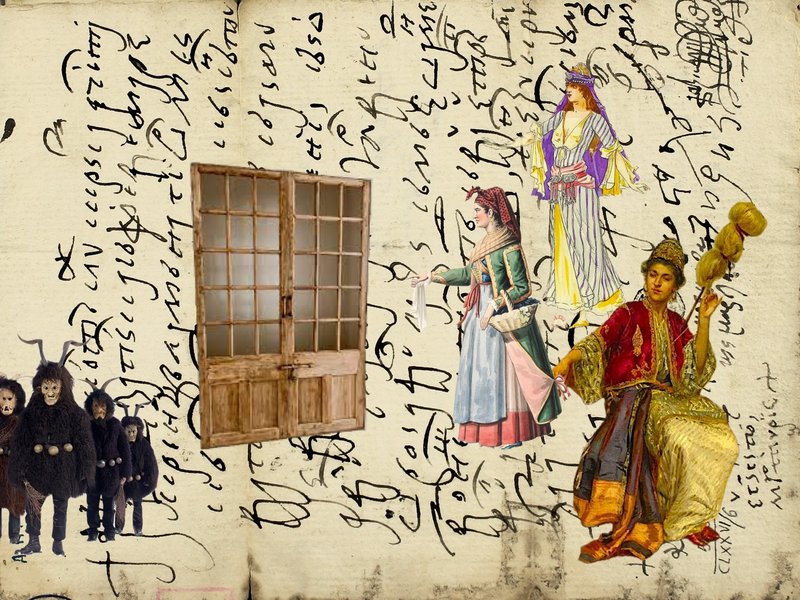
There are numerous stories that illustrate the saint’s character, often called Marțisara. She comes disguised as a familiar figure and catches women working on Tuesday night, between Tuesday and Wednesday. Her greatest challenge is to manage to enter the house. And in order to do so, someone must answer her when she calls.
She kills with cold blood: she scalds children, burns houses, flays women. It is pure horror.
From Marțisara derives Marțolea, another hideous being, whose head is that of a woolly goat, while her legs and hooves resemble those of a horse. This description appears in the work of Simion Florea Marian. Marțolea can take any form, though most often she appears as an unimaginably ugly and cruel old woman, faithfully served by cats.
Disguised, insinuating, cruel.
There are, however, a few weapons against her, among them a wheel placed in the doorway and a black animal, most often a cow.
These two protective elements prevent Marțisara from entering the house. The wheel signifies suspended time, as it is nailed to the door, symbolically sealing off the period over which the saint rules—the evening and night of Tuesday, until dawn on Wednesday. The symbol of the black cow evokes sacrifice, since animals used to force fate are often black, a color associated with mourning and death. The black cow is tethered at the door to replace, through a blood sacrifice, the projected death of the girl.
Among the offenses, in Saint Tuesday’s eyes, are—first and foremost—the violation of Tuesday evening, a time devoted to meditation, but especially the punishment of a cat.
Marțisara also presides over Mărțișor Day, when she sometimes gives a girl a silver coin, a bringer of good luck.
There are also stories in which Marțisara falls in love with girls—and eats their hearts.
Where does this bizarre, hybrid, malevolent being live? In the solitude of the mountains, of course. There she sometimes sings, and her song is so tender that it moves the hearts of those who hear it.
All these traits and zoomorphic features reveal her kinship with the fauns and sylvan deities of Greco-Roman mythology. But unlike Silenus or Pan, Marțisara appears as a cruel, warlike, and vengeful figure, like the god Mars himself.
In another sense, that of archaic symbolism, Saint Tuesday also presides over the month of March, the month of nature’s rebirth, when spring and winter are locked in a fierce conflict.
As the bloodiest and most relentless of the week’s archetypes, Marțisara has generated numerous superstitions related to the ominous time of Tuesday, including the belief that if you sneeze on a Tuesday, you are certain to quarrel with someone or suffer misfortune.
In order to soften this superstition, I decided to write here every Tuesday—a story, a thought, a discreet incantation. And of course, by reading, you too are protected from the malice of Tuesdays. 🙂