Once there was a highly successful actor named Achile Popescu. He was prepared for any role, and audiences knew him from the National Theatre, where he played memorable parts in L’habit vert, Buridan’s Ass, The Flower Seller, and many others. He was a master of comedy. He even founded his own troupe and toured the country. But he died young—of a heart attack, in a foggy February of 1916.
Little is known about him today. His death was mourned in the streets, and his funeral was filmed; the footage became a short documentary that was screened repeatedly in cinemas, before the main feature, until it wore out and disappeared, like all things that once enjoyed immense success.
And yet he was not forgotten. True actors, whose art vanishes without leaving traces, do not truly die. They linger in the minds of those who loved them, who in turn pass them on to others—people who rummage through the remains of another time.
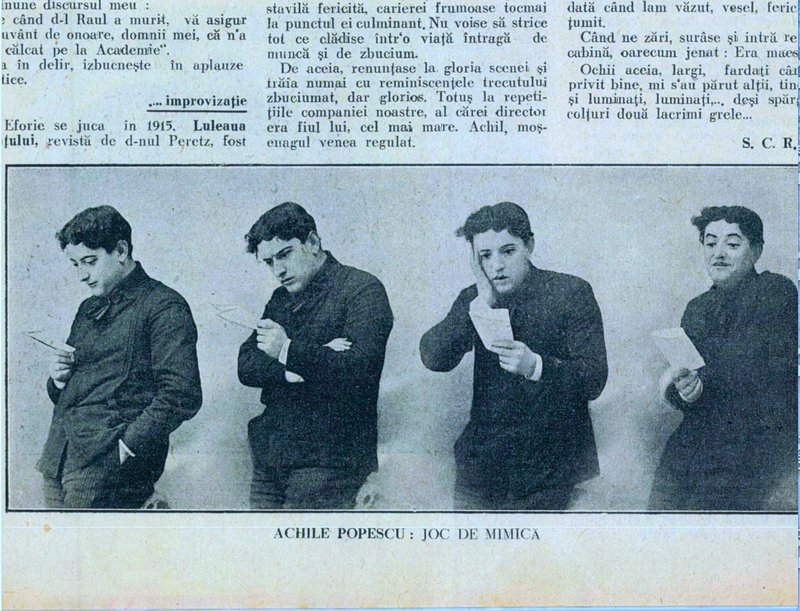
Achile’s name resurfaced periodically in cafés and newspapers. I found several photographs of him in a 1928 issue dedicated to his memory. The homage, written by fellow writers, transformed his life into literature. Among other things, it announced the screening of the documentary of his funeral that very evening at the Trianon cinema. And since the journalist was, as I said, writing literature, he claimed that admirers could meet Achile himself at the cinema.
Among the readers of that newspaper was Anette—and she is the one I want to tell you about.
It was May 1928. The city sighed in anticipation of summer, and young souls hoped for that exceptional encounter—the kind that allows one to copy all one’s desires into a single file, guarded for the rest of one’s life, so that the euphoria of a first great meeting rarely ever returns. Anette was in exactly this state. She had recently turned nineteen and had inherited the unfulfilled lives of the women before her: a grandmother who had been a royal cook, a mother—an actress with only two minor roles to her name—and two aunts swallowed by the sadness of the times.
Her ideals were clear. Whatever she would do in life, she would not repeat the mistakes of the women in her family. She would be dignified. She would seek true love and build a good family, one worthy of albums filled with composed faces and many children.
Anette had never known her parents. Her mother died shortly after giving birth, and her father was listed as unknown on her birth certificate. Still, her aunts occasionally alluded to a famous actor named Achile Popescu—a name that clung to Anette’s soul like a reference point.
The article about the great vanished actor brought her to tears and awakened in her an overwhelming need for consolation.
After finishing her shift at the Princiar pastry shop, Anette rushed home to Berzei to change and dress carefully. That evening, she presented herself at the Trianon cinema, where she was to see the great Achile—celebrated actor and the only notable figure in the uncertain life of her mother.
For several years now, Elisabeta Boulevard had been the most coveted place in Bucharest. Even if you didn’t go to the cinema, it was mandatory to walk along it, past the brightly lit theatres flanking the boulevard like open mouths. From them poured the seductive voices of fashionable singers, often performing songs from the films or other popular hits; fragments of the first sound films could already be heard. It was pure madness—turning the boulevard into a place of promenade and love affairs, sometimes of life-and-death clashes between the city’s toughs.
Flower sellers swirled about, their baskets artfully arranged; at request, they would also produce little packets of narcotic perfumes or small flasks of pantopon. Skirts hissed like snakes, beads sounded like rain against oilcloth and umbrellas. And the smells—strong perfumes were in fashion, opening in heavy wafts of honeysuckle or lily, over which settled the boulevard’s own aromas: overheated asphalt, weary soles, petrol, grills hidden in back kitchens, and in autumn, smoke and crushed grape must sprinkled from wooden watering cans.
On this boulevard—the main artery of Bucharest—every kind of sound could be heard: trumpets from gardens, the sharp voices of cabaret singers, names shouted in desperation, and the feverish hum of a city of half a million souls.
The cinema was full; Neapolitan Blood, starring Francesca Bertini, was playing. Anette found a spot in the last row of the balcony, where those seeking furtive touches usually gathered. At least she could stand up to see better—especially the newsreel, which was why she had come.
And it was worth it. Achile appeared in close-up photographs revealing every detail of his face—his large eyes, the sadness falling from his lashes. As the film unfolded, Anette began to notice small resemblances linking her to the unknown actor. Achile was slightly stooped, just like her when she wiped tables; he closed his eyes with a particular tic she believed akin to her own. And then his hands, and finally his dark, wavy hair—arguments she would never forget.
The documentary was brief. The feature film followed, and Anette immersed herself completely in the drama, forgetting the newsreel halfway through—or so she believed. For a bond once lived with intensity does not vanish easily.
In the midst of the story, as Francesca Bertini’s eyes dug deep into the screen, usurping Achile’s portrait, a shoulder pressed against Anette’s, forcing her to sit. The heat of the hall, rising from countless minds, flowed into her blood. It was the shoulder of a stranger she dared not look at—a mysterious touch, wrapped in the projector’s mist, growling above her head. It became more than that: a story that lasted, almost mystically, nearly three weeks.
What remains inexplicable is that throughout this time—which later became, with the passing of years, the time of her great love—Anette felt that Achile himself was beside her, descended from nothingness. His face, which she thought forgotten, the expression caught in a few photographs, even the flower-covered coffin, passed slowly behind her eyes, in the dark, warm world that had become her own.
Anette gave birth to a child with an unknown father. But she knew the true author had stepped down from the screen: he was a ghost, a dream projected onto a wall.