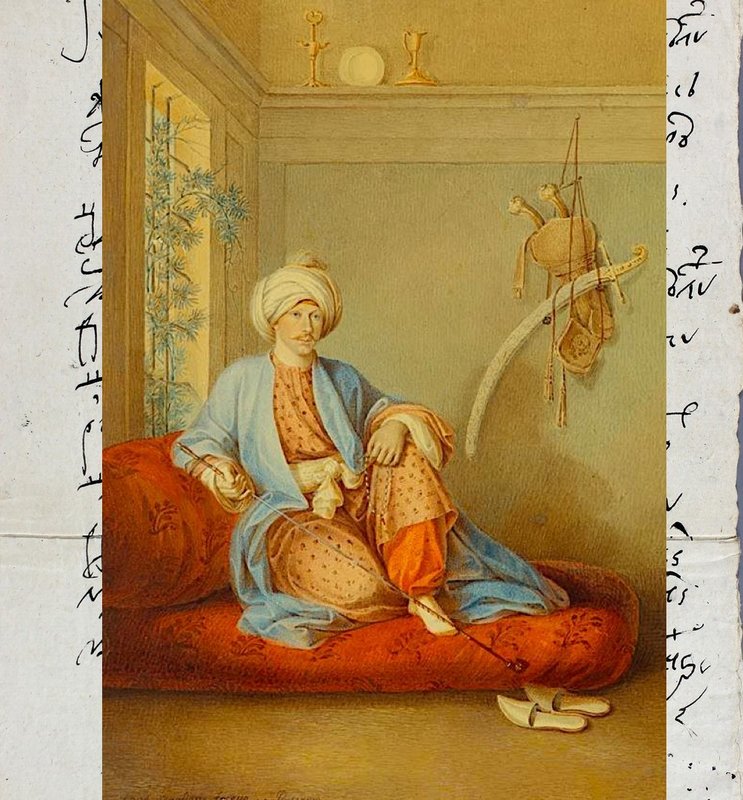
A clerk from the Gorgani district made his living exclusively from writing. He had a luminous hand, with small, clear letters and delicate flourishes—tiny flowering branches that never suffocated the text, placed exactly where a hint of emotion was needed. He wrote divinely, in inks of several colors, framed by carefully drawn borders whose small illustrations told you at a glance what the letter was about. This clerk specialized in letters and charged one taler per page—and rightly so, since no one ever had more to say. Any confession, declaration, or curse fit neatly onto a single page. Those with more to express did so in person or through a paid messenger.
The clerk’s name was Zarpale, a nickname earned from the beauty of his letters, which resembled expensive brocade. People came to him when they needed exactly one page—no more, no less.
He was sought not only for his fine writing, but also because he was a decent man, without pretensions. You could pay him not just in money, but with a hen or a bottle of brandy. He never judged. You could pour out all your bitterness, and he would write it down without comment, without grimaces, as others did. Nothing surprised him. He never interfered. Whatever you told him was sacred—rendered faithfully, artistically, and without moral judgment.
Zarpale received all kinds of things: shawls and slippers, glass beads, or food, which he usually took to the neighborhood inn to be properly cooked. He loved good food, adored sauces above all, and enjoyed lingering at the table, usually alone, by the inn window, where he would also write after savoring his meal.
Once, he wrote a letter for a măjer—as fishermen were then called—a man weary of life and determined to kill himself. The letter was a farewell. Zarpale wrote it without blinking, without questioning the man’s wish, without asking anything. As payment, the fisherman gave him a fine piece of freshly caught sturgeon—the very best cut, two palms below the gills.
Zarpale was struck to the core. The ink on the suicide letter had barely dried when the noble fish—noble, for those who may have forgotten—was already crossing the district, passing the Dâmbovița (which at the time curved sharply near Gorgani), almost floating over the houses of the boyar Racoviță, before coming to rest at Hanul Zlătari.
All along the way, the clerk thought only of food, barely noticing how empty the streets were. Twice he passed armed mercenaries brandishing freshly severed heads, and from his experience as a man of letters he understood that yet another disturbance was underway, likely sparked by some Greek intrigue, for which other Greeks would pay—as usual. In those days, now called the Phanariot era, Greeks fleeing Istanbul often ran wild in Bucharest, prompting some zealous pasha to order a few heads cut off. Any mercenary who brought a Greek head to the Turkish inn received a small coin. Zarpale had seen such things before.
At Hanul Zlătari—a luxury inn, full of finicky clientele—there was a famous cook, especially renowned for fish dishes. Among them, sturgeon with almond sauce was one of the most sought-after.
A gourmand willing to make financial sacrifices in the name of pleasure, Zarpale asked the cook to prepare the fish and resolved to wait as long as necessary. He waited two hours.
Here I must say that this dish depends greatly on spices, but above all on the almond sauce, and it is described in detail in the Brâncoveanu Recipe Book. The sturgeon is lightly fried in elegant slices, then simmered in verjuice and white wine, seasoned with salt, pepper, thyme, sugar, and cinnamon. Toward the end, more herbs are added, along with crushed coriander seed. But the essential element is the sauce: fried hot pepper mixed with the cooking liquid, thickened with almond flour (roasted, ground almonds) and fine breadcrumbs.
Thus the sturgeon was brought to Zarpale, covered in the sauce for which he had crossed the entire city.
It was fully dark by the time he left the inn. He was happy, indifferent to everything else. He had eaten the finest dish he knew. And so, as he headed toward his carriage tethered behind the inn, while the stable boys fetched his horse, he suddenly found himself face to face with a drunken mercenary who, in a not entirely steady motion, took his head—and that was that.
Thrown onto a pile of heads in the cart bound for Vidin, where they were to be treated and stuffed with straw, the clerk’s smile compelled attention. For a long time his head was displayed with respect on a pasha’s veranda, because in that smile—fixed for eternity—lay the rest of the story: whoever looked at it could not help but rediscover the sturgeon, and the gaze of a fisherman who, on an ordinary day, had decided to die.