Young Filipescu of Gorgani had a weakness for a rather complicated dish made from veal liver. Few people knew how to prepare it properly, and among all the cooks there was one butcher who had become famous for it. After hacking through animals in the yard, he would step into the kitchen and—struck, as if by the wing of culinary art—produce a dish one never forgot.
But the man had many duties and little time, so for some while he had been trying to pass his talent on to his only daughter, Dina.
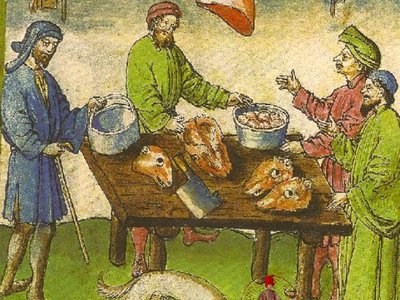
Around midday he would pause from work, set aside his cleaver, drive the heavy knife into the blood-stained chopping block, and set upon instructing the girl. Surrounded by the entire family— aunts, uncles, servants craning their necks, the godmother, cousins who lived nearby, sometimes even the priest from the neighborhood—Dina cooked, following with strict devotion the artistic advice of her father.
A few words now about Dina.
She had clear, serene eyes that made you relax the moment you looked into them. She seemed gentle and good. Yet behind those obedient eyes began a carnival. If life in the butcher’s shop was dull, the green balconies of her imagination were anything but. Unknown cities, enchanting creatures, and above all a garden of delights were Dina’s favorite territories.
And there she had many friends.
Among them was one Leonida Prapur—so called because he fed on membranes and delicate skins. He was a tiny winged creature, full of charm. Dina would give him small offerings from the butcher shop: scraps placed on leaves or in walnut shells, left behind the house, thrown into running water or into wells. In return Leonida told her stories about his adventurous youth, from the days when he had been a great warrior.
The butcher had noticed that his daughter was somewhat absent-minded, and for that reason tried to keep her constantly busy. Naturally he had no idea that she possessed an entire world—and a friend named Leonida. Even if she had told him, he would never have believed such things.
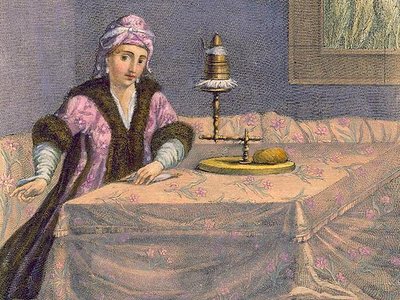
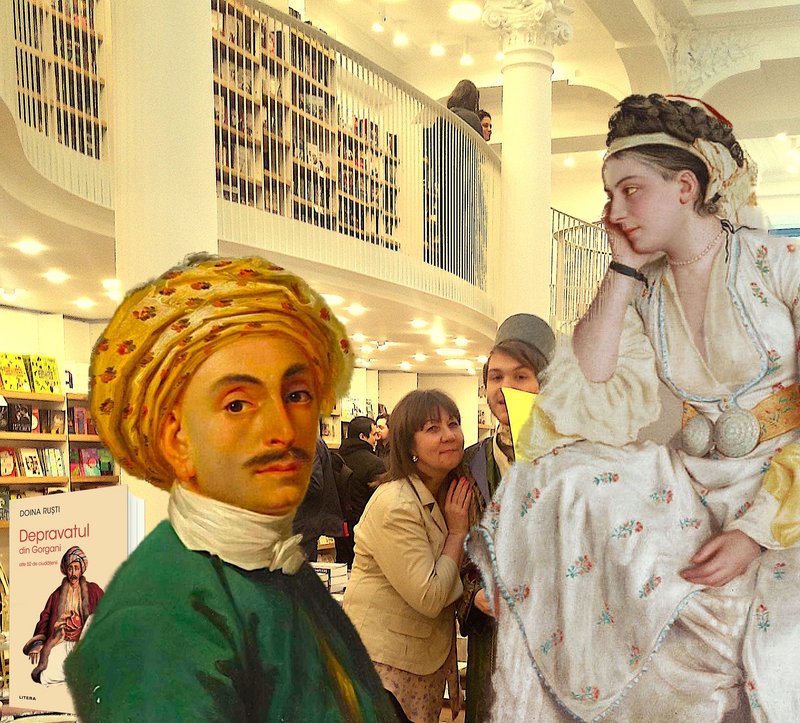
From time to time the butcher received orders from young Filipescu, especially for dishes made from veal liver. Filipescu belonged to the well-known family of boyars whose residences were scattered all over Bucharest, including Gorgani. He was a somewhat pretentious young man, the sort who tastes food and then falls into thoughtful silence. Tall and rather thin, with large pale ears half covered by a silk turban.
On the day when everything began, Filipescu ordered stuffed liver, a demanding dish. One takes the liver, cuts it carefully, and fills the cavities with a mixture of chopped liver, heart, a little goose fat, raisins, pine nuts, egg, dill, and orache—finely minced—everything wrapped in caul fat and fried slowly in butter.
This—one might call it a gently browned pâté—was then laid on a bed of lettuce, sprinkled with orange juice, brushed with a little jelly, and sent by carriage to the back gate of the Filipescu house, where it was expected.
The butcher decided the time had come for Dina to test her talent on this dish, which required passion.
Under the gaze of the entire family she began carefully rinsing the heart, then the liver. And when she picked up the caul fat, Leonida appeared.
And he had every reason to appear: it was a delicate membrane veined here and there with soft creamy fat.
At first Dina meant to give him a small scrap of it. But through an unfortunate movement—because of a finger—Leonida slipped straight into the minced liver mixture.
How could anyone find such a tiny creature in a paste of egg and meat?
Dina tried her best while everyone around her shouted advice. She dropped the spoon, spilled the pepper, and forgot the pinch of cumin that was indispensable in any chopped meat.
Leonida did not appear again.
Dina fell under a veil of sadness.
The dish nevertheless arrived on Filipescu’s table exactly on time.
From there on things continued more or less normally. Except that the next day small leaves—tiny wings—began to appear on the young boyar’s large ears.
At first he found it amusing, especially since the petals fell off by themselves, floating gently above the washbasin.
But in their place others grew.
Filipescu stared at himself in the mirror, scrubbed his ears with soap, and waited. As soon as some fell, others appeared, with astonishing speed. After only a day the floor of his chamber was carpeted with wings.
He ordered them gathered and burned.
Yet these fragile petals would not burn, would not wither. They resembled carp scales, oat flakes, the fingernails of sylphs.
Within a few weeks the entire district of Gorgani seemed covered with them. Streets and houses glittered with tiny glass wings.
Filipescu summoned doctors and even healers, in whom he had no confidence at all. He swallowed elixirs, rubbed himself with ointments and oils, took pills of every sort.
Still the mysterious wings continued to grow from his burning ears.
At last questions began to be asked. One led to another until they arrived at the stuffed liver, at the butcher, and finally at Dina, who was urgently summoned to the Filipescu house in Gorgani.
The carriage advanced slowly through drifts of wings.
The butcher sat frowning. Beside him was Dina, with her calm eyes.
Young Filipescu lay on a divan in the veranda, gazing at the sky with complete resignation, while doctors hovered around him asking questions. The wind moved the wings from place to place, and beneath the sea of scales there could be heard a faint song—perhaps from the green balconies of imagination.
Or so it seemed to Dina, who continued to sigh, saddened by the death of Leonida.
Especially because he had died in such a banal way.
Questions floated back and forth like murmuring water. The butcher listened, frowning. Dina could not answer; her mouth was tightly closed.
At last Filipescu lowered his gaze toward the courtyard. His eyes, tired and somewhat dry from staring at the sky, stopped on the clear eyes of the little cook.
“Do you always cook this liver?”
“Ah—so only this once!” he exclaimed.
Encouraged by the kindness now resting on his face, Dina began to explain how she had prepared the dish, how many eyes had stared at her while she worked. She might have told them about Leonida’s death, but she did not know where to begin, so she wandered into describing how difficult it was for her to cook.
Filipescu was astonished at the torrent of words flowing from the cook’s mouth. Yet he needed one clarification.
“So in the end,” he asked, “do you actually like cooking?”
Silence fell.
Everything seemed to freeze. Even the wings paused in their growth upon his large ears. The doctors looked respectfully on. The butcher did not dare to speak.
Then Dina opened her mouth and said slowly that no one had ever asked her such a question before. She had never imagined such a question existed. She had never thought she might one day touch upon a matter that her father treated as unquestionable. How could she doubt the butcher’s wishes, or express an opinion about them? Yet hearing Filipescu ask—whose words commanded more respect in her heart than even her father’s—she felt encouraged to confess:
She did not like cooking at all.
While Dina spoke—far more words than I have written here—a torrential rain began to fall over Gorgani.
Everyone hurried for shelter. Words flew away with the rain.
And when the sun returned, the mysterious wings had vanished.
Filipescu resumed his life. His ears lived happily ever after.
As for Dina, she never cooked again.
A year later she began singing at weddings and celebrations. Her first ballad—soon heard across the entire city—told of the extraordinary deeds of Leonida the Winged.