Among the fiddlers of the eighteenth century, I have chosen Matase, who was said to have been born singing. Instead of crying or wailing, the moment he saw the light of day he was seized by cheerfulness, and amid baby babble and giggles he would let out short melodic hums, squinting one eye—exactly as he would do for the rest of his life. And what a life it was.
Charismatic and always ready to sing for free, he needed very little. He obtained whatever he wanted and could pass anywhere: instead of papers or permits, he drew the bow across the strings and sang a few words. That was how he passed through many cities unknown even by name to ordinary Wallachians. He was fortunate enough to head toward Brașov, then on to Budapest and Vienna, and after years of wandering across Europe, he returned home, astonished by how easy life was in Bucharest.
Back home, he found a good spot to play near a coffeehouse, and people dropped handsome coins into a tin box. And indeed, he had a voice worthy of his name. He played the fiddle and sang as well, in languages that had never before echoed through the city—songs gathered along his travels, especially those that set sparks and tear-bringing desires aflame in the blood.
The coffeehouse, filled with the murmur of drunken voices, stood opposite the house of Petrache Sticlaru, a famous healer who could take pain away with his hand and with six small glass cups—called ventuze by the city dandies who fancied themselves Greeks.
Sticlaru was a healer by passion. Nothing life had offered him seemed more beautiful than his craft. From childhood he had been fascinated by plants, elixirs, and above all by practice on bodies in distress. Whenever he saw someone dead drunk, he rushed at them with thyme tincture. His pockets were always full of pills and homemade brews, ready to help at any moment. Of all his skills, cupping made him famous: he knew exactly where to place the glass, how long to heat it, how to anoint the skin with oils—one of them made with venom. Hence his nickname, Sticlaru, master of healing glass.
He had a divan by the window where patients lay, and as he passed the flame through the cups, he would sigh, gazing outside toward the coffeehouse where Matase played. There was something in the music—an urge to fling open the door, run down the twenty-seven narrow steps, rush into the street—not to hear him better, but to seize the violin and smash it over his head.
Of course he liked the melodies. He loved the voice, which went straight into his blood like a tenacious octopus with two hundred arms. Yet alongside this pleasure lived a desire—admitted, detestable, and without cause—to trample the singer underfoot, to erase him from the Lipscani quarter.
And so, on a Tuesday in the year 1781, he stepped into the street with a resolve written plainly on his face.
Sticlaru stood in the middle of the road, a massive bearded figure dressed in dusty purple velvet, wearing a tubular ișlichighlighted by a small muslin scarf, white as fresh milk—an imposing man staring straight ahead at the poor fiddler. Poor, because Matase looked frail: small, with unruly moustaches and sad eyes. That day he wore a high-collared vest unlike any seen in Bucharest before, and a discreet beige satin turban. He played confidently, his bow gliding as his rings caught the sunlight, singing in Italian—a language made to remind you how small you are, how indebted to life.
They stared at each other for a long time: Sticlaru thinking how to kill the singer; the singer, who had seen much in life, thinking how to bring the hostile healer to heel.
At dusk, when café patrons began to leave in search of supper, when Bucharest fell under the screaming eagle’s protection and the first bell rang from among the city’s hundreds, Matase stopped playing. Sticlaru finally approached. For the first time, he saw such a polished violin and silently asked to hold it. There was something frozen in its depths, a spirit from another world, awakening all his murderous impulses.
He pressed it to his chest and caressed the strings. They began to speak to him—voices of people long dead—and as he listened, he finally understood what Matase had meant. Enlightened, he realized it was time to abandon his elixirs and six healing cups, to leave behind all his former happiness. He no longer wished to heal people. He no longer wanted to be Sticlaru.
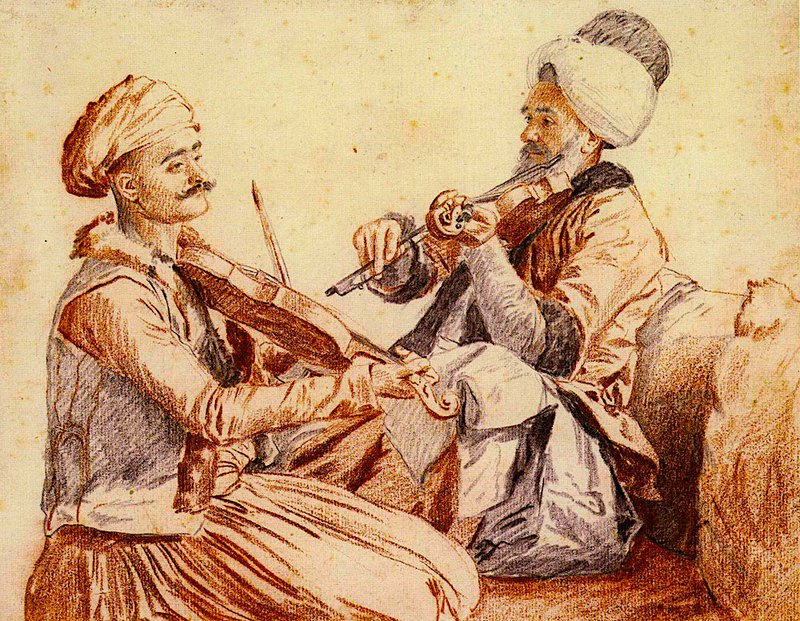
And lifting his eyes to meet the watery eyes of the singer, he saw his entire future life—as a second violinist, in a duo destined to become famous.