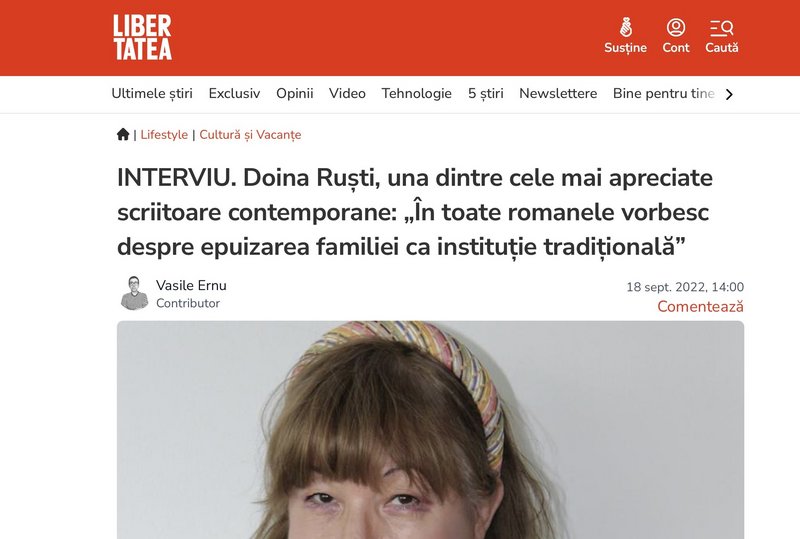
Doina Ruști, one of the most acclaimed contemporary writers: “In all my novels I write about the exhaustion of the family as a traditional institution”
Vasile Ernu – Contributor \| September 18, 2022
She has written eleven novels covering several historical eras, from the Phanariots and the communist period to the present day.
What connects these different epochs? Writer Doina Ruști explains in an interview by Vasile Ernu in the series Literature Today.
Doina Ruști: My earliest memory is of my father trying to photograph me. I remember the words, the timbre of his voice; I can describe the emotion that reached me. But I couldn’t see him — he was only a grey shadow projected over me. Later, looking at the photograph, strangely, I remembered the hazy silhouette, the voice, his frustration that he couldn’t make me pose. In the end, a photograph of attitude came out, and on the back my age was written: one year and six months. I lost the photo during adolescence, but the details of that action remained in my mind, especially the impression that I was doing something important. He knew I was making an effort, and I tried not to disappoint him. Diffused and reinterpreted, the event became my first heroic deed.
VE: Tell me how your passion for writing appeared. What is the story of your debut?
DR: Everyone in our house wrote, and books were absolute values, so it came naturally. In primary school, on a day of rain and lightning, I was alone at home and very afraid. I began writing a story to open a gate to another part of the universe, and from then on I wrote daily. My editorial debut came late, after the fall of communism.
VE: After The Phanariot Manuscript, you returned to the Phanariot era with The Book of Perilous Dishes, Homeric, and Occult Beds. Where does this fascination come from?
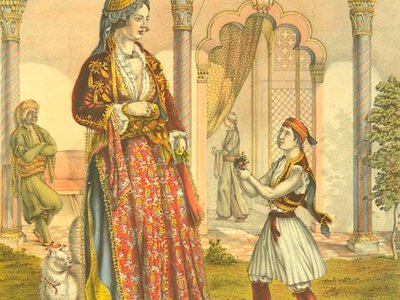
DR: Renewed Balkanism. With the Phanariots came a reconnection to the sources. From vocabulary to mentalities and imagination, the Phanariot Greeks brought elements of old European culture and of a Balkan world that still preserved the mystery of Antiquity. I was born in the Romanian Plain, in an ethnically mixed area. Superstitions, archaic customs, and daily rituals came from an ancient Balkan time. Among my ancestors are Turks, Aromanians from Montenegro, and Danubian Romanians. In the storeroom of my childhood home there were still red fezzes, bells for collars to scare away ghosts, hiding places in the floors, and magical silver bowls called polovece. I grew up in a conservative world deeply connected to the old spirit revived by the Phanariot era. The eighteenth century was Enlightenment everywhere in Europe, but in our region Rousseau’s ideas arrived through enlightened Greeks who argued for individual freedom using the metaphor of an underground prison. I rediscovered the Phanariot world at the moment of maturity, when one feels the acute impulse to return to origins and recover hidden inheritances.
VE: How did eighteenth-century Bucharest smell? You wrote: “Apricot sighs twisted in the nostrils…”
DR: Smell obsesses me because it is deeply connected to memory. I cannot speak about anything until I know exactly what it smells like. For me, smells have an epic character. The Romanian eighteenth century smells exactly as it does for Leun when he first enters Bucharest:
“In his nostrils twisted the sighs of apricot trees and dusty leaves. Then he was struck by the smell of hot bread, different from that in Cățol, because in Bucharest bread is kneaded with grapes, making it more fragrant than Bergamot pears.”
But there was more: the incense-like perfume of tobacco from Ioannina, the delicate scent of meat and smoke mixed with sharp garlic sprinkled with vinegar. People loved flowers and unusual mixtures; they never went out without ointments or perfumed oils. Musk and lilac were among the most expensive, followed by jasmine, vanilla, lemon, and especially linden blossom. Perfumes showed a person’s true worth.
And we must not forget the “fumigators” — small censers carried through the city, especially during ceremonies. They burned chili seeds, nuts, cinnamon, sugar, and citrus peels. This perfumed smoke embalmed the streets, often softening the harsher smells of life.
DR: In literature it is very important to write about what you know best. My first passion was seventeenth-century history; my academic career began with a course in early Romanian literature at the University of Bucharest. Passion for documents overlapped with the chronicles of the Brâncoveanu era. At one point I even collected old manuscripts. Naturally, I moved toward the eighteenth century. A crucial moment came in the early 2000s when I made a documentary film about Stanca the Widow and St. Sylvester Church. I was teaching at the MediaPro University Film Faculty at the time. For a year, I involved students in this project through workshops held in Bucharest and at the Buftea Studios. Among the participants were film professionals, historians, and writers. Recently I found footage from those meetings — the zero point of my passion for the Phanariots.
Read the full interview:
https://www.libertatea.ro/lifestyle/interviu-doina-rusti-una-dintre-cele-mai-apreciate-scriitoare-contemporane-4280154