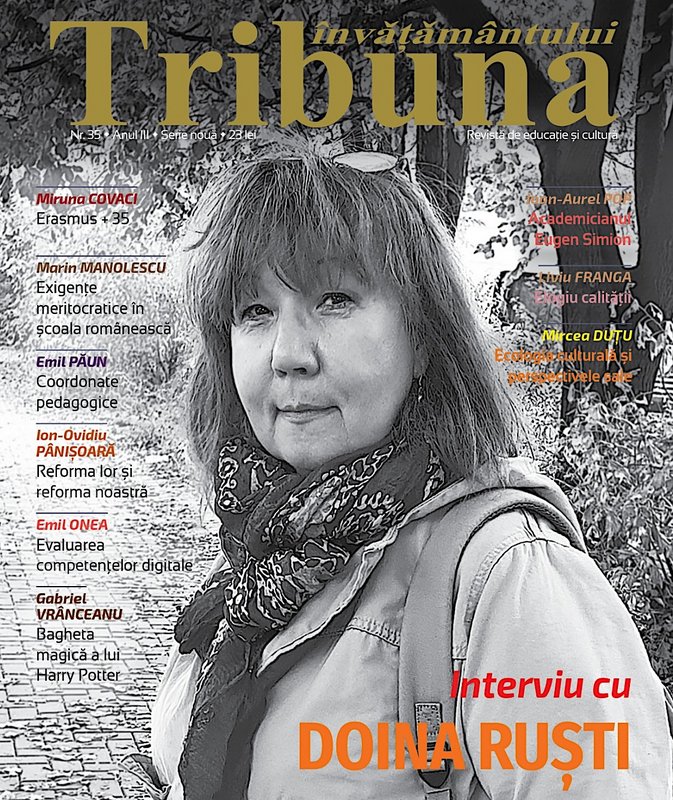
Excerpt from an interview published in 2022 in Tribuna Învățământului, an issue whose cover featured Doina Ruști.
In moments of panic and uncertainty, under the pressure of my personal history, I found my balance in a library. As for my journey through the “forest” of books—it went through many stages. Until high school, I read freely, without a plan, ignoring all recommendations.
The decisive encounter was with The Human Comedy by Balzac, which I read systematically from seventh grade until the end of ninth grade. Balzac became the backbone of my life as a reader and offered me, at a very early age, an understanding of social mechanisms. At sixteen, already concerned about my future, I began preparing rigorously for university, enrolling in a classical track—one of only three in the country at the time—where half of my studies were devoted to Latin and Ancient Greek.
Alongside world literature, Romanian literature, history, and French, I began to form a chronological image of literature, linking it closely to history, religion, and philosophy. My reading notes from high school and later from university eventually became a book—a concise chronological history of ideas (The Encyclopedia of Humanist Culture for the Hurried), published in the early 2000s, which would later turn into a character in my debut novel. These notes form the foundation of my intellectual development.
My obsession with chronology and minimal synthesis began on a particular day in ninth grade, when my Greek teacher placed two books in my hands—Batrachomyomachia, attributed to Homer, and A History of Greek Literature by Maria Marinescu-Himu—and told me it was time to discipline my reading. That day played a decisive role in my intellectual evolution.