On one of the lists of stolen objects from around 1760 appears a ring whose description immediately caught my attention. It had belonged to a woman from the Filipești family, who had sent an “old coat” to be dyed—a coat trimmed with fox fur—forgetting in its pocket a small pouch filled with jewelry and trifles, carefully listed in her complaint: Venetian glass earrings, small silver buttons, gold crosses, watch chains, and five rings.
Since the dyer was well known in Bucharest, the Filipești woman was not worried. She sent a servant to retrieve the items, which were promptly returned. All except one ring.
It was an inherited piece, made of soft, thin gold, set with a stone. No one knew exactly what kind of stone it was. In many respects it resembled jade, yet its color was unlike anything anyone had seen before—a dull, poisoned red.
The dyer lived on Pitar Moș Street, a rather select area even at that time. Her prestige came entirely from her dye workshop, one of the largest in Bucharest: a compound of nearly 3,000 square meters, with vats and large furnaces, drying rooms, and a laboratory where she prepared her dyes. She was an artist, meticulous about shades, materials, combinations. Among the colors that had made her famous was a coral tending toward yellow, in which red preserved a certain arrogance—something warm, a color of promise, like melted rose hips mixed with milk and passed through honey.
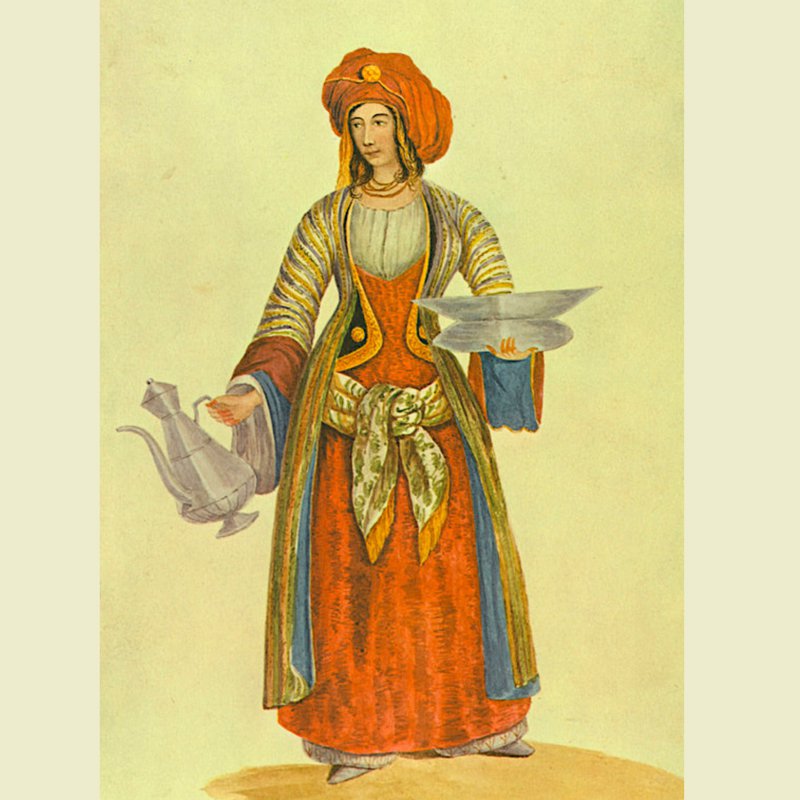
She herself wore a turban in that shade, a thin yet sumptuous shawl wrapped around her head three times and tied with a small bow above her forehead. You could recognize her from afar without looking closely. You knew it was her because the color cut you beneath the chin, melted into the flowers of your chest, twisted itself into your retina.
People of standing came to her for that color, bringing fabrics—especially silk gauze—that only she knew how to dye, often highlighting nothing more than the cotton threads artfully woven into silk. Bucharest folk came to her for fez dyeing, for tinting astrakhan fur, for collars in rare hues. She knew how to dye anything, from wool—the easiest—to goatskin, lace, wooden beads, hair ornaments, heavy cloaks, and other refinements.
The color of the missing ring’s stone matched her preferences too well, and suspicion fell upon her.
There was also her statement. Yes, she had received the coat—a long, wide malotea—which she intended to leave overnight in a dye bath, only to give it its true color the next day. Of course she had checked the pockets and found the pouch. Still, she had not sent word immediately. She thought that if it was meant to be claimed, someone would come for it. She realized there were rings and other items inside, though she had not looked closely—she had only glimpsed them, since the pouch was not tightly closed.
Her deposition contained fissures. Especially since the servant who came to retrieve the pouch harbored suspicions of her own. The dyer had taken too long before returning it. What she had done all that time in the house, only she knew. And she would say no more—she claimed not to remember.
No one suspected the servant; she belonged to a great household and was therefore beyond doubt.
There was also a princely official who suggested a thorough investigation, arguing that many people had passed through the place. But he found no allies. The unanimous opinion was that the dyer had taken the ring.
The workshop was closed under princely seizure, to the great regret of many Bucharest residents. The dyer was held for a time in the prison on Domnească Street, spent all her savings without result, and was eventually brought home. In front of her gate, in full public view, she was beaten on the soles of her feet, then dragged by the hair and struck again before the Colțea Church. That was all.
The ring was never found. From the sale of the dye workshop, the Filipești woman recovered the value of the ring and more, as moral compensation.
From her former wealth, the dyer was left with a narrow strip of yard and one of the vats that had once been the pride of her workshop. She continued to wear her unusual turban.
For many years, Bucharest residents saw her planting things near the vat—hot peppers, turnips, other vegetables that kept hunger at bay. She improvised a shack, and sometimes boiled dyes in a pot, just for herself. This made her appear alive, dressed in clothes that were colored, vibrant.
One winter she was found dead in her fragile dwelling. She looked like a bundle of copper-colored rags, cruelly lit by the winter light. And among the cloth, on her shriveled hand, shone a ring with a reddish stone.