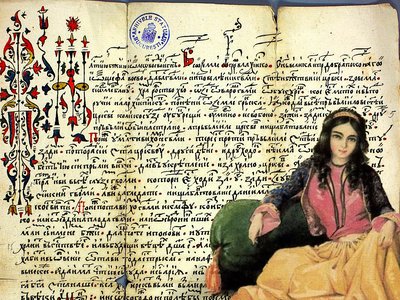
A few days ago, I opened the Brâncovenesc Anonymous Chronicle and my eyes fell on a strikingly personal sentence. While recounting the conflicts between Brâncoveanu and the Austrians, the chronicler notes that “the Germans are a wicked and tyrannical people.” Naturally, I wondered which Germans the anonymous chronicler (probably Radu Popescu) had actually known. With whom had he formed such a categorical opinion? How many Germans had he met in his lifetime? You can easily picture him thrown among barbarians, trying to save his silk anteriu and his agate beads.
It was the time when the Austrians were flooding into Transylvania and Wallachia and, angered by Brâncoveanu’s refusal to send the requested provisions, they slaughtered people, abducted women, and killed children. Not for a day or two, but for weeks on end, until Brâncoveanu finally sent the demanded tribute. Before that, however, there had been messages, envoys sent back and forth, hostages, and endless talk.
Among these messengers was a very young lieutenant who was detained in Bucharest until Brâncoveanu’s envoys returned. In the meantime, of course, he had to be lodged and properly hosted.
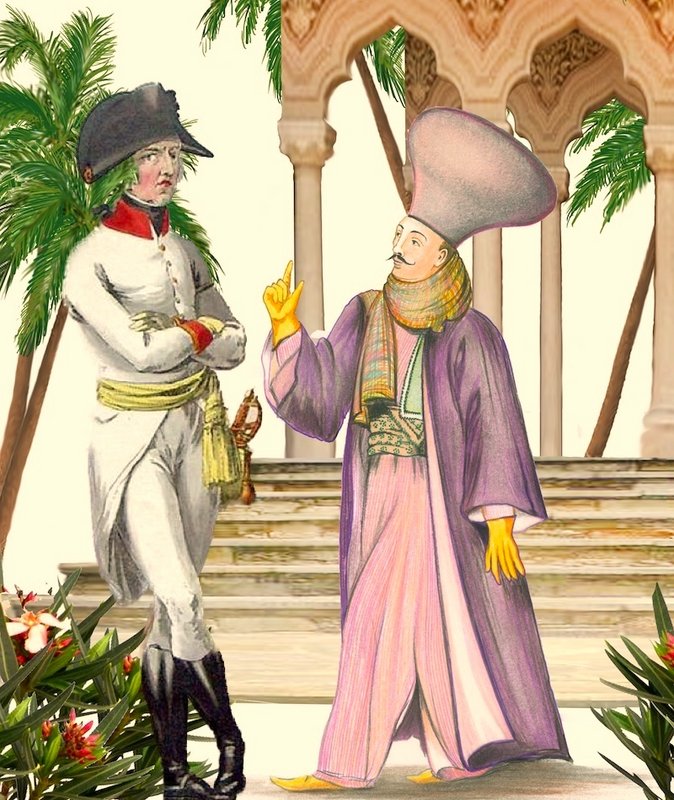
The lieutenant—a “German with a tail,” that is, a genuine Austrian, exactly how the entire palace household would come to call him—was sent to Popești, to the estate of Radu Popescu, a great boyar, holder of important court offices, and a chronicler who, for many of us—including myself—was a true precursor of prose.
At first, Vornic Popescu was delighted to have a guest, whom he entrusted to the care of the servants on the estate.
But the lieutenant was young and exceedingly conscientious. He wanted to do something in return for his hosts and decided to share part of the education he was so proud of.
Naturally, at Popești no one spoke German, nor did the Austrian know any Romanian, which rather damaged his standing among the estate’s people—folk who considered the Romanian language superior to all other languages in the world.
But words, you know, are not indispensable for people who wish to collaborate.
One morning, the lieutenant woke up and had a man sound the bugle. Bleary-eyed, the servants—raised there, the property of Boyar Radu Popescu, people born into slavery and accustomed to commands—lined up as the lieutenant ordered them to. Meanwhile, he walked past each of them, elegantly snapping his gloves against the heel of his palm. He was tall and stiff, while they were all rumpled from sleep, eyes watering from yawning. At the end of the inspection, he said something grave and cutting—you didn’t need to be a scholar to understand that he was displeased. Then he motioned for them to undress and burn their clothes in a furnace.
Naturally, this took several hours.
After further brief but eloquent explanations, the lieutenant ordered them to make new clothes from the household’s reserve linen—bales freshly brought back from the dye house, meant to become bedsheets. But the lieutenant had been seduced by the color: a blue that reminded him of the sky back home.
For several days, the entire courtyard sewed clothes, during which time neither the people nor the chickens were fed. The lieutenant delighted in plum brandy, nibbling at the delicacies the butler laid before him. In the rest of the yard, only sighs and the growling of empty stomachs could be heard.
Finally, when everyone in the Popescu household had turned blue—wearing sky-colored trousers, short jackets or even vests adorned with buttons—the lieutenant smiled in satisfaction.
But matters did not stop there. Every morning the house awoke to the sound of the bugle, and everyone rushed to line up. Like a great blue serpent, the servants were led to the pond. There followed washing in cold water, together with the lieutenant, who lived the moment with a passion hard to forget.
Next came the rules of the household, of the kitchen, but most time was devoted to table service: the ordering of dishes, the bowing after each course, napkins stood upright like helmets—all demanded a mental strain that left many with headaches. But the hardest task was pouring the wine into glasses that the boyar himself had never even unwrapped, but which the lieutenant discovered with crushing enthusiasm.
All life in the Popescu household had changed for the worse. The housekeeper had developed dark circles under her eyes, and the cooks sulked, exactly like the new master. Finally came the musicians, whom he taught to play something resembling the bailiff’s voice when counting the blows administered to someone’s soles.
The lieutenant was immensely proud of the household’s transformation and would sometimes ask perfunctorily, in his own language: Well, isn’t it something else now?! Good! Don’t forget who taught you, he would add, pronouncing his name so harshly that no one realized it was a name at all, or that the lieutenant might have needed one. No one understood him, but no one thought to protest either: it was clear he was mad, and it would have been foolish to cross him. The two sides smiled at each other, and the days went on, with further changes.
When Radu Popescu’s carriage entered the estate gate, a howl rose from the far end of the yard that made him lean out the window. The entire population, dressed in blue, ran toward the carriage in a verbal uproar that Popescu, despite his imagination and literary talent, had never suspected possible. The servants screamed with eyes bulging from their sockets, the housekeeper wept, and at some distance, the lieutenant—guest of honor—smiled broadly from the veranda. It was impossible not to notice his satisfaction, which, together with the servants’ cries, could only be interpreted as the deed of a tyrant.
That same day, the carriage took the lieutenant to Bucharest, straight to the mail coach for Sibiu, and Popescu threw a feast for the household, to help them forget that they had been flayed by a man they were incapable of forgetting. Even today, if you pass through Leordeni, you may see a chalky silhouette, which some say is the ghost of an Austrian from long ago, who once tried to drive a village mad.
As for the lieutenant, the entire journey he swayed in the carriage’s cushioned seat, happy with his deeds. He had done something good and lasting, and the lives of those servants in Popești had, without a doubt, become better.
Author’s Note
This story is part of a series of urban legends inspired by forgotten episodes, marginal figures, and distorted memories. It does not reconstruct history but imagines how power, order, and excess leave traces that outlive those who imposed them.