Lila the Healer was a full-bodied woman, with a severe gaze and the gift of healing. She owned a fine house in the Stelea quarter, where people queued, hoping to reach the terrifying Lila, who could cure you with a single look. From time to time she harnessed the horses and set off toward Galați, but more often toward Upper Moldavia, where she was awaited in the homes of important invalids. For as you know: if you have money, a crowd will care for you; if not, you die like a dog—and in both cases what remains is a fine dust, containing room for a single sigh, the strongest of one’s life, and sometimes not even that.
Lila stopped only at the houses of the powerful, filling her pockets with money which, at a certain point in her life, ceased to matter. What remained was the pleasure of travel and a small joy in meeting people cut from the same cloth as herself.
One summer—August, we know precisely, thanks to a note written in a book—Lila arrived in the city of Iași, ruled at the time by Constantin Moruzi, father of Alecu, whom I have often mentioned. The year is 1778, and above the streets floats an air of freedom. As now, people hope for better days; honeysuckle scatters its scent through gardens. It is a summer of preserves and great expectations, and Lila meets a man who would radically change her life.
His name was Pavel, a former convict turned captain and trusted man of Prince Moruzi the elder. Chroniclers wrote about him; he entered history. Pavel, who had seen much, encountered the healer before the Metropolitan Church and froze in astonishment. He had never seen a woman like her—one whose gaze could fry you crisp and preserve you in a jar.
Between them an instant bond was forged, sealed like a Gordian knot.
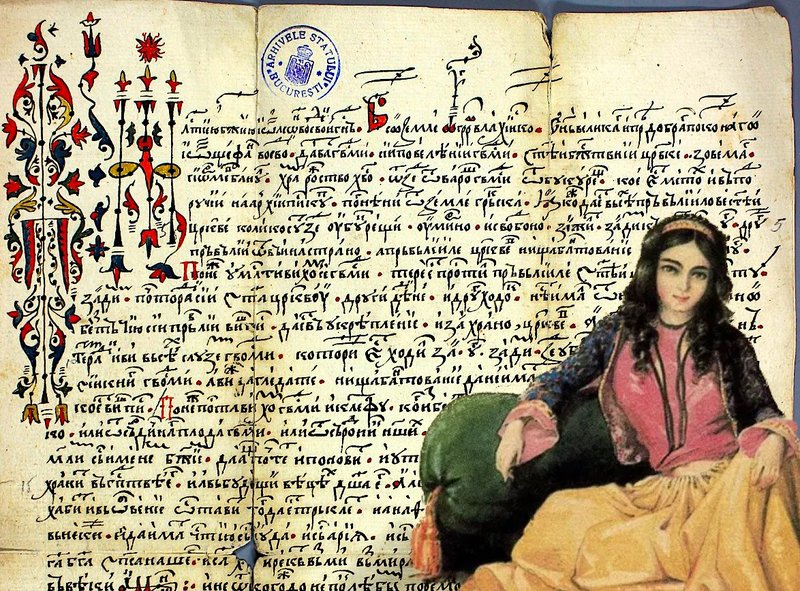
For two days they lay tangled in sheets, stunned by desire. Then Pavel introduced her to acquaintances and friends. Lila received as a gift a Gospel book, fresh from the press—a volume that has survived to this day. She also met a high-ranking dignitary named Caragea, later a ruler and part of a historic plague.
People swarmed around her, for everyone had an illness, and Lila removed it with a glance, shifting her frog-green eyes from one person to the next. Even a leper passed beneath her gaze, after she had taken rheumatism from certain boyars and cleared a spătar’s house of coughs. Soon the inn where she stayed was buzzing with people. Yet amid all this, Pavel remained her priority.
As he was bound by palace duties, Lila began to accompany him.
That fateful summer, an event more significant even than Lila’s visit to Iași was the conspiracy of certain Freemasons, about which much has been written. Among those captured were two renowned boyars: Manolachi, from an old family, and Ioniță Cuza, of the lineage of the future prince of the Union. Pavel seized the two unfortunates in the dead of night, grabbed them by the necks, and threw them into prison.
What the chronicles do not say is that the healer was with him—she whose eyes, trained to see only the demons of illness, began to lose their intensity.
Pavel, former convict and palace executioner, began to reveal his cruelty. And as his roars pierced walls and made windows tremble, Lila the Healer began to lose her sight and her medical powers. She still saw, of course—but no longer in depth as before. Instead, she noticed small grimaces, subtle movements of the head, the colors of eyes, the fluttering of eyelids. She perceived the delicacy and emotions of hands searching for one another. As Pavel slapped his victims, Lila’s vision retreated to the fragile surface of things. Yet even there it was no longer of use. Blood running down a stranger’s cheek clouded her eyes; a neck struck by a whip blinded her completely.
Standing against the wall, watching from a distance, Pavel appeared to her in another light.
First he ordered the two boyars to undress, but Ioniță Cuza—known to be hot-tempered—spat straight into his eyes. Caragea, the ruler’s adviser, was present and tried to calm the situation. But Pavel had already drawn his cleaver, and with a single blow the boyar Cuza—boyar though he was, with princely descendants—lost his head.
Lila had never seen a beheading and pressed herself to the wall. Her vision had already dimmed, but she heard Manolachi, the other accused, begging for forgiveness. Cuza’s eyes stared at the ceiling, and Pavel, palace executioner, howled like a wolf calling its pack to attack. The adviser was speaking of the ruler’s orders when Manolachi’s head also flew across the floor.
Caragea slipped out the door, and Lila followed instinctively.
They ran along corridors lit by lanterns. Night had fallen and the city was sinking into darkness. When they reached the courtyard, the Healer’s eyes could no longer even discern the silhouettes of the guards Caragea was instructing. We know from the chronicles that the two heads terrified Iași for an entire day, displayed at the palace gate.
As for Lila, she realized she had lost her sight—and with it her healing powers. At last, she too had reached a lesson learned by everyone: that consequences must be accepted.
Before leaving the city, she had one final wish. She asked Caragea to write a few words in her book—the Gospel she had received as a gift—about the terrible event. He did so, secretly deciding from then on to record all important deeds.
The healer’s book has been preserved and is today held by the Academy. On the margin of a page one reads:
“Cuza lost his temper entirely and was cut down by Pavel, former captain; and Manolachi, having confessed with a movement of the soul and having testified, was also beheaded by the same. In the year 1778, August 18, Friday night toward Saturday.”
Lila, however, did not enter history. Little is known about her. For this reason I have decided to do her justice—and also out of deep indignation that, in general, writers rush to write about the wretched Pavel, forgetting entirely that the Healer is the true protagonist here.