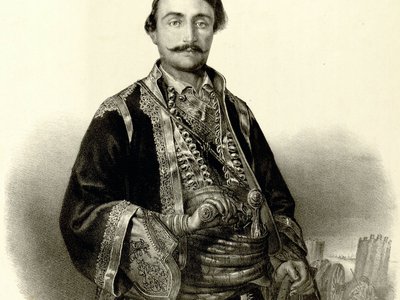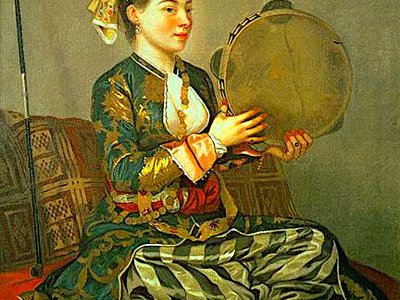
Ecaterina, the sister of Prince Alexandru Moruzi, gained full freedom after her marriage and used to harness her horses and take frequent excursions through Bucharest and its surroundings. Three years after the wedding, she already had the reputation of a restless wanderer.
Among her close servants was Nicolache, a nineteen-year-old boy. Being part of such an elite entourage had filled him with confidence—only one small step separated him from arrogance.
One day, during a visit to Văcărești Monastery, the lady noticed Nicolache’s insolent behavior. What exactly provoked her remains unclear. What is certain is that she ordered him beaten on the back of the neck and left there, on the road.
The incident had witnesses. People running after the carriage saw Nicolache lying in a cloud of dust. “I am ill,” he complained, adding that the lady would pay well to anyone who would host him for a few nights.
Eventually, a widow named Gherghina offered him shelter, impressed by his fine clothes and, above all, by his manner. Nicolache belonged to that rare category of people you like at first sight: dark-skinned, smiling, wearing a glass bead earring—a small red spark beneath his patterned headscarf.
The widow had a sixteen-year-old daughter—a detail that makes the ending painfully transparent.
Nicolache prolonged his stay, allowing a love affair to blossom. The hostess felt flattered; the daughter lost her mind. But after about a month, around Easter, Nicolache grew bored with village life and decided to return to the princely palace, to his former position.
On May 11, 1796, a petition reached Moruzi’s desk. The widow accused Nicolache of having “ruined her daughter’s virginity,” deceiving her with promises of marriage, only to change his mind and flee back to Bucharest. She made sure to emphasize that Nicolache was the lady’s servant—thus implicating Moruzi himself.
The petition and the trial records were later published by V. A. Urechia and mentioned briefly by other historians. But I am not interested solely in what documents record in dry lines.
At the trial, Nicolache declared loudly that he had no intention of marrying the girl. Something had happened in the meantime—something that reactivated his vanity. All attempts by the metropolitan to convince him to marry failed. The way Nicolache glanced from under his lashes, lips tightened in an elegant line, made it clear that he relied on something. The priest gave up and reported the situation to the prince.
According to the law, the girl’s misfortune had to be compensated with a pound of gold. But Nicolache was poor. So the next punishment was chosen. He had used no weapons; he was guilty only of deception. And for such perfumed illusions, only vanity deserved punishment.
Nicolache was to be shaved, paraded through the market, and exiled—thrown across the Danube.
The guilty youth seemed satisfied with the sentence. Moruzi signed the document that has survived to this day, while from a palace window Lady Ecaterina watched the crowd escorting the condemned.
Left in open fields, exile could be punishment—or not. Those educated among noble households often found their way back within hours. The Danube was difficult to cross, but the lady had paid the right people to bring her servant back.
Yet Nicolache was arrogant—a sin that invites disaster. On the return journey, he encountered an enraged guard. With no money but still looking down on others, lifting his eyebrows with all the insolence of the Phanariot world, Nicolache sealed his fate.
The guard’s fuse was short.
And thus ended the life of a nineteen-year-old.