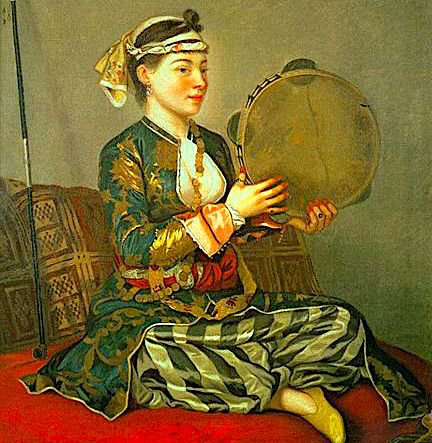
Among the many shades of an amorous bond, there is one recorded in the laws of the Phanariot world:
if a young woman has sexual relations with a man who asked her only once, she is entitled to no compensation whatsoever.
If, however, she yielded after a long period of pleading, gifts, and acts of seduction—and the man then abandoned her—he was obliged to provide compensation, in one form or another.
Maria, an orphan from Prahova raised by her uncle, a priest, lived an honest life and already had suitors for marriage. She fell in love, however, with a man who acted as a local overseer on the Dudescu estate. His name was Constantin—known as Tache. He was not from the area but had come from Mehedinți, which suggests a man already well traveled. Stylish and vain, he wore, beneath his fez, a woman’s kerchief, cleverly tied at the nape of his neck.
They met several times—planned and accidental—through groves, by the pond, in ravines and gardens.
Summer, Dărmănești, 1786.
Maria dreamed of Tache’s floral scarves, while within her body the seed of a future life had already taken root.
When autumn came, Tache realized he wanted something else from life. He did not see himself married to Maria, nor a father. He had plans that did not include her, and he threatened that if she ever spoke his name, he would shoot her.
The child born of this summer affair alerted the family and the village. The priest demanded the full story. Tache was found, reprimanded, then formally accused. The case reached the princely court.
The ruler at the time, Hangerli, found the story irresistible. He summoned the former lovers and asked Tache to choose: marriage—or execution at the butcher’s block in Obor.
The wedding took place immediately.
Tache stayed only a few days before announcing he would return to Mehedinți to retrieve his belongings and inheritance. He never returned.
Years later, accused of bigamy, Tache was brought to trial again. He claimed the marriage had been forced, carried out under threat of death, and therefore invalid. The case dragged on, debated endlessly by men who transformed Maria’s life into anecdote and rumor.
In the end, the law was applied: Maria had yielded only after repeated encounters. Tache owed her compensation—money, a horse, and the kerchief he had once worn beneath his fez.
Maria returned home with that kerchief, still carrying its poisonous perfume—not of the man who abandoned her, but of a summer that had become her entire life.