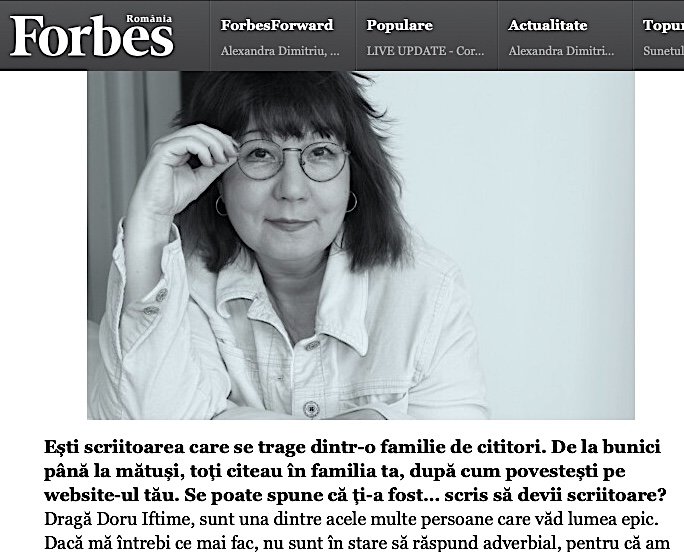
You are a writer who comes from a family of readers. From grandparents to aunts, everyone in your family read, as you recount on your website. Could one say it was… written that you would become a writer?
Dear Doru Iftime, I am one of those many people who see the world epically. If you ask me how I am, I can’t answer with an adverb — I need to explain the context, to tell you about the people involved. Had I lived in an archaic age, I would have perched myself in a lookout tower, narrating whatever appeared on the horizon. But my life would have been short, because I wouldn’t have been able to resist telling the possible ending of events that had barely begun.
What does writing mean to you? A release, a dependency, a demon, a job, a hobby? What exactly do you enjoy in what you do?
I love building things, and the joy of this game is so intense that nothing else matters. One childhood summer, surrounded by many cousins and friends, someone suggested we each build a hut from my grandparents’ endless stash of things. And there truly was a lot there — sheds, old carriages, stables and chests, not to mention attics and cellars. I began to envision details, to search for pieces of my future house, furniture. I chose a good spot between the fig trees, and I worked the whole day with fervor until I built a hut — with a flag and even a door — already imagining what would happen there, who would live in it, and how it would decay over time, when and where it would disappear forever. It looked like a giant turkey head hidden among the leaves, and I was so absorbed in the game that I forgot about the others, though I sensed them nearby. Only toward evening did I realize that no one else had started working. They were watching from the balcony, sprawled on deckchairs or on the divan in the gazebo, amused at my expense.
This is exactly what writing is like: when I begin a novel, I am wholly there, and the act itself un-hourglasses me — it turns me into a blissful cat.
In the ’80s there was a song called Video Killed the Radio Star. The book now seems to be the next victim—not of television, but of the screen, whether phone, laptop, or tablet. There are far fewer readers today than in your or my adolescence. What do you think? How does this situation affect you?
The book?! The physical medium is irrelevant. Only the story matters — it is part of our DNA, it cannot be discarded. And in this respect, we are actually progressing. The story is not threatened; I firmly believe we are entering the era of the author's disappearance — consider as a symptom the generalized desire to write a novel. Before long, we will read stories on a particular theme, we will search for characters and keywords inside an immense file. Many of us already read books in electronic format, looking for the narrative’s key moments, the passages about a cat or about a murder. I’m not being ironic at all. I think it’s natural for a person to respect their own time, and this new kind of reading expands, in its own way, individual life.
The leisure of reading remains one of life’s pleasures, without having to become a routine. Imagine if we all sat for days in a trance with Berlin Alexanderplatz on our knees! There are readings for holidays, for sadness, for intellectual formation, for training, for the loneliness of a mind searching for another mind worthy of it. The reader is not a consumer but an adventurer. That’s why I believe the number of readers will not shrink; rather, two things are changing — or have already changed: the pace and the manner of reading. I include here online reading, synopsis reading, excerpt reading. There will always be a need for words that bring into your mind the scent of wisteria and blood, but no one will care anymore about the hand that first wrote them, or about Faulkner’s name or the title of the novel.
You’ve received, among others, awards from the Writers’ Union and the Romanian Academy. Your novels are translated into countless languages; half the globe has probably read you. What makes you satisfied? What is the reward for your talent? The people who resonate with your writing, with your gift? Money, fame?
Ha-ha, you’re already writing literature! I’m referring to “half the globe.” Well, that’s my reward: to infect Doru Iftime with the literary bug!
You write short stories, novels, and screenplays. How do the screenwriter and the novelist get along? You attended, for example, a workshop run by John Vorhaus, one of the Star Trek screenwriters. What does an award-winning novelist translated into many languages say when receiving lessons from a screenwriter — even a Star Trek one?
A novel takes me months, sometimes years. To write a full-length screenplay, I need three days. As a rule, I don’t sign my scripts. There was a period when I repaired scripts written by others. Other times I built the story from start to finish, as I did with the short film Cristian (in the volume The Checkered Shirt), which I created from script to directing, and through production and editing. It was an experiment, like stumbling upon a box of chocolates and being unable to stop until you finish it. From John Vorhaus’s course, held at Media Pro Pictures where I worked at the time, I remember only one thing: that summer I suddenly had a wild urge to reread the ancient tragedies.
Do you watch Star Trek, Star Wars, Marvel films?
No.
Since we’re here — what films or series do you enjoy, which directors/actors do you admire, and why?
I like the newest films; I follow only the story and connect to the mental dynamics of strict contemporaneity. I enjoy the bloody epic of Tarantino, the literariness of Chicken with Plums (Marjane Satrapi, Vincent Paronnaud), the subject of Parasite (Bong Joon-ho), the diegetic ingenuity of Inception (Christopher Nolan), the sociology of Monsters (Marius Olteanu), and the honest integration of the fantastic in Waterworld.
Would you be tempted, for instance, to write a video game script?
Oh yes, very much so. My debut novel, The Little Red Man (2004), was written during a period when I played video games intensely. I love quests; I don’t like strategy games, because they erode narrativity, kill the story, and feed the vicious impulse to accumulate. In The Little Red Man, a programmer invents a virus that manipulates the information in a computer. For him, it is a game that ultimately contaminates the life of a woman, making a tiny red creature appear. I would love to turn the adventure of that Little Red Man into a game. But as we know, the screenwriter is not a creator but a scribe who puts on paper the story living in someone else’s mind.
A writer you admire?
I loved Faulkner from the first moment — for the depths of his story, for his style, for our shared admiration for Balzac. You read him and you can almost smell the wisteria and the fresh blood spilled for no reason. Michel Folco’s dynasty of executioners meant a lot to me; I relished Paolo Giordano’s art of delay; I admire the steady hand of Ludmila Ulitskaya. Last year I had a moment of tenderness with Fernando Aramburu. When I lose the rhythm of my storytelling, I read a page of Coetzee, and when the story begins to drag, I return to Death on the Installment Plan (Céline). But my longest periods of admiration were in adolescence, spent with the literature of Greek and Latin Antiquity. And I haven’t even mentioned the South American madness, the feverish nights.
Do you live the life you wanted? Is this what you dreamed of in adolescence?
Back then, I imagined I would write only one book — about my father’s murder. When I was eleven, my father was killed. My adolescence was spent in trials, investigations, the search for the murderer, who was never found. At that time, I wanted to write only that story — which I have, in part, written in all my books.
Does the book have the power to reinvent itself?
It already is. Since the end of last year, I’ve been part of a top-level experience in this regard, working on a contemporary prose collection at Litera Publishing. This gave me the chance to see from the inside the direction books are heading. First of all, I find the recording studios the publishing house works with fascinating — and I must say the three editors are young, visionary, and, importantly, none of them is a writer. Recording audiobooks with top actors seems to me a renewing stage in the book industry. I read and recorded Occult Beds in full, and audio sales matched the print run. E-books and the fragmentary circulation of books online are already standard. Not to mention PR literature: hundreds of mediocre books are presented daily in a literary style, with clever stories, ideas, or characters invented on the spot, and this paraliterature is also part of the new direction. We are in the midst of a shift in reader mentality, and the writer will finally find the serenity of anonymity.
Where do you refill your inspiration?
In markets, from people, from old documents, sometimes.
If we were to read between the lines, who is Doina Ruști? What do you want? What do you lack?
For the moment, I would like to make a story out of filmed sequences; à la longue: I don’t want to know.
Read more here: Forbes