The roots of winter holidays—especially Christmas—reach back to pre-Christian times and are tied to the arrival of the cold season and the winter solstice, the threshold beyond which daylight begins to grow again. For this reason, Christmas is fundamentally a solar celebration, associated in some religions with victorious deities, such as Mithra, celebrated on December 25.
The etymology of Crăciun belongs to a ritual context, which is precisely why its meanings scatter and overlap. I will not even consider here Papahagi’s theory, with his pagan priests announcing monthly festivities—gatherings supposedly called calatio, an unattested term he labels Daco-Roman. I find it far-fetched.
It seems far more plausible to me that the beginning of winter was always a major event for Europeans, deeply connected to vegetation and the general death of nature. The tall tree dies, its leaves fall, yet its death is not final—nothing in the world truly is. Thus the tree is cut down and brought into the house, placed on the fire: winter has arrived, and at last the great log is lit.
The existence of similar words for Crăciun in Slavic languages does not say much in itself. What matters more is the broader family of meanings formed within Romanian, including words such as cracă / crăci, or the fact that in popular language crăciun can also mean club or cudgel. It is always worth glancing toward Albanian, which preserves a related form as well. All these elements point to what Vasile Pârvan once called an imprecise time.
And since I have mentioned him, I will also invoke the ancient existence of a cult dedicated to a female deity celebrated at the winter solstice—not because it directly explains Christmas, but to reinforce the idea that we cannot speak of a single holiday, and certainly not of the Christian meanings Christmas acquired much later. At its core, it remains connected to fire, the onset of frost, and the shouted blessings of carolers.
Winter celebrations are accompanied by games and carols. The word colind itself is much debated, but I believe it belongs alongside horă and a hori, descending from an extended Latin lineage with roots in Greek—echoes of the chorus, the groups of popular performers who sang and danced during agrarian calendar rituals. Hence the older form corind for colind.
In this context, we cannot speak of a single mythological figure embodying Christmas. We can, however, refer to the many zini—benevolent or malevolent spirits—who bring about the magical acts of winter.
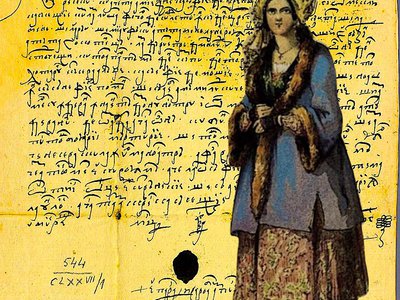
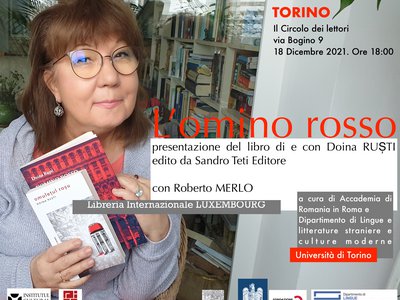
At Christmas and New Year, mysterious strangers appear and miracles occur, as they once did in the time of Marica Alba. You may remember her: a character from Manuscrisul fanariot—a woman of extraordinary beauty, married to a jeweler and abducted by a mysterious official. That story is told in the novel. What I did not include there is what happened on Christmas Eve, a time even more important than the holiday itself: the time of waiting, of fairies, of preparation.
On Christmas Eve, people have visions and premonitions; they are visited by spirits and sorcerers.
Marica Alba had a decisive dream.
As the fire crackled in the stoves and baskets of walnuts and apples gathered on the tables, as the jeweler’s entire household awaited Christmas and its mysteries, Marica Alba went to bed. And in that winter night, when the snow had reached the windows, a voice from the other world entered her dreams.
Go, the voice said, and call out the name Marinache.
She had never heard of him, yet in the dream everything felt almost real: the street appeared before her, the house, the gate, even the linden tree in the yard. She did not have much to do, the voice instructed her—only to call the man’s name a few times, and then she could return to her life.
She awoke troubled, the memory of the dream vivid, for dreams dreamed on Christmas Eve are unforgettable. This one sounded like a command.
Marica Alba unwrapped her gifts—the jeweler had, of course, given her a ring unlike any other—and beneath the branches of the tree she found painted baskets, little boxes, silk pouches. Guests came and left. But Marica could think of nothing except the dream. As time passed, it grew sharper, more insistent.
So on Christmas night, when everyone slept, Marica set out through the snow. It was a moonlit night, and here and there the fairies breathed among the white branches, over the frozen, snow-covered roofs.
The house from her dream stood near what is today Piața Națiunilor, on the bank of the Dâmbovița, beside a mill.
Marinache, she called, and the syllables were swallowed by the night. She knew she had to call several times, and she did so with conviction. When a light finally came on, she understood that her mission was over and ran home.
That night she slept without fear.
But as often happens, questions followed in the days after. She wanted to know more—who Marinache was. She questioned the servants, then sent someone to gather information. Yet Marinache, the man she had called at the urging of spirits, had vanished from his home.
He was a miller—you may remember him from the novel—the man who hears a voice one night and sets off toward Bozărie.
What I did not tell in Manuscrisul fanariot concerns Marica’s life afterward. Over time, the information about the miller became oppressive. He had disappeared completely, leaving no trace. Dissolved into the frozen breath of that Christmas, a time when mysterious things always occur, Marica became convinced that fairies or other obscure spirits had abducted the poor miller.
But what if she had acquired the power to make people disappear?
The thought became persistent, and Marica Alba began to test her idea. First she called a random man’s name, then tried again at night, as she had with the miller. She modulated her voice, practiced vocal exercises, and before long it all turned into obsession.
At midnight, she wandered through Bucharest in search of victims.
The jeweler watched the situation with compassion. At first he hired an arnăut to follow her at a distance, then summoned a doctor. When matters worsened, he took her to the Monastery of Viforâta, to be purified of sins and fantasies.
And while she continued to call out men’s names with her nose pressed to windows, the miller wandered madly through Bozărie. All because of a dream—one the Christmas fire had stretched and transformed into obsession.
So that you are not left carrying this story with you, I should add that the dreams of New Year’s night and of the five or six nights that follow are beneficial. The pagan time of fairies and malevolent spirits is long gone; the gates of Heaven open, and in the first days of the year a frost descends that kills everything—from cloud-floating monsters to micro-entities hidden in floorboards.
During those days of bitter cold, when even stones crack, Marica Alba had her second dream—the dream of healing.
I will not tell it here. At the end of the month, the fourth edition of Manuscrisul fanariot will appear, and Bucharest will be full of drifting pages. I will say only this: on the fifth night of the new year, you will have a decisive dream. And in the morning, as you sip your coffee, think of Marica Alba for a moment—perhaps of me as well—because all the dreams of the world are connected.