The worst was when he began to feel indebted to people who had not even been born yet. Once he told me that in the Stelea slum there lived a girl who was supposed to die that very evening.
— She’s a girl with a sharp nose, like a greyhound scenting its prey from afar. Believe me, my friend, this girl, not yet sixteen, will leave for Brașov tomorrow morning with a German who has taken a liking to her, and after a year she will give birth to a boy with a long, sharp nose, a cautious and obscure individual. No one will record him in the chronicles, yet by his hand a brilliant man will die—the inventor of the flying horse. He stared at me as if pinning me down, motioning that I should not interrupt. Wait, I’m not finished: this murderer will have a scrawny daughter, with a nose as sharp as his, who will set fire to the library in Vienna, where a unique Pythagorean hymn is kept, copied from a papyrus by an Arian priest around the year 300. Of course, she will have a sharp-nosed descendant too, a son who becomes an army general. Tens of thousands of soldiers will lose their lives because of him!
Stories like these were so long that I began to dream of the history of the criminal lineages the coffee seller told me about.
— Tonight you must hurry to Stelea and rid humanity of this sharp-nosed girl. Do you realize that if you don’t go now, tomorrow you’ll have to make the trip all the way to Brașov? Are you capable of such a journey, instead of just dashing over to Stelea?
Do not judge me too harshly—I really did go, I really did what he asked of me.
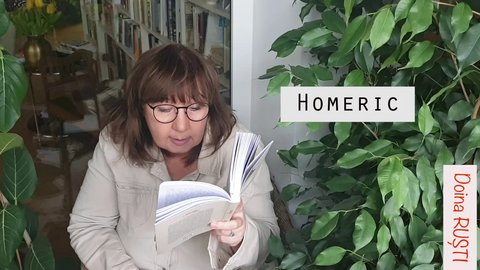
(Doina Ruști, *Homeric, 2019)*