When someone falls in love with a building that has been demolished, venerates a street they have never seen, or becomes obsessed with a perfume known only from books, that person will surely infect others. Perhaps they are mad. Perhaps a fanatic. In any case, this is how tradition and the pride of having admirable ancestors are born.
When I read that there once stood in Bucharest a bridge called Cilibiul’s Bridge, my first impulse was to expand the story, whatever it might have been — which I later did in my novel Homeric, where an episode takes place at this bridge.
Some histories claim that Cilibiul (“the handsome one,” “the stylish one”) was the nickname of the stolnic Constantin Cantacuzino (1639–1716), widely regarded as the enlightened mind of the Brâncoveanu era.
In his youth he was distinguished yet restrained, not prone to flamboyant clothing, although he dressed in the Italian fashion, having studied there. He was full of ideas and peculiarities. He spoke several languages, managed Wallachia’s foreign policy, founded a printing press, instituted the first scholarships, and raised the buildings we now call Brâncovenesc. He helped his brother in cultural matters and placed his nephew and disciple Brâncoveanu on the throne — and later removed him as well.
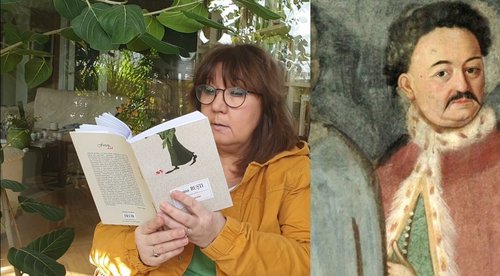
Sadly, there are few portraits of him; the best known is the one at Horezu Monastery, shown above. But by then he was already mature. So imagine him young — perhaps you will Photoshop him and send me the result.
In youth he could only have been cilibiu, and certainly expressive. Cantemir, who disliked him, wrote that he always had a look of astonishment on his face. But even Cantemir never knew him young; the stolnic was already a mature man when they met.
In front of his house (roughly near today’s United Nations Square) there stood a bridge over the Dâmbovița, built at his expense, so it is natural that it should have borne his name. Still, I have doubts about the connection between the bridge’s name and this scholar. Why would anyone call such a wise man “the handsome” or “the dandy”? And in Turkish!
To understand my doubts, let me tell you a few things I read while researching the novel. After the famous rocket experiment of Lagâri Hasan Çelebi (1633) in Istanbul — the so-called “rocket man” who attempted flight using gunpowder — imitators appeared, some of whom reached Bucharest in 1666. His name, Çelebi, was invoked at every opportunity.
At that time, performances took place exactly there, on Cilibiul’s Bridge. It must have been imposing, considering that the stolnic built only historic works. We know nothing about the spectacle of the flying Turks, because no one recorded it. Yet in the same year, 1666, a princely engagement took place, described in detail.
On that occasion a grand spectacle was organized at the bridge — an event of almost cosmic proportions. It was a vast show of actors and acrobats, meticulously described in the Chronicle of the Băleni family. From here the dream begins to grow, that intoxicating fantasy that dissolves all regret. For what is nostalgia for, if not to make sadness bloom?
All the high society of Bucharest attended, pitching their tents toward Mihai Vodă. They came prepared, with all the comforts of home — servants, feasts, festivities. And in the streets games unfolded, especially at the bridge, raised like a stage. The celebrations lasted several days.
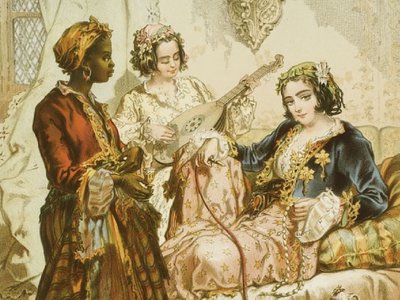
Acrobats filled the banks of the Dâmbovița, performing astonishing feats, among them imitators of the rocket man. And also a cilibiu, a Hindu pehlivan whom the chronicler described with enthusiasm: a swift, dark-skinned man who performed unheard-of feats. First he leapt over eight buffalo lined up on the bridge, somersaulting in midair. Then he tied his hair to the tail of a princely horse and had someone whip the animal — yet the horse would not move. It was hypnotized, petrified. Finally, he ran along a long shawl and passed unseen between the interlocked arms of the crowd, leaving the people of Bucharest open-mouthed.
I do not think any chronicle contains such a detailed description of a seventeenth-century spectacle. That is why I trust the echo left by this Hindu acrobat. If he compelled a chronicler — who recorded only historical facts — to recount his performance, surely the city’s inhabitants were deeply marked.
Not long afterward, the bridge began to be called Cilibiul’s Bridge.
The stolnic was twenty-seven at the time, newly returned from Adrianople and preparing to leave the following year for Padua to complete his studies. Was he cilibiu? Of course he was. But few people knew of him then. As Ionescu-Gion wrote, he was merely “a modest but very clever and very economical boyar.”
În Adevărul