You must admit it sounds wonderful as a poem title. It is, in fact, a line of verse: Degremele de sarâk cu flori albe. You read it and you do not dare ask what it means. From the moment questions arise, poetry extinguishes itself — like a lump of limestone drenched in water.
It was around the year 1785 when Elenca, from Bucharest, married an arnaut named Dincu, the son of Dima Delibașa. A grand wedding, a dowry to match. And among the many objects carefully listed in the dowry inventory were five degremele de sarâk cu flori albe, valued at twenty-five talers.
To put this into perspective: with one taler you could buy many things, even a slave — though this is an exaggeration, since only the Princely Court had the privilege of pricing a slave at a single taler. Everyone else paid, at best, three. An ox cost four talers, and the cheapest cart five. A turkey was worth half a taler. I learned all this from various lists published by V. A. Urechia — some dowry inventories, others registers of purchased, inherited, or stolen goods. There is more life in these lists than in sentimental novels or histories written with academic strain.
Among these eighteenth-century inventories, the dowry mentioned above served me an entire story on a platter. Elenca had refined and costly tastes. Among the many items she received from her parents was a rând de haine — a complete outfit — that cost no less than 320 talers. By now, you can imagine how much money was stitched into those garments. And this was only one outfit, meant to be worn once, on a single occasion.
It consisted of white silk șalvari, over which she wore an atlas gown embroidered with gold thread; a shawl fastened with ornate clasps; and over these, a light outer garment of butter-colored wool, lined with white ermine fur. On top came a fitted vest, also white, also of ermine. Both pieces were closed with leather laces.
Accessories completed the ensemble. Elenca owned shoes with atlas uppers embroidered in gold thread (worth a modest five talers), as well as boots. Among her many jewels listed in the dowry, she would certainly have worn the diamond necklace valued at six hundred talers, at least two rings — one with a diamond (150 talers) and another with a sapphire (50 talers). She did not own many earrings: only two pairs are mentioned, one worth one hundred talers and another with pearls, valued at twenty. Little, compared to the rest.
But what did she wear on her head?
Here, at last, we return to the degremele de sarâk cu flori albe.
The word degremea (plural degremele) is a temporary, colloquial derivative of dermeá / dirmeá, grimeá, or digrimeá — all playful distortions of the Turkish dürme, meaning a triangular or square headscarf folded diagonally. But this was no ordinary kerchief. It was an extremely fine fabric, light as foam — a kind of muslin or silk gauze — made to be wrapped around a small fez. It was called saric or sarâk and signaled high social rank.
As I recount in The Phanariot Manuscript, in Istanbul Christians were forbidden to wear the saric. In Bucharest, however — as today — rules, especially those governing dress, were broken with enthusiasm.
This delicate fabric, called sarâk, was artfully wrapped around a fez, rounded or tubular, sometimes adorned with a long tassel or covered with beads, usually pearls of various sizes. In this case, it was probably an off-white fez decorated with pearls, matching the white flowers of the saric, which stood out against a darker background.
But do not imagine that this was all. The fabric was not simply twisted like a rag. It was fastened artistically. This is why the dowry inventory mentions four fonte de sarice, worth eight talers — small ornamental clasps shaped like bows, used to secure the saric. Usually, one alone was sufficient, placed at the nape of the neck or above the ear.
Elenca was not the daughter of a nobleman, but of a wealthy merchant widow named Zoița. Nor was the groom anything extraordinary — today we might call him a security officer, perhaps attached to the Palace or the city guard. This was a solid middle-class family.
The dowry list contains many other items: two additional outfits, each valued at over three hundred talers, other garments, linens, brass and silver vessels — all amounting to 3,850 talers, plus cash: 120 gold coins.
The groom, the arnaut Dincu, had his own list as well, including garments (many embroidered with gold thread), curtains, blankets, and copper cauldrons. Naturally, he too owned five degremele de sarâk — white, but without flowers.
Dincu’s father, old Dima Delibașa, bought the couple a pair of houses near Mihai Vodă Monastery, not far from Gorgan.
All these possessions were reevaluated in February 1794, during a bitter winter. The sumptuous ermine-lined outfit was now worth only ninety-nine talers and sixty paras, and the family chest contained just seventy gold coins. The jewelry, however, had not been touched: it was all there, retaining the same value.
In the meantime, plague had descended upon Bucharest. Elenca and Dincu died, cut down together with their children.
After the epidemic subsided and grief dulled, Zoița claimed the dowry she had given her daughter many years earlier. The house and all its outbuildings were now in the hands of Filip, Dincu’s brother. He drew up a list of what remained, from which we learn that many objects were worn, while the jewelry and more valuable items had been sold for 1,300 talers to cover debts totaling 1,900.
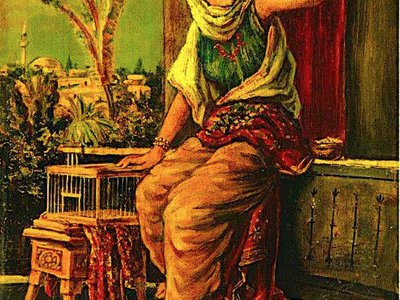
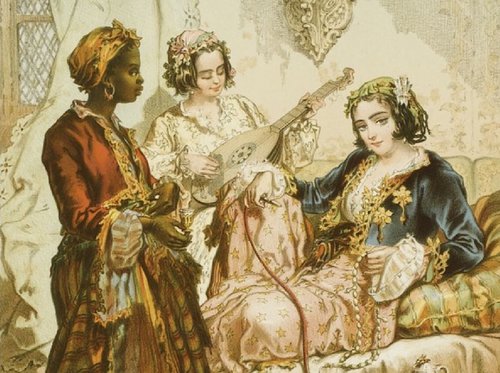
Of this family, nothing remained but the flutter of a muslin saric with white flowers. Yet women’s attachment to a gossamer scarf endured — as did the fonta de saric, worn long afterward, as we can see some sixty years later in a painting by Amedeo Preziosi.
Degremea / degremele – a colloquial Romanian term derived from Turkish dürme, meaning a folded headscarf.
Saric / sarâk – a fine muslin or silk scarf wrapped around a fez, signifying social rank.
Talers – silver coins widely used in eighteenth-century Central and Eastern Europe.
Arnaut – an armed guard or soldier of Balkan origin, often in Ottoman service.
Fonte de sarice – ornamental clasps used to fasten a saric.