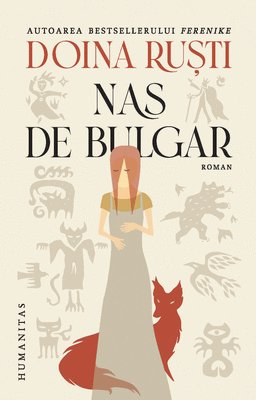
Excerpt published in Balkanski književni glasnik / Balkan Literary Herald, Belgrade, No. 63, 2026.
Doina Ruști
1
It smelled neither of hot brick nor of ash. He knew those scents well enough: they came from the bread oven he had swept out barely an hour before. The warm breeze had carried them far away, down into the valley, and by now they were finding their way into other people’s nostrils.
But this was a different smell. It was alive. It had only just been born. He could smell wood turning to charcoal; the scents of burning beds entered his brain, of mattresses where pampered women had rolled, of sheets in which the water-flower had died before drinking in the sun’s strength. From every side, the smell of his future life closed in on him. He knew too well the essence of that life, though it had not even begun.
Veliku took a few cautious steps towards the stable, straining to hear. There was no movement in the quarter, at least nothing out of the ordinary for a day nearing its end. Even so, his nostrils had flared; the wisps of scent rising from the charred wood kept warning him.
He opened the stable and let the horses out. Persuading the girls to slip away through the back of the garden proved harder.
“Go on to the sheepfold, to the goatherd’s hut! Stay there,” he told them, refusing to answer the flood of questions pouring from their coaxing little voices. “I said don’t move. I’ll come for you later. Tonight.”
The girls swayed among the bushes, their red skirts bidding him farewell. If he was never to see them again, he would die with that image in his mind: five poppies among white rocks.
The iron tang was close now — a breath of blood, the smell of a sword that had passed through flesh. A chill went through him. He prayed he was wrong.
From Marcu’s yard he could hear voices sharpened by pride and adoration. When a Vlach starts preening, you hear him from a long way off. His voice turns sharp, and the air moving through his lungs gathers the zuli of conceit, tiny impertinent creatures stuffed full of humiliations. At every word you can hear their little feet treading the air around him. And there would be much to say about these zuli, old souls born of limestone in the honeycombed caves of Mount Lovćen or in the burrows dug into the banks at Kotor. But I won’t speak of the zuli now. After sleeping unknown for so long, they can sleep a while longer yet.
The voices in Marcu’s yard belonged to his pupils, who were learning a ballad. For days now that was all one heard throughout the quarter. An order had come from the Sultan: everyone might sing in their own language, not only in the house, but out in the street as well. If you were born speaking Vlach, now you could write it too. You could walk along, pull out your knife, and scratch on the city walls: Lord, help me, for I am Vlach! You could count in your own tongue, fill your black slates in it. Enlightened Abdul Hamid II, the Sultan who deserved a candle in the Vlaska Crkva, had given the order, read aloud in front of the town hall, that from that day on anyone at all might speak their own language.
Veliku had been thinking of ordering a bread stamp, carved with something in Vlach, to press into every ring-shaped loaf, into the belly of every loaf. A few heartfelt words, say: Eat me today, because tomorrow may never come!
They had all rejoiced at the new law. The town of Cetinje had rung with Vlach songs. Marcu had opened the school, and the square had filled with people; pies were brought out, little barrels of brandy rolled across the tables; the women whooped all night long, and many ran through the town like madmen carrying burning torches. Old ballads were dug up out of memory, and Veliku baked eight ovenfuls of little loaves and walnut pastries.
But no joy ever comes alone. Swords can always be heard in its wake, and among them those raised by Iorgos the Dwarf’s band.
“What language?” he had shouted, stepping into his gateway on the very night of the celebration. “We are all Greeks!”
“And Serbs!” Cocrici had shouted from the balcony, swinging a club over his head.
The Vlachs went on singing, though not quite as loudly as before, continuing the celebration up at the sheepfolds of Njeguši. Some, stupider than the rest, even ran down to Kotor to baptise themselves in the waters of the sea.
A few days passed, and then came this evening.
After Veliku had finished his work, after he had swept out the oven and flung the ashes over the garden, watching them fly and rise towards the white rocks, he was struck by a foreboding, by a perfume, by the fears of death. Into his nostrils came the smell of a sword that hums once it has come out of flesh, and he knew armed bands would enter their houses, smashing doors, cutting down heads beset by zuli.
He opened the stable, let the horses out, and sent his girls through the garden.
“Don’t you dare come back,” he told them, drawing in the smell that was coming.
It was close now. It hung over the street, moved through his yard, wrapped itself around the oven and the stable doors.
From next door Marcu’s voice kept pouring on, followed by the shrill voices of his pupils, climbing into the branches of a pine so ancient that no one passed it without a pang.
Veliku pressed himself against the oven, waiting for the moment when the gate would leap off its hinges. It was still warm; a thin, anaemic mist hovered there, holding the memory of warm loaves, flatbread made in haste, plaited little loaves smeared with crushed plums. Over the fence he could see the white school, like a sugarloaf, and not far off the silver spire of the Vlaska Crkva, where their god sighed — an old man with white hair, completely mute.
The street had filled with mingled smells, from the hot leather of tall boots to the perfumes left in women’s clothes. All the life Veliku had no wish to know was coming at him in waves, forcing itself upon his senses. First he heard the horses neighing from the direction of the church, and with it came the stench of dung, the smell of old grape mash lingering in their guts, the scent of the gardens the riders had passed through.
It was Iorgos, there was no mistaking him, the spiteful dwarf no one could love, not even his own Greeks, at whom he would shout from the height of his horse:
“You there! Bring out the money, for Iorgos, defender of the nation!”
And So-and-so — most often the pharmacist, a man whose eyes were clouded by flocks of ducks and other birds forever crossing the waters of his gaze — would take out the tin box, or the handkerchief in which he kept his money, and without looking at him, without saying a word, set it down by the gate.
Veliku wrapped his arms around the oven. The thin little voices next door fell silent. He could hear the sword, and the Greeks’ shrill cries rose. Marcu’s mouth had gone quiet, and into the air rose the hot smell of a living creature, of livers sliced through by a sword blade. He listened for the gate, breathed in a sudden reek of sweat, and for a moment thought of the apple tree behind the house, where he had buried the box.
They won’t find it, he told himself, especially not when the first thing they’ll see is that week’s earnings, left out in plain sight in a white bowl with yellow flowers.
The blow landed on his shoulder, and, almost glad it had not been a sword, he slid down the wall of the oven, a small heap of clothes and flesh where such a hulking man had been only a moment before. Across the yard the smell of death drifted slowly outward — wild blood and entrails that had never known hunger.
2
Of all his possessions, his nose still came first.
Around him lay chairs smashed to splinters, shards of crockery, and here and there the marks of Iorgos’s narrow soles. He had taken everything from Veliku, even the box buried under the apple tree, with all thirty silver coins and four gold pieces their family had kept for generations.
It was not only Iorgos who had come the night before. Fate itself had slipped a drop into his veins, waking him from a long dream, one that had begun when his father left and ended with Iorgos’s band bursting in to take whatever had been left after the last raid.
Things had seemed to be turning out well, especially after Abdul Hamid’s order, when Marcu opened the school and the whole quarter took to celebrating. Maybe they had rejoiced too soon and run down to Țetine, thin little stream that it was, to float lights down it and rejoice in the white shadows of their forefathers.
And now the quarter was smoke, and in the air floated the smell of Vlach flesh, burnt or cut by the sword. In the next yard Marcu lay senseless, one eye gone.
“The Sultan is mad,” Iorgos used to say, “and the Vlachs are wretches swollen with airs!”
Even the baker, meaning Veliku, was fit to be bound, he said — not because he had done anything, but on account of his father, who had vanished four decades earlier, in the time of Levski the Mad.
Veliku had hardly known his father’s crackpot ideas. The man had disappeared from Cetinje before Veliku was eight. Everything he knew about him came from hearsay, mostly from their relatives in Plovdiv, who visited at least once a year. Levski was mad, that much was certain. His deeds had been told in so many ways that Veliku had come to understand the man well enough. This Levski, a stubborn Bulgarian bursting with ideas, had swept through many towns, gathering followers as restless as himself, men for whom life with a wife and little children was not enough.
This Levski was responsible for his father’s disappearance: old Bandula, a tall, broad-pawed man like all his people, with a nose Veliku had inherited and later passed on to his daughters and their children, who had cherished and preserved it for generations.
That nose, come from God knew where, from the upheavals of tribes long since vanished, had its gifts, but its defects too, and they were beyond repair. It was the nose of the Bandula clan, and it had carried many a soul far off, into the muddy valleys of discontent. It had first appeared back when Cetinje was still only Țetine, a hollow hemmed in by rock, and the Vlachs were giants no one could bring down, silent men with great hands, impossible to ignore.
Yet for all that, the nose itself looked almost ordinary. Maybe a little fleshier than most, but that was all. On the face of it, it was plain enough, though deep down inside it swarmed with whole armies, little zuli unlike all other zuli, who knew how to gather from far away not only smells, but the events bound to them too, histories long since dead, yet still strong enough to carry on the essence of a deathless perfume.
Old Bandula could smell danger. He always knew which direction it was coming from. He would draw in the scent of thistles and know how many feet had passed that way and how many were still to come, lured on by the fumes of the plain and the endless smells of the earth. There was not a stone that failed to send him the scent of what was yet to happen, the calls rising from horses’ hooves. Bandula, and after him all those born with the same nose, could tell from a single faint waft whether danger was on its way, whether some frail creature was near, or whether a woman’s thought had passed by. Veliku had inherited it too.
One evening, long since dissolved by time, his father had told him: Be careful, Veliku. In this life only the nose matters.
In time, Veliku had come to see he was right.
He had known this time too that evil was coming. An hour earlier the faint breeze that brings misfortune had already reached his nose. He had smelled the peppers Iorgos had eaten that day, rolled in ash, smeared in garlic juice. He had drawn into his nostrils the loneliness the man lived out under the lime tree behind the house, and the rages that never left him.
Veliku had known what was going to happen, and still he had not moved. Clinging to the oven like a rag, he had waited for the man to come and trample him. A faint wisp had brushed his forehead, and he knew it was smoke that would soon rise; the thought flashed through him that Iorgos would set fire to the school, though not once had it crossed his mind that he would mutilate Marcu.
He had not moved. He had not raised a finger, for fear of stirring the avalanche of malice still further.
But that evening had been worse than any before.
The school had burned, Marcu was dying, and their joys, the joys of keepers of Vlach words, had scattered into the wind. Old Bandula had been right: his nose could take in every shade of a perfume, but that was no use to a man pressed against an oven, ready for death to strike him from behind, eyes shut, like a dog driven off by its master.
Only now did he understand that this nose had driven Bandula not merely to leave home, but to step into Levski’s dream. This Bulgarian, who had taken his father from him, dreamed of raising up all the downtrodden people of the mountains, and even formed a Balkan legion, under whose flag he rallied Vlachs, Bulgarians, and other peoples who wanted to free themselves from Ottoman rule, but also the Greek bands and the swords of Serbian brigands.
Levski believed in union, though all he had gathered was a handful of men, among them Bandula of the Montenegrin Vlachs. There were battles, there were betrayals. And in that time, which Veliku could barely remember, Levski and his men headed north, towards the wastelands beyond the Danube, where other Vlachs lived, Vlachs of a different kind.
Levski was caught and hanged. Bandula, though, who could smell danger from far away, was said to be living in Wallachia. The relatives from Plovdiv claimed he had married again and fathered more Bandulas who no doubt wore the family nose with pride.
Veliku had spent an entire lifetime in Cetinje, kneading bread dough and shaping the little ring-shaped loaves he sold each day at the gate, saving coin upon coin so he could marry off his daughters, above all the eldest, Jelinca, but little frail Zaha too, and three more who would soon grow up.
He would never have left home, not for anything in the world. But the previous night had lodged the foreboding of a storm in his mind. He kept drinking in the faint smoke rising from the heap of fire-ravaged belongings, and he knew it would not disperse.
And there was something else.
From Marcu’s yard came death with all its refined scents, scents Veliku knew only too well and wanted no part of. To see Marcu broken and wounded was one thing. To bury him behind the Vlach Church was beyond his strength.
He ran down into the valley where the horses were grazing, lucky survivors, and found his daughters sobbing in the goatherd’s hut. Their red dresses looked wilted, damp with frost. He hammered a few nails into the cart-shafts and loaded the wagon with what little they still had.
That night Veliku took his daughters and set off for Bulgaria, following his father’s trail.
He had no hope of finding him, and still he was glad. Behind him came other wagons, other Vlachs, leaving behind their homeland and inheritance, following him towards the land where Bandula had once fled.
The road was not easy, but as soon as he crossed the Danube, Veliku married off two of his daughters, giving them nothing as dowry but the nose, which they carried onward.
One of those noses reached me, and it is of that nose I want to write here, gathering up its blessings and its burdens: the story of my nose.
(From the opening of the novel Bulgarian Nose)


